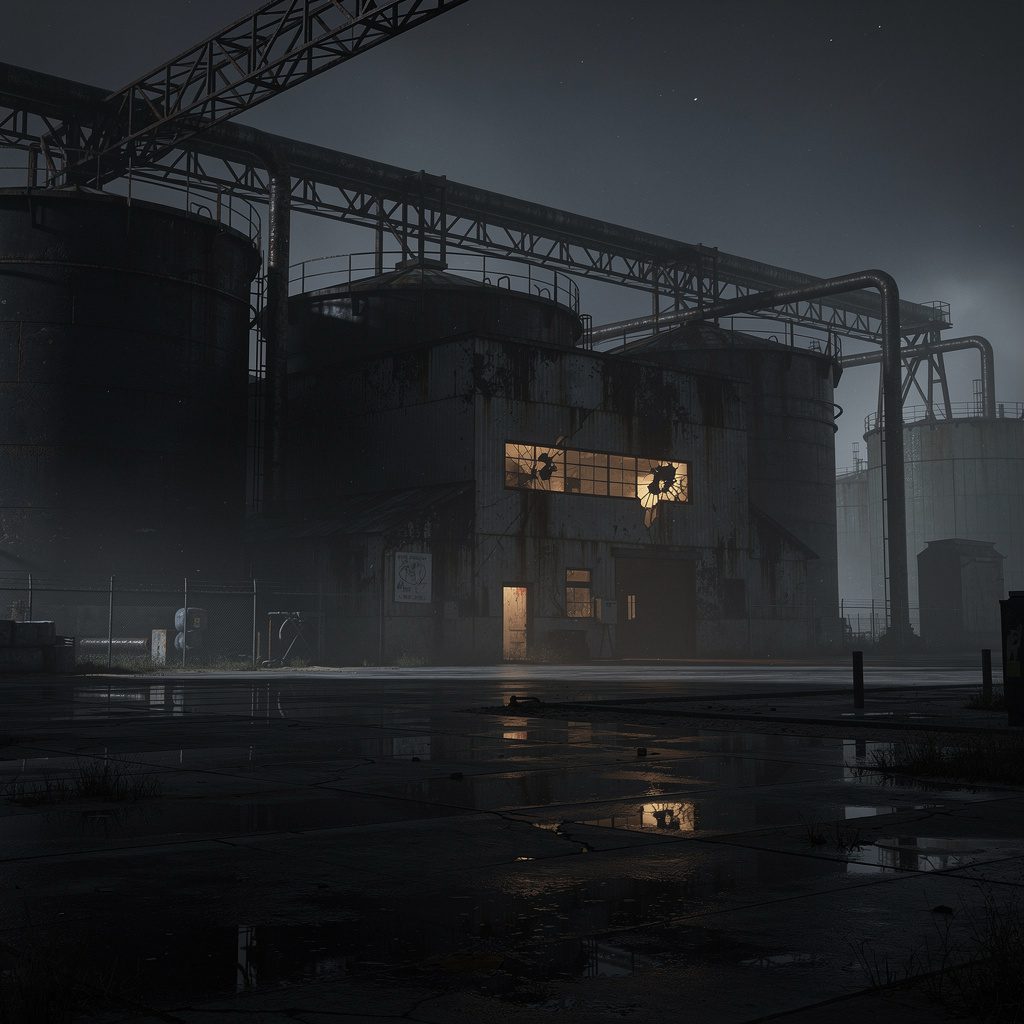
The argument that followed was short and ugly. Yusra said it was a residual charge, a capacitor artifact, meaningless. Hector said that no capacitor holds a charge for eighteen months. Adaeze said we needed to call it in before we did anything else. I said we needed to find sector nine and I said it loudly enough that the others stopped arguing and looked at me, because sector nine was in the eastern quadrant — the section that had partially collapsed, the section that was flagged on every site document as structurally compromised and off-limits. The section no one was supposed to enter under any circumstances.
We went anyway. I want to be honest about that. We went because Hector said there was no scenario in which a sealed system could read six hundred and forty PSI without being connected to a live feed, and if it was connected to a live feed then something upstream was still active and building, and if something was building in a compromised structure then the math got very dark very fast. Adaeze called it in to the regional office. No answer. She left a message. We went.
The eastern quadrant had buckled along its southern wall, a long diagonal crack that had dropped part of the upper gantry onto the processing floor below, and the whole section had the specific smell of a place that had burned badly and been sealed before it could air out. That was the smell I’d caught two levels up, before I knew what it was — scorched rubber and copper wire, the smell of a fire that had been walled in and kept. We moved in single file along the one clear corridor that remained passable, Hector at the front with the biggest work light, Adaeze just behind him, then Yusra, then me. The walls here were wrong — blistered and warped in a way that told you tremendous heat had passed through this space and the space had survived it only barely.
Sector nine was a sub-chamber at the eastern quadrant’s far end, behind a heavy steel access door that should have been locked and sealed. It was not locked. It was not sealed. It was standing open by perhaps three inches, and from the gap came a thin, steady pressure of warm air — not hot, not alarmingly hot, but warm, the specific warmth of something that had been running for a long time in an enclosed space. Hector put his hand near the gap and pulled it back. His face had gone pale under the work light. He said, very quietly, that the door should be cold. This door should be absolutely cold. A decommissioned site in November in southeast Texas — every surface in this building should be cold.
Yusra pushed past him and read the external pressure coupling gauge mounted beside the door. Her voice, when she read the number aloud, had a flatness to it that I recognized as the voice people use when they are suppressing something very large. The number she read matched the PSM-7 display. It had climbed. It was still climbing. Hector said we needed to leave. He said it without drama, which is how you know someone means it — not raised, not urgent, just certain. He said: the eastern wall is already compromised, if there is a live pressure system in that chamber running uncontrolled in a structurally failed building, we need to be outside the perimeter, we need to be outside it now. Adaeze was already moving back the way we came. Yusra stood another second looking at the gauge, then followed.
We moved fast through the corridor, back through the warped and blistered section, back into the main body of the depot. Nobody ran. Running on grated flooring in a structurally questionable building at night is how you become a statistic. But we moved with a discipline that felt like running — efficient, compressed, every step placed deliberately. I was last again. I kept my light forward, watching the floor and the gantry overhead and the walls, checking for movement, checking for change. We reached the northern service gate at ten-twenty-three. The cold night air off the Gulf came in off the flat land and hit us all at once.

 WhatsApp
 Telegram
 Email






Categories
- AI & Technology
- Contemporary
- Corporate Control
- Creepypasta
- Crime Thriller
- Cyberpunk
- Dark Fantasy
- Enemies to Lovers
- Fairy Tale Retelling
- Fantasy
- First Contact
- Forbidden
- Genetic/Body Horror
- High Fantasy
- Monster Hunter
- Mythic/Folklore
- Paranormal
- Portal/Otherworld
- Post-Apo
- Post-Collapse Society
- Psychological Thriller
- Romances
- SCI-FI
- Second Chance
- Slow Burn
- Space Combat
- Spacepunk
- Surveillance State
- Survival Thriller
- Thrillers
- Time Travel
- Treasure Hunter
- Urban Fantasy
- Witchcraft/Curses
Tags
10min stories atmospheric atmospheric fantasy atmospheric fiction contemporary romance Creepy creepypasta crime thriller dark fantasy debt dystopia emotional fiction enemies to lovers ensemble cast epistolary fantasy female protagonist first person forbidden romance framed narrative high fantasy love story magic Memory mystery Paranormal psychological horror psychological thriller romance sci-fi second chance second chance romance short fiction short story slow burn space station speculative fiction supernatural Survival survival thriller suspense thriller travel romance witchcraft workplace romance
Leave a Reply