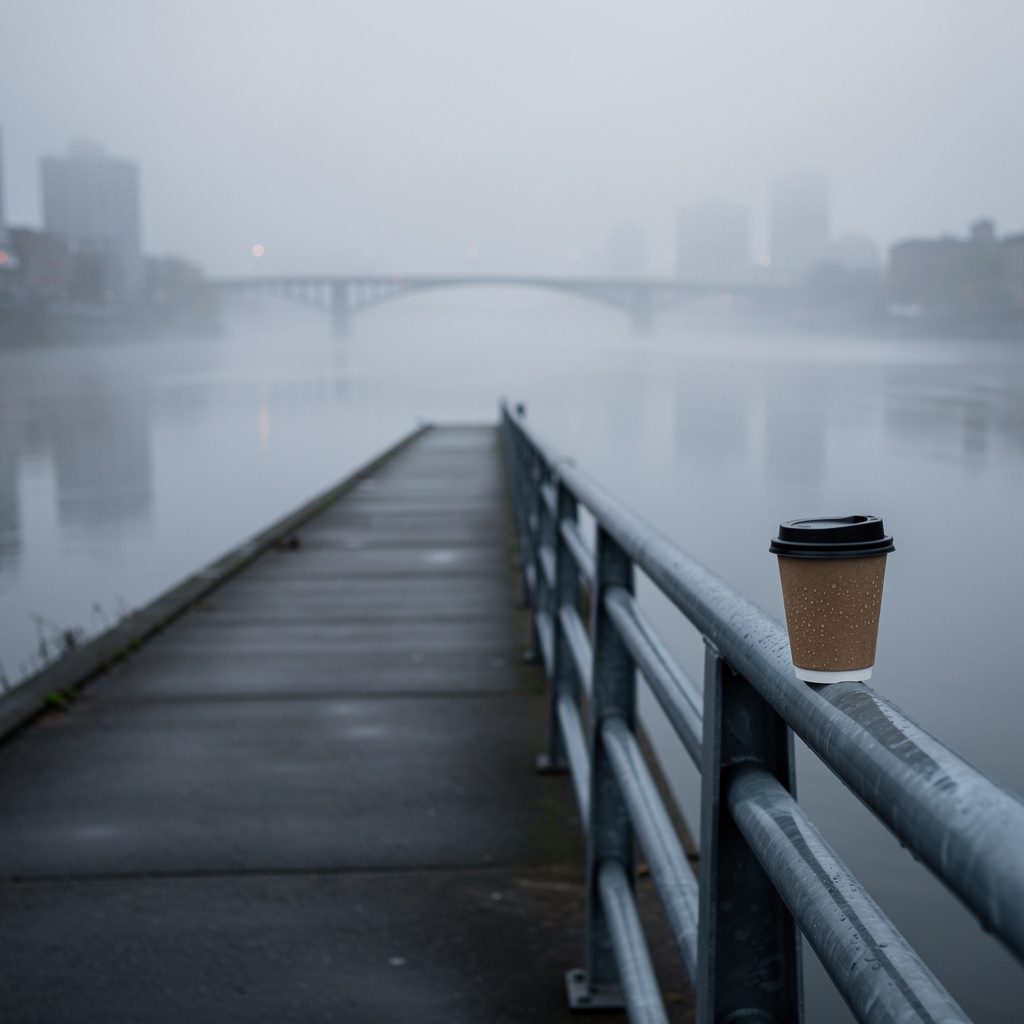
Ananya Sarin had a routine, and she kept to it the way some people keep to religion — not out of devotion, but because it was the only thing that made mornings feel survivable.
She left her apartment in Portland’s Pearl District at seven forty-two. She stopped at the same coffee cart on Lovejoy, ordered a medium oat flat white with one sugar, and took the same route along the waterfront to the design studio where she worked. She had done this for eleven months. She had never thought about it until she met the man at the cart.
It was a Tuesday. The kind of Tuesday that looks exactly like every other Tuesday — overcast, the Willamette flat and gray beneath a sky that couldn’t decide whether to rain. Ananya was waiting for her coffee, scrolling absently through her phone, when the man stepped up beside her.
He was ordinary in almost every way. Middle-aged, brown jacket, a canvas tote bag over one shoulder. The kind of person you forget before they’ve finished speaking. But he smiled at her — not a stranger’s cautious smile, more the smile of someone who has just spotted a familiar face across a room — and said, “Still doing the one sugar?”
Ananya looked up.
“Sorry?”
“You used to do two,” he said pleasantly, as though continuing a conversation they had already started. “Switched about four months ago, right?”
She stared at him. She tried to place him — ex-colleague, neighbor, someone from her gym. Nothing connected. His face gave her nothing back. He had pale eyes and a forgettable jaw and the calm posture of a man who has nowhere urgent to be.
“I don’t think we’ve met,” she said carefully.
He tilted his head, unbothered. “No, I suppose not formally.” He accepted a coffee from the cart vendor, thanked him by name — Marco, a name Ananya herself had never learned in eleven months — and walked away along the waterfront path without another word.
Ananya stood with her cup warm in both hands and felt something she couldn’t immediately name. Not quite fear. More like the sensation of stepping onto ice and hearing it shift beneath you — the knowledge of instability before the fall.
She told herself it was nothing. A regulars-at-the-same-spot coincidence. People notice things. She noticed things. She had probably been observed without knowing it, the way everyone is observed without knowing it in a city. She walked to work and sat at her desk and designed a brand identity for a small architecture firm, and by noon she had more or less convinced herself that the morning had been unremarkable.
The next Tuesday he was there again.
She saw him before he saw her — or before he let her see him see her, which she would later understand was not the same thing. He was standing a few feet from the cart, already holding his coffee, watching the river. When she stepped up to order he turned naturally, as though the movement were coincidental.
“You’re earlier today,” he said.
She hadn’t spoken. She hadn’t ordered yet. She was standing in line.
“Seven thirty-eight,” he added, glancing at his watch. “Usually closer to seven forty-five.”
The cold came up through her feet. She looked at him directly. “Who are you?”
He smiled again — that same warm, social smile, the one that belonged to a person who knows you. “Just someone who walks the same route.”
“You know my coffee order. You know what time I get here.”
“I pay attention,” he said, without apology, without discomfort. “You’d be surprised what you notice when you’re not looking at your phone.”
He walked away again. Same direction. Same unhurried pace.
Ananya did not go to work. She walked back to her apartment, sat on the edge of her bed, and breathed in the careful way her therapist had taught her — four counts in, hold, six counts out. She thought about calling someone. Her sister in Vancouver. Her friend Priya. But she turned the encounter over in her mind and it kept coming out looking small. A man at a coffee cart who noticed details. That was it. That was the whole thing. There was no threat she could point to, no word he had said that she could take to anyone and make sound alarming.
She went back the following Tuesday because she refused to let herself not go back.

 WhatsApp
 Telegram
 Email







Categories
- AI & Technology
- Contemporary
- Corporate Control
- Creepypasta
- Crime Thriller
- Cyberpunk
- Dark Fantasy
- Enemies to Lovers
- Fairy Tale Retelling
- Fantasy
- First Contact
- Forbidden
- Genetic/Body Horror
- High Fantasy
- Monster Hunter
- Mythic/Folklore
- Paranormal
- Portal/Otherworld
- Post-Apo
- Post-Collapse Society
- Psychological Thriller
- Romances
- SCI-FI
- Second Chance
- Slow Burn
- Space Combat
- Spacepunk
- Surveillance State
- Survival Thriller
- Thrillers
- Time Travel
- Treasure Hunter
- Urban Fantasy
- Witchcraft/Curses
Tags
10min stories atmospheric atmospheric fantasy atmospheric fiction contemporary romance Creepy creepypasta crime thriller dark fantasy debt dystopia emotional fiction enemies to lovers ensemble cast epistolary fantasy female protagonist first person forbidden romance framed narrative high fantasy love story magic Memory mystery Paranormal psychological horror psychological thriller romance sci-fi second chance second chance romance short fiction short story slow burn space station speculative fiction supernatural Survival survival thriller suspense thriller travel romance witchcraft workplace romance
Leave a Reply