He took a slow sip of coffee.
The pressure data on his secondary monitor was real, for what it was worth. He had not actually disabled anything on Row C. The jamming equipment had been calibrated carefully so as not to interfere with the facility’s actual safety systems — only with communications. He was not trying to cause a disaster. He was trying to understand what stood between a person and one.
The answer, in his experience, was very little.
He watched Cunha pace the length of the room, run a hand along the back of his neck, and return to the terminal. Round three was loading.
—
By round four, Tiago had stopped thinking about the squares.
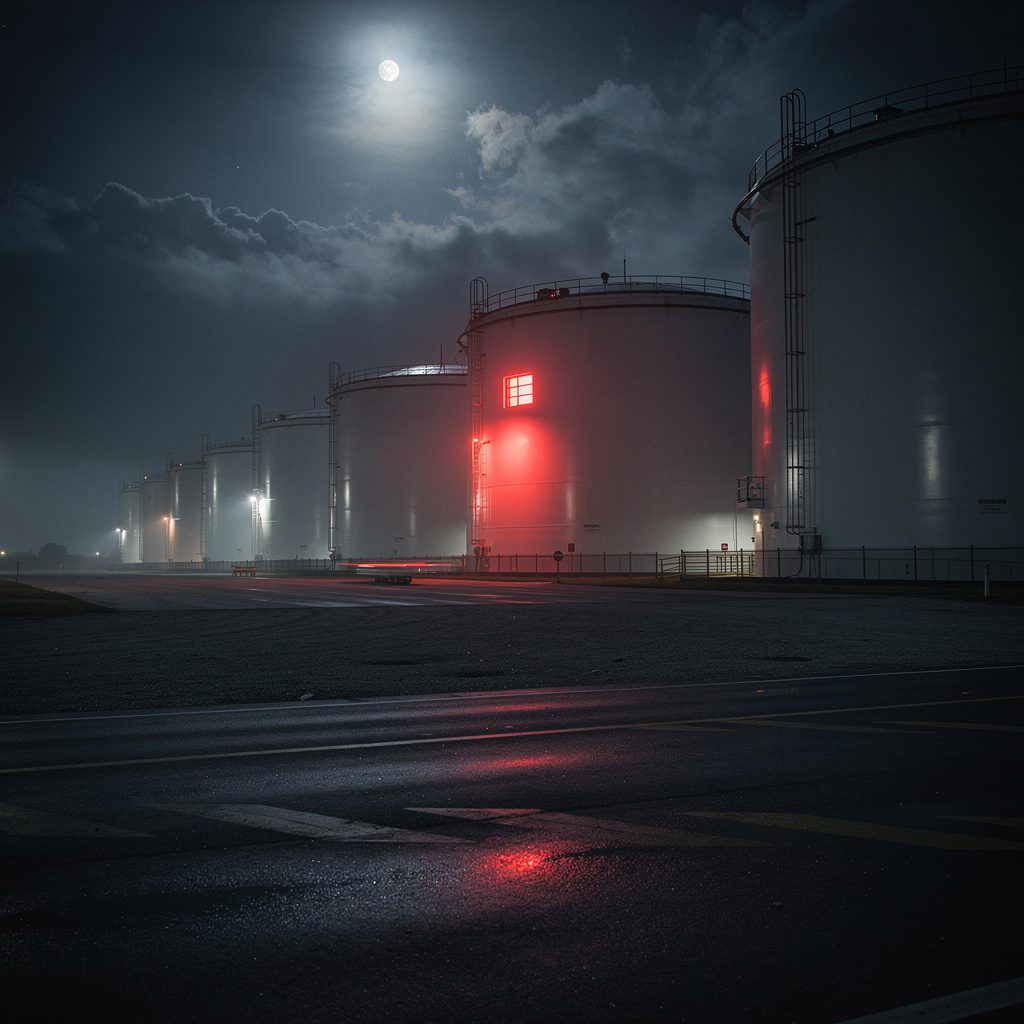
He was thinking about the people who worked the adjacent facility — a chemical blending plant two hundred meters east, separated from the fuel depot by a chain-link fence and a gravel service road. Day shift started at five-thirty. It was currently three forty-two. If something happened to Row C before five-thirty, those workers weren’t here yet. If something happened after — they were.
He had a wife. He had a daughter who was eight and who had recently become very serious about the classification of clouds. He thought about these things in a distant, compartmentalized way, the way you think about what matters when you’ve accepted that the situation is real.
He chose square five.
The screen flickered. CORRECT. ROW C PRESSURE NOMINAL. ROUND 5 OF 6.
He realized his hands were steady.
That surprised him. He had expected trembling — the body’s predictable answer to sustained adrenaline — but his hands were flat and quiet at his sides. His breathing was measured. He was not calm, exactly. It was something else. Something more deliberate than calm.
—
Anders leaned forward.
This was the anomaly. Most subjects showed escalating physiological distress markers by round four — he could read enough from posture and movement. Hyperventilation, erratic pacing, occasionally attempts to smash the terminal itself. Cunha was doing none of those things. He was standing at the center of the room with his arms loose, staring at the screen without urgency, as if he had set something down and was deciding whether to pick it up again.
Anders typed a note: Subject appears to be decoupling from the game’s authority structure. Possible adaptive shutdown, or —
He stopped typing.
Cunha was not looking at the screen anymore. He was looking at the camera.
Directly at it. Not searching — not the sweeping scan of someone who’d heard a sound — but a fixed, deliberate gaze, as if he had known exactly where the lens was and had simply chosen this moment to acknowledge it.
—
Tiago had found the camera eleven minutes ago.
It was a small thing — a wide-angle unit mounted inside what appeared to be a decommissioned smoke detector housing, up in the corner above the fire suppression cabinet. He had seen dozens of its type. He had also, six years into night shifts at an industrial facility, become fluent in the difference between equipment that belonged and equipment that had been placed.
He had said nothing. Done nothing. Continued playing the game through rounds three and four because the threat to Row C — real or fabricated — was not a risk he could dismiss without verification he didn’t have. But he had been building a picture in his mind with every round.
Someone was watching. Someone had isolated him. Someone had constructed a scenario designed to strip away every tool he had — radio, phone, colleagues, time — until the terminal was all he had left.
He understood, in a way that arrived not as panic but as cold recognition, that the game was not really about the squares.
Round five had loaded. The screen read: THIS IS THE FINAL PRESSURE SEQUENCE. ONE SQUARE DISARMS THE SYSTEM ENTIRELY. CHOOSE WRONG AND ALL ROWS ENTER CRITICAL TIMER.
Tiago looked at the board for a long time.
Then he did something none of the instructions had anticipated: he walked to the fire suppression cabinet, opened it, and pulled the manual discharge lever.
The alarm was deafening. Emergency lighting dropped the room into red. And more importantly — because suppression systems ran on a hardwired circuit independent of the jamming frequency — the facility’s emergency communications backbone came alive. He could hear the automated distress signal firing on the panel across the room.
He had not beaten the game. He had made the game irrelevant.

 WhatsApp
 Telegram
 Email







Categories
- AI & Technology
- Contemporary
- Corporate Control
- Creepypasta
- Crime Thriller
- Cyberpunk
- Dark Fantasy
- Enemies to Lovers
- Fairy Tale Retelling
- Fantasy
- First Contact
- Forbidden
- Genetic/Body Horror
- High Fantasy
- Monster Hunter
- Mythic/Folklore
- Paranormal
- Portal/Otherworld
- Post-Apo
- Post-Collapse Society
- Psychological Thriller
- Romances
- SCI-FI
- Second Chance
- Slow Burn
- Space Combat
- Spacepunk
- Surveillance State
- Survival Thriller
- Thrillers
- Time Travel
- Treasure Hunter
- Urban Fantasy
- Witchcraft/Curses
Tags
10min stories atmospheric atmospheric fantasy atmospheric fiction contemporary romance Creepy creepypasta crime thriller dark fantasy debt dystopia emotional fiction enemies to lovers ensemble cast epistolary fantasy female protagonist first person forbidden romance framed narrative high fantasy love story magic Memory mystery Paranormal psychological horror psychological thriller romance sci-fi second chance second chance romance short fiction short story slow burn space station speculative fiction supernatural Survival survival thriller suspense thriller travel romance witchcraft workplace romance
Leave a Reply