She had not filed the report immediately. She told herself it was because she needed more documentation. She told herself a lot of things that week.
The name Fernando had given her was Clive Hartmann. Clive was her supervisor.
—
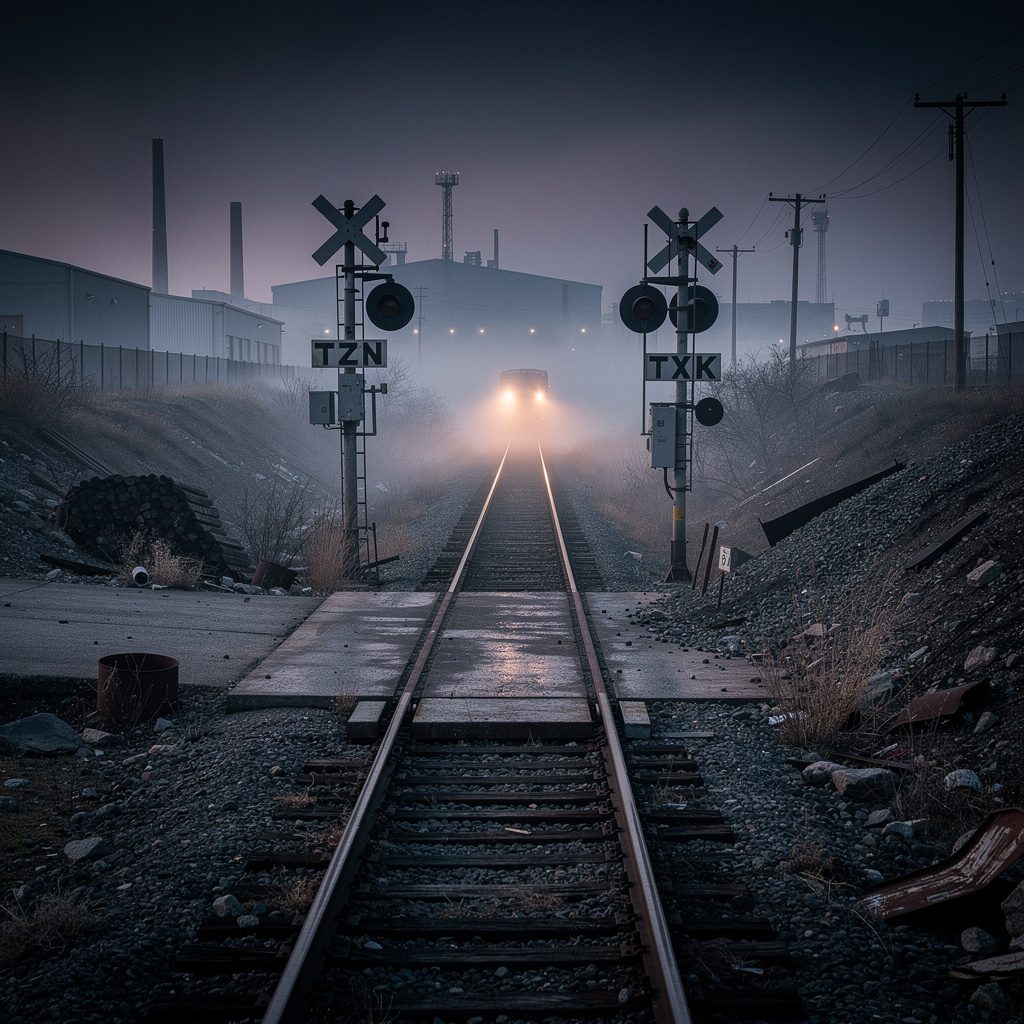
The crossing road was a narrow two-lane that dipped between the embankments and ran straight as a ruler for a quarter mile before the tracks. Verity came down the grade faster than she should have and saw the Dodge immediately — dark blue, sitting square across both rails, hazard lights blinking with the dutiful, futile rhythm of a thing trying its best.
She stopped her car diagonally across the road, blocking any other traffic on instinct, and was out and running before she had fully processed the decision. The air smelled like rust and river damp. The evening light was the color of old brass.
She could hear the train. Not as sound yet — as sensation. The rails carried it like a wire carries current.
“Hey!” She hit the driver’s window with the flat of her hand. “Hey, open the door!”
Fernando looked at her through the glass. His face did the thing that faces do when relief and disbelief arrive at the same time — a kind of collapse, a loosening. He said something she couldn’t hear. He pulled the door handle.
It didn’t open.
Verity grabbed it from outside and pulled. The door moved a centimeter and stopped, as though something on the inside of the frame was catching. She felt the resistance — not a mechanical failure, something deliberate, something added. She looked at the door frame and saw it: a small wedge of hardened material, dark, pressed into the channel where the door seal met the body. There was one on the rear door too. She could see it from here.
Somebody had done this to the car before Fernando got in it.
She had four minutes, maybe less.
She looked around. Her eyes landed on the embankment to her right — loose stones and scrub grass — and on the tire iron in her own trunk, which she registered and dismissed because there was no time to get back to her car. Fernando was watching her through the glass with an expression that had gone past fear into something quieter and more terrible: acceptance. She recognized that expression. She had seen it before.
She wedged her fingers into the door frame gap and pulled with everything she had. The wedge shifted. Not enough.
“Kick the window!” she shouted.
He shook his head. “Safety glass, it won’t —”
“Not to break it. Kick it to help me. On three.”
He understood. He turned sideways in the seat, both feet against the glass. She got her fingers in as deep as she could manage, the metal edge biting into her palms. She counted. He kicked. She pulled.
The wedge popped out and skittered across the gravel and the door swung open so fast that Verity stumbled backward two steps and sat down hard on the ground.
Fernando Cordoba was out of the car and pulling her to her feet before she had finished falling.
They ran. The train’s horn hit them like a wall of sound — it had been visible for ten seconds, maybe, a fixed white light growing at a rate that the human brain is not wired to correctly interpret — and they cleared the embankment edge and threw themselves down the far side of it as the freight came through.
The noise was total. The ground shook. The Dodge became, for a moment, part of the train.
Then it was over and the freight was continuing toward Pittsburgh and the crossing was a mess of displaced gravel and the evening was quiet again in the particular way that follows enormous sound.
—
They sat on the embankment for a while without talking. Fernando had a cut on his forearm from the scramble over the stones. Verity’s palms were bleeding slightly from the door frame. Neither of them addressed these things.
Finally Fernando said, “How did you know?”
Verity looked at the crossing. “Radio,” she said, because it was the only answer she had.
He looked at her the way people look at an answer that doesn’t satisfy but that they accept anyway because the alternative is spending time on it that neither of them had.

 WhatsApp
 Telegram
 Email






Categories
- AI & Technology
- Contemporary
- Corporate Control
- Creepypasta
- Crime Thriller
- Cyberpunk
- Dark Fantasy
- Enemies to Lovers
- Fairy Tale Retelling
- Fantasy
- First Contact
- Forbidden
- Genetic/Body Horror
- High Fantasy
- Monster Hunter
- Mythic/Folklore
- Paranormal
- Portal/Otherworld
- Post-Apo
- Post-Collapse Society
- Psychological Thriller
- Romances
- SCI-FI
- Second Chance
- Slow Burn
- Space Combat
- Spacepunk
- Surveillance State
- Survival Thriller
- Thrillers
- Time Travel
- Treasure Hunter
- Urban Fantasy
- Witchcraft/Curses
Tags
10min stories atmospheric atmospheric fantasy atmospheric fiction contemporary romance Creepy creepypasta crime thriller dark fantasy debt dystopia emotional fiction enemies to lovers ensemble cast epistolary fantasy first person forbidden romance found text framed narrative high fantasy love story magic Memory mystery Paranormal psychological horror psychological thriller romance sci-fi second chance second chance romance short fiction short story slow burn space station speculative fiction supernatural Survival survival thriller suspense thriller travel romance witchcraft workplace romance
Leave a Reply