The morning Signe Dybdahl wins the hiking lottery feels like a gift from a world that rarely hands out gifts.
She stands at the trailhead of the Cascades backcountry permit zone north of Seattle, backpack settled against her hips, the air so clean it almost stings. October light cuts sideways through the Douglas firs, turning everything amber and gold. The kind of morning that makes a person feel, briefly and completely, that they have made every right choice. She checks her permit one more time — not because she doubts it, but because holding the paper makes it real. Three days. Twenty-two miles. Solo.
She starts walking.
The first hour is everything she needed. Rhythm of boot on packed earth, the soft percussion of a creek somewhere below the ridge, the occasional far-off drum of a woodpecker. Her breathing settles. Her shoulders drop. The city — the job, the apartment with its thin walls and thinner relationships — compresses itself into something small and manageable in her chest, something she can carry without it crushing her.
She does not notice the device until she stops to eat lunch.
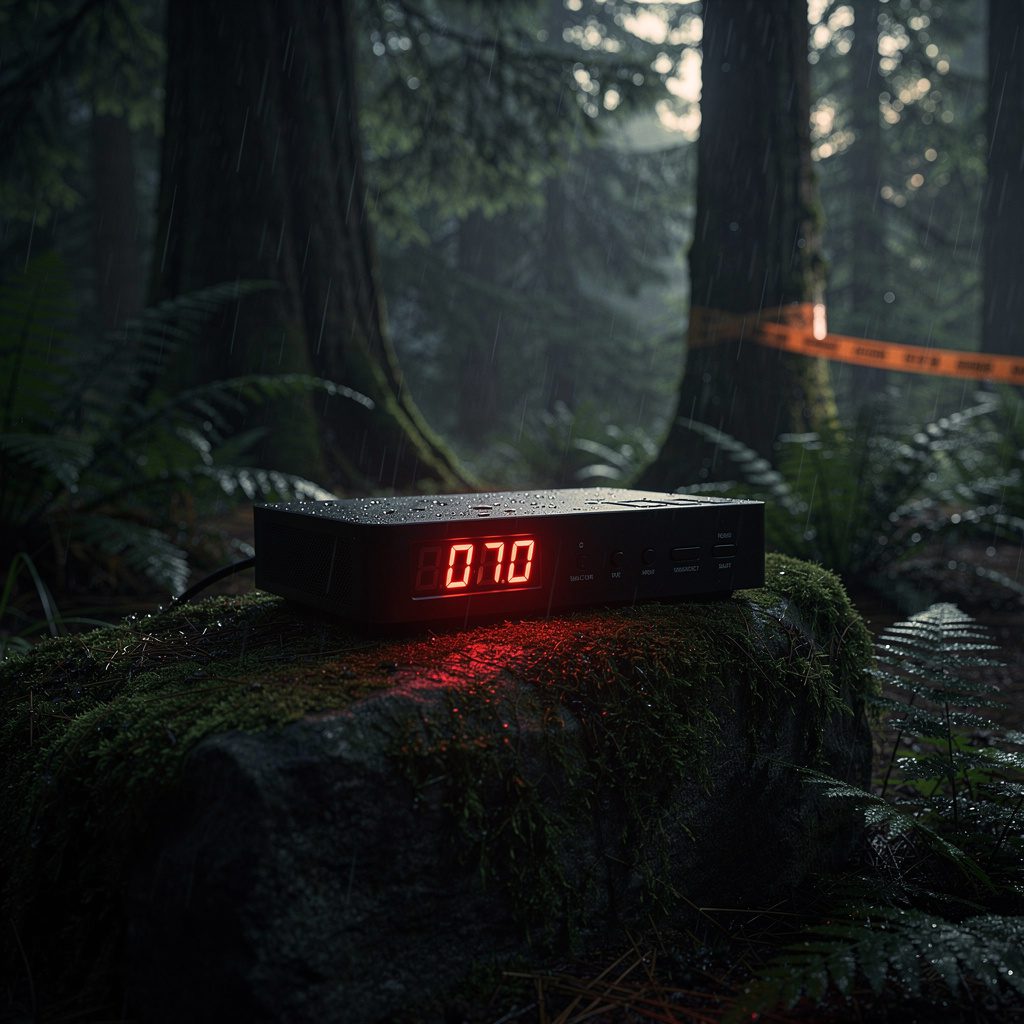
It is sitting on a flat rock beside the trail, as if placed deliberately. Small, matte black, roughly the size and shape of a thick lighter. No brand markings. No visible seams. A single red number glows on its face: 91. Even as she watches, it blinks to 90.
She picks it up.
It is warm. Not sun-warm — the rock is shaded — but body-warm, as though someone carried it a long time. She turns it over. Nothing on the back. No buttons. The number drops to 89.
She sets it back on the rock, takes a long drink from her water bottle, and keeps walking. It is probably a timer left by another hiker. A prank, maybe. A forgotten piece of gear she doesn’t recognize. The wilderness is full of things that don’t belong to you.
But she thinks about it. All through the afternoon she thinks about it, and eventually — because she is the kind of person who cannot leave a question unanswered — she stops and waits for another hiker to appear. She hasn’t seen one since the trailhead. The permit system keeps numbers low. But after twenty minutes, footsteps.
The man who rounds the bend is older, maybe sixty, lean and weathered in the way of someone who spends real time outdoors rather than performing it. He carries a frameless pack and walks without poles, and his eyes, when they land on Signe, are careful.
“You find one?” he asks before she can speak.
She stares at him. “Find one what?”
He glances at her hands, then at her pack. “The counter.” He says the word the way you say the name of an illness you’ve been living with long enough to stop fearing it.
“On a rock. Back about two miles.”
He nods slowly, as if this confirms something. He does not stop walking — just adjusts his angle so he passes her on the wider side of the trail, keeping distance without being rude about it. “Leave it,” he says. “Don’t touch it again. And don’t go back.”
“Back where?”
But he is already past her, moving fast, and when she turns to call after him, she notices something that makes her breath catch. His left hand, swinging at his side, is clutching something small and matte black.
His number, she understands somehow, is lower than hers.
She walks faster after that.
Not panic — not yet — but a new quality enters the afternoon. The light seems to flatten. The creek sounds different, less musical, more insistent. She starts doing the math she should have done at the rock: if the counter dropped one digit per minute, ninety clicks is ninety minutes. She found it around noon. She has been on the trail for over three hours since.
Which means whatever it was counting down to — it already reached zero.
She stops in the middle of the trail.
Thinks. Breathes. Tries to be reasonable about this because being reasonable is the thing she does when fear starts making noise. A timer reaching zero doesn’t mean anything. Timers reach zero all the time. Ovens. Parking meters. Bombs — no. Not that. Be reasonable.
She keeps walking.

 WhatsApp
 Telegram
 Email







Categories
- AI & Technology
- Contemporary
- Corporate Control
- Creepypasta
- Crime Thriller
- Cyberpunk
- Dark Fantasy
- Enemies to Lovers
- Fairy Tale Retelling
- Fantasy
- First Contact
- Forbidden
- Genetic/Body Horror
- High Fantasy
- Monster Hunter
- Mythic/Folklore
- Paranormal
- Portal/Otherworld
- Post-Apo
- Post-Collapse Society
- Psychological Thriller
- Romances
- SCI-FI
- Second Chance
- Slow Burn
- Space Combat
- Spacepunk
- Surveillance State
- Survival Thriller
- Thrillers
- Time Travel
- Treasure Hunter
- Urban Fantasy
- Witchcraft/Curses
Tags
10min stories atmospheric atmospheric fantasy atmospheric fiction contemporary romance Creepy creepypasta crime thriller dark fantasy debt dystopia emotional fiction enemies to lovers ensemble cast epistolary fantasy female protagonist first person forbidden romance framed narrative high fantasy love story magic Memory mystery Paranormal psychological horror psychological thriller romance sci-fi second chance second chance romance short fiction short story slow burn space station speculative fiction supernatural Survival survival thriller suspense thriller travel romance witchcraft workplace romance
Leave a Reply