The man at the coffee counter smiled at Mara before she said a single word. Not the polite smile of a barista. Something slower. Something that said he had been waiting.
She ordered her usual — oat milk flat white, one sugar — and he was already writing her name on the cup.
She told herself it was a coincidence. Maybe she had been here before and forgotten. Maybe she looked like a Mara. People said that sometimes, though she had never understood what it meant.
She took a seat by the window, laptop open, earbuds in. The city moved outside in its usual blur of grey coats and headlights. She had a deadline in two hours and a presentation that was nowhere near ready. Normal Tuesday problems.
The man sat down across from her.
She pulled out one earbud. ‘This table is taken.’
‘I know,’ he said. ‘I just need five minutes.’
He was ordinary in every visible way. Mid-forties, clean shave, a dark jacket that could belong to anyone. But his eyes did not move the way ordinary eyes did. They were too still. Too settled on her face, like he had already memorised it and was simply confirming the details.
‘I don’t know you,’ Mara said.
‘You moved here from Edinburgh fourteen months ago,’ he said, not unkindly. ‘You work in urban planning. You jog the canal route on Tuesdays and Thursdays, always the same direction, always with the green headphones. You eat lunch alone. You haven’t called your sister in six weeks.’
The noise of the café seemed to drop away.
Mara’s hand moved toward her phone without her deciding to move it. He noticed. He did not react.
‘I’m not here to frighten you,’ he said.
‘Then what are you here for?’
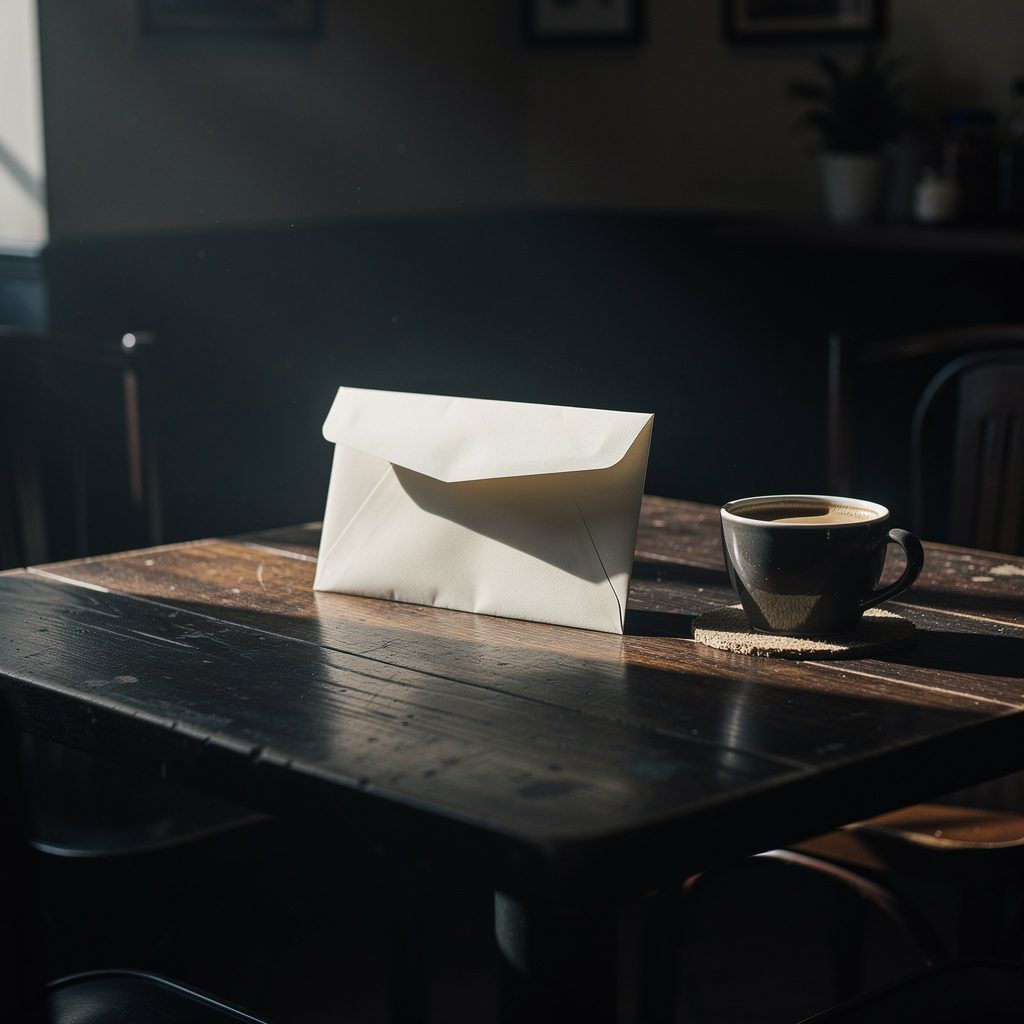
He placed a small envelope on the table between them. Cream-coloured, sealed, her name written on the front in handwriting she did not recognise.
‘Someone asked me to deliver that. In person. They were very specific about that part.’
She did not touch it. ‘Who?’
‘Someone who knows you better than you’d like.’
Her mind ran through possibilities the way it always did — methodically, professionally. She was not famous. She was not wealthy. She had no enemies she could name, no history that would make her a target. She was, by every measure, unremarkable. That had always felt like safety.
Now it felt like a lie she had told herself.
‘If this is some kind of marketing stunt—’
‘It isn’t,’ he said. He stood, buttoned his jacket. ‘Read it when I’ve gone. Don’t read it here.’
He walked out without looking back. Through the window she watched him cross the street and disappear into the crowd with the ease of someone who had practised disappearing.
She sat very still for a long moment.
Then she picked up the envelope.
She did not open it in the café. She walked six blocks to the small park near her office, sat on a bench away from the path, and broke the seal.
Inside was a single sheet of paper. At the top, a date. Three weeks from today. Below it, an address she did not recognise. And below that, one sentence.
You need to be there. You already know why.
She read it four times. Then she read it again.
She did not know why. She was certain of that. And yet something in her chest had shifted when she read it — not recognition exactly, but something adjacent to it. The feeling of a word on the tip of your tongue that will not come.
She spent the afternoon trying to work and failing. She searched the address. A business park on the edge of the city, half the units empty, nothing that connected to her life in any direction she could trace.
She searched for the man. She had no name, no image, nothing. She described him to herself and understood for the first time how useless ordinary is as a description.
That evening she called her sister.
It rang seven times before Joanna picked up. ‘Mara. It’s been a while.’
‘I know. I’m sorry. Listen, has anyone contacted you about me recently? Anyone asking questions?’
A pause. ‘What kind of questions?’
‘Anything. Where I live, what I do. Anything personal.’
Another pause, longer this time. ‘No. Mara, what’s going on?’
She almost told her. Instead she said, ‘Nothing. I’m fine. I just wanted to hear your voice.’

 WhatsApp
 Telegram
 Email







Categories
- AI & Technology
- Contemporary
- Corporate Control
- Creepypasta
- Crime Thriller
- Cyberpunk
- Dark Fantasy
- Enemies to Lovers
- Fairy Tale Retelling
- Fantasy
- First Contact
- Forbidden
- Genetic/Body Horror
- High Fantasy
- Monster Hunter
- Mythic/Folklore
- Paranormal
- Portal/Otherworld
- Post-Apo
- Post-Collapse Society
- Psychological Thriller
- Romances
- SCI-FI
- Second Chance
- Slow Burn
- Space Combat
- Spacepunk
- Surveillance State
- Survival Thriller
- Thrillers
- Time Travel
- Treasure Hunter
- Urban Fantasy
- Witchcraft/Curses
Tags
10min stories atmospheric atmospheric fantasy atmospheric fiction contemporary romance Creepy creepypasta crime thriller dark fantasy debt dystopia emotional fiction enemies to lovers ensemble cast epistolary fantasy female protagonist first person forbidden romance framed narrative high fantasy love story magic Memory mystery Paranormal psychological horror psychological thriller romance sci-fi second chance second chance romance short fiction short story slow burn space station speculative fiction supernatural Survival survival thriller suspense thriller travel romance witchcraft workplace romance
Leave a Reply