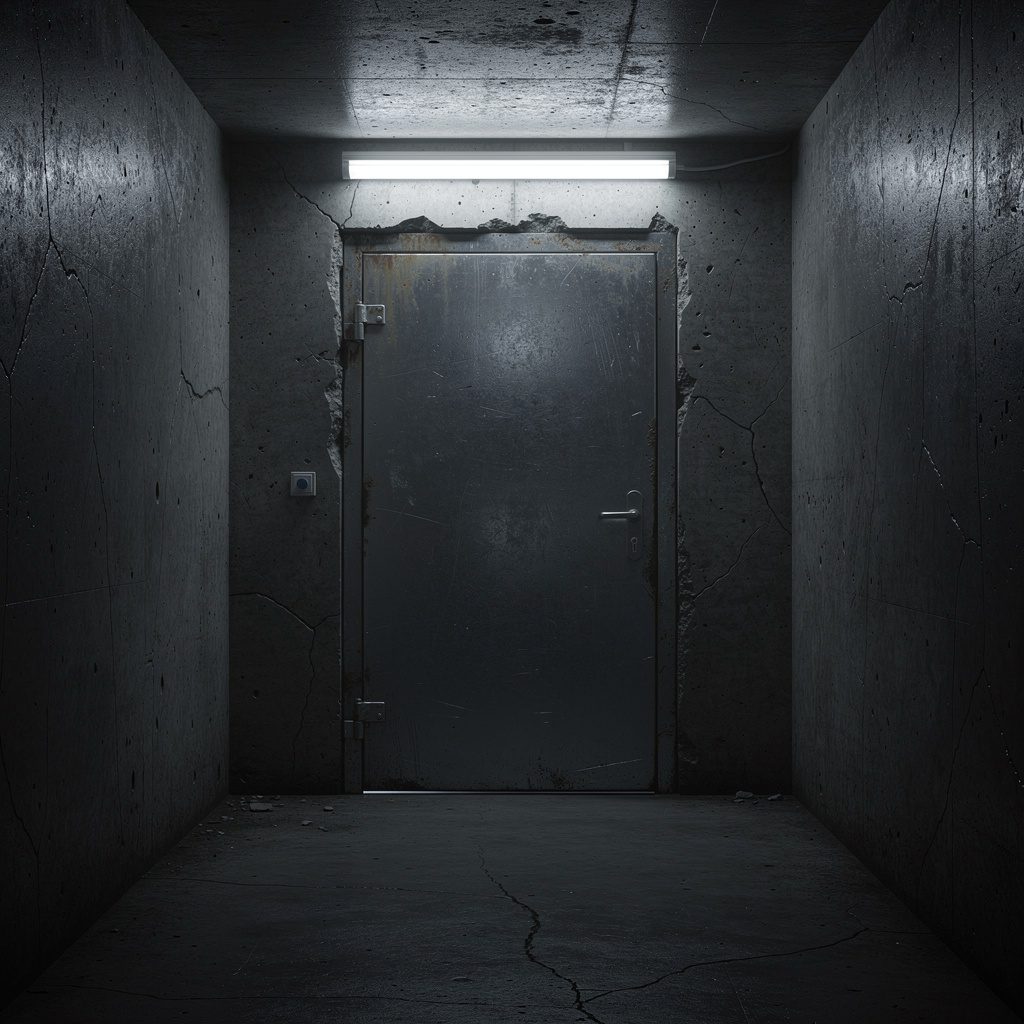
The solution, when it comes, is Ifeoma’s. It is unglamorous and exhausting and takes another ninety minutes. The filing cabinets are on industrial casters. The back wall of the room, behind the last row of shelving, has a seam in it — not a door, but a join in the construction, a place where two poured sections meet that has, over decades, developed a hairline gap. Behind enough displaced shelving, with enough combined weight applied to the right point, the gap becomes something we can work with. A panel. A secondary access point, probably a utility corridor, that Delacroix or whoever built this room either forgot or assumed was impassable.
It is barely passable. We make it work.
We come out into a maintenance corridor, then a stairwell, then a fire exit on the south side that opens onto an alley. Seve meets us there eleven minutes later.
And then we are in a car. Moving. Baltimore sliding past the windows in that flat gray morning light, and no one speaks, and I am holding the key — the key from Ifeoma’s kit that she handed me at some point during the night and that I forgot I was holding.
—
So that is how we got there. That is the shape of the night.
But that is not, I understand now, what I need to tell you — what I need to tell myself.
The personnel files. The photographs. The notations in that shorthand ledger.
I recognized one of the names.
A man I worked a job with three years ago in Philadelphia. A man named Okafor who was careful and professional and who I assumed, when he stopped returning messages, had simply moved on to other work. The way people do. The way I have always told myself people do, in this particular line of work, when they go quiet.
His file had a date. Fourteen months ago.
And below the date, a location. A building in the old warehouse district of Baltimore.
I closed the cabinet. I went back to the others. I said we needed to focus.
I made a decision in that room — a fast, clean, tactical decision — to protect our ability to function, to get out, to survive the immediate problem. I told myself it was the right call. I have made versions of this decision before, in other rooms, in other circumstances. I am good at it. I have always been good at it.
Sitting in the car now, Renato beside me with his eyes closed, Ifeoma looking out the window, Seve driving in silence — I feel the full weight of what that means. Not that I withheld information in a crisis. That is almost defensible. But that I did it without hesitation. That the hesitation never came. That when I found those files, something in me simply catalogued them as a variable and moved on.
That I have done this before, in smaller ways, in moments I have not let myself examine.
I am still holding the key.
I set it on the seat between us. I watch the harbor disappear behind us, gray water behind gray buildings, and I think about Okafor — about what it means that I have been doing this work for six years and this is the first time I have felt the full weight of a name.
Renato opens his eyes. He looks at the key, then at me.
He doesn’t ask. Maybe he already knows there is something I haven’t said. Maybe, with Renato, there always is — with all of us, maybe that is what this work does. It teaches you to close the cabinet and keep moving.
I did not keep anyone safe by closing that cabinet. I kept myself functional. And I am not sure, sitting here in the thin morning light with the city moving past and my hands finally still, that those have ever been the same thing.

 WhatsApp
 Telegram
 Email







Categories
- AI & Technology
- Contemporary
- Corporate Control
- Creepypasta
- Crime Thriller
- Cyberpunk
- Dark Fantasy
- Enemies to Lovers
- Fairy Tale Retelling
- Fantasy
- First Contact
- Forbidden
- Genetic/Body Horror
- High Fantasy
- Monster Hunter
- Mythic/Folklore
- Paranormal
- Portal/Otherworld
- Post-Apo
- Post-Collapse Society
- Psychological Thriller
- Romances
- SCI-FI
- Second Chance
- Slow Burn
- Space Combat
- Spacepunk
- Surveillance State
- Survival Thriller
- Thrillers
- Time Travel
- Treasure Hunter
- Urban Fantasy
- Witchcraft/Curses
Tags
10min stories atmospheric atmospheric fantasy atmospheric fiction contemporary romance Creepy creepypasta crime thriller dark fantasy debt dystopia emotional fiction enemies to lovers ensemble cast epistolary fantasy female protagonist first person forbidden romance framed narrative high fantasy love story magic Memory mystery Paranormal psychological horror psychological thriller romance sci-fi second chance second chance romance short fiction short story slow burn space station speculative fiction supernatural Survival survival thriller suspense thriller travel romance witchcraft workplace romance
Leave a Reply