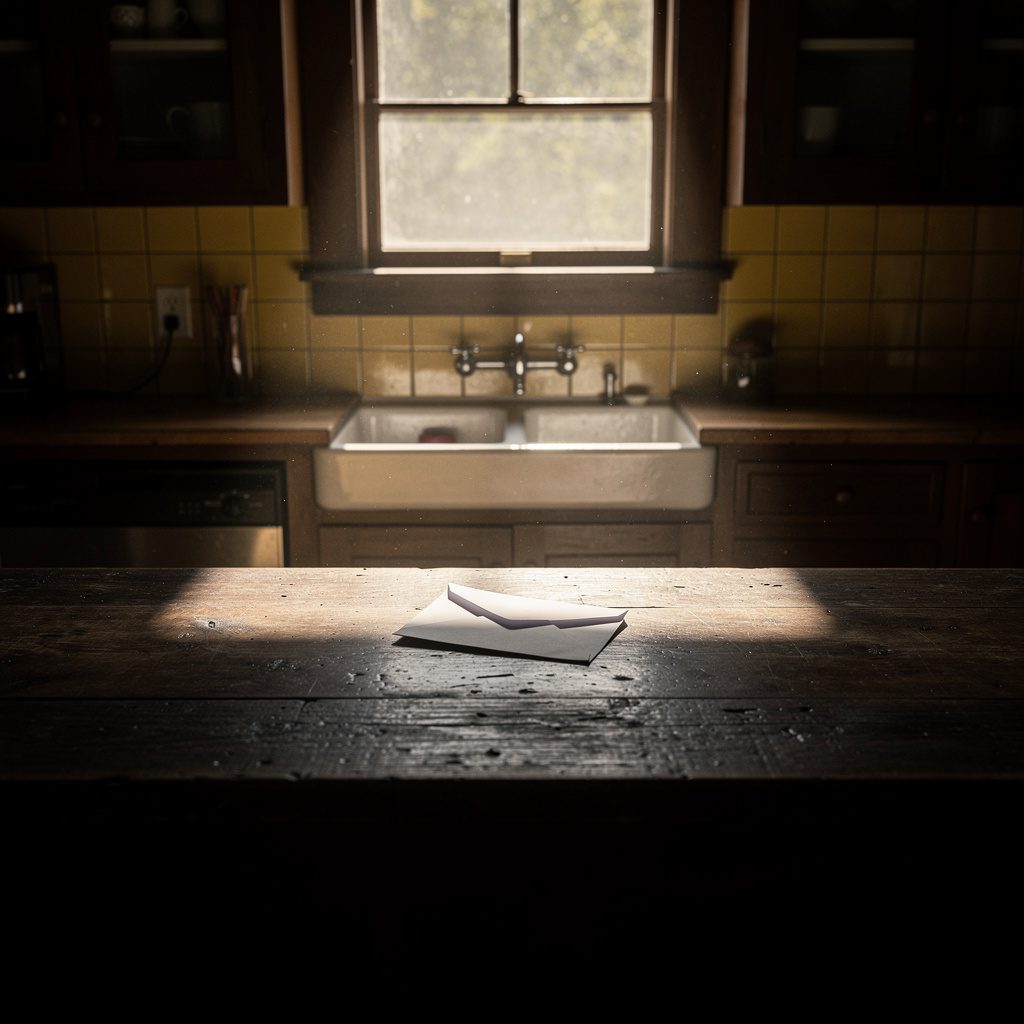
She started going through the mail that night. Most of it was ordinary—a credit card statement, a dentist reminder, a library notice for a book about architectural history. But near the bottom of the stack was an envelope with no return address, already opened and re-sealed badly with a strip of tape. Inside was a handwritten note on plain white paper.
*Stop looking into the Dennard properties. This is the only time I’ll write instead of visit.*
Sofia read it three times. She set it on the kitchen counter and made tea she didn’t drink and then read it a fourth time.
In the morning she called the rental company.
—
Joao Vasilikos did not answer his phone, but his office manager did, and within twenty minutes Joao himself called back, his voice carrying the careful neutrality of someone choosing words the way you choose footholds on unstable ground.
“Ms. Cunha, I understand you have some concerns—”
“Who is Dennard?” she said.
A pause. Not long. But long enough.
“I’m not familiar with that name in relation to your property.”
“There’s a note in the previous tenant’s mail. It references Dennard properties, plural. The house has changed ownership four times in eleven years. Two of those transactions went through companies that no longer exist. I do this for a living, Mr. Vasilikos. I read financial structures.”
Another pause. “I think we should meet in person.”
“I think so too,” Sofia said. “But I’d like to know first whether me asking you this question is going to make anything happen that I’m not going to like.”
He said no. She believed him about forty percent.
She photographed the note and the photograph and the mail stack and emailed the images to herself from three different accounts. Then she looked up the name Renata Voss.
The results were thin—a LinkedIn profile last updated eight months ago, a reference in a neighborhood newsletter from the prior year, a comment thread on a local history forum about Pittsburgh’s early twentieth-century residential architecture. Renata had been researching the history of Beechwood Avenue specifically. One of her posts mentioned a property developer whose estate had been dissolved under contested circumstances in the nineties. She had used the word *irregular* twice.
The thread ended mid-conversation, as if Renata had simply stopped typing.
—
Karthik found Sofia’s name through the rental listing.
It took him a Tuesday afternoon and a phone call to a contact in the county assessor’s office, but once he had the new tenant’s name he ran it against public professional registrations and came up with her firm affiliation, her licensing number, her specialty. Forensic accounting.
He sat with that for a moment.
Then he drove to Beechwood.
He parked half a block down and watched the house the way you watch something that might move if you look away. The porch light was on even though it was afternoon. The front curtains were drawn except for a two-inch gap on the left side, and through that gap he could see the blue light of a laptop screen moving as someone scrolled.
He wrote her a note. He thought about knocking and decided against it—not because he was afraid of her, but because he wasn’t sure yet who else might be watching the house. He folded the note into an envelope with his name and number and a single line of explanation: *I’m looking for the woman who lived there before you. I think you may have found something that belongs to her investigation.*
He slipped it through the mail slot.
The house was very quiet as he walked back to his car.
—
Sofia heard the slot open and close. She was at the kitchen table with Renata’s mail spread in front of her like evidence, which she supposed it was. She waited thirty seconds before going to the door, and when she picked up the envelope she stood in the hallway and read it without moving.
She looked up Karthik Chauhan’s name. His firm had a website that hadn’t been updated in two years, but there was enough there—a professional photo, a Pittsburgh business registration, a small mentions archive in a local crime reporter’s old column—to suggest he was real and not a reason to panic.
She texted him. *This is the new tenant. What do you know about Dennard?*
His reply came in under a minute. *More than I should. Can we meet somewhere that isn’t the house?*

 WhatsApp
 Telegram
 Email







Categories
- AI & Technology
- Contemporary
- Corporate Control
- Creepypasta
- Crime Thriller
- Cyberpunk
- Dark Fantasy
- Enemies to Lovers
- Fairy Tale Retelling
- Fantasy
- First Contact
- Forbidden
- Genetic/Body Horror
- High Fantasy
- Monster Hunter
- Mythic/Folklore
- Paranormal
- Portal/Otherworld
- Post-Apo
- Post-Collapse Society
- Psychological Thriller
- Romances
- SCI-FI
- Second Chance
- Slow Burn
- Space Combat
- Spacepunk
- Surveillance State
- Survival Thriller
- Thrillers
- Time Travel
- Treasure Hunter
- Urban Fantasy
- Witchcraft/Curses
Tags
10min stories atmospheric atmospheric fantasy atmospheric fiction contemporary romance Creepy creepypasta crime thriller dark fantasy debt dystopia emotional fiction enemies to lovers ensemble cast epistolary fantasy female protagonist first person forbidden romance framed narrative high fantasy love story magic Memory mystery Paranormal psychological horror psychological thriller romance sci-fi second chance second chance romance short fiction short story slow burn space station speculative fiction supernatural Survival survival thriller suspense thriller travel romance witchcraft workplace romance
Leave a Reply