
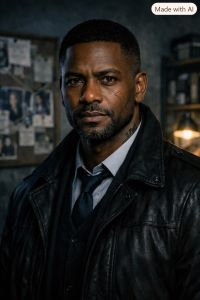
The phone rang at 2:47 a.m., and Cornelius Grantham answered it because he was already awake, already sitting at the kitchen table of his rented house on the edge of Tacoma’s industrial waterfront, staring at nothing in particular. The ringtone was wrong — not the chime he had set, but something older, a flat mechanical trill that belonged to a rotary phone from another decade — and that small wrongness should have been enough to stop him. It wasn’t. He picked up, and the voice on the other end said his name. Not his full name. Not his nickname. The exact version of his name that only one person had ever used: Cornie. A breath. Then silence.
He had not heard that voice in eleven months.
His mother had been buried in November, in the clay-red soil of a cemetery outside Savannah, Georgia, under a sky the color of old pewter. Cornelius had stood at the graveside in a coat that was too thin for the wind, and he had not cried, and he had not spoken, and he had driven back to the airport alone with a paper cup of gas station coffee going cold in the cupholder. He was a methodical man by nature — a former claims investigator for an insurance firm, trained to look for inconsistencies in stories, to find the seam where a lie met a fact and had been poorly stitched — and grief, in his experience, was something to be processed the way you processed evidence: carefully, in order, without losing your head. He had told himself this every day since November. He was not sure it was working.
The watcher noticed him for the first time three days before the phone call, though he did not know that yet.
He had moved to Tacoma for no reason he could articulate clearly. The job he had taken was remote, auditing digital records for a logistics company, the kind of work that required only a laptop and a reliable connection. He could have done it from anywhere. He had chosen Tacoma because the rent was manageable and because the grey Pacific sky felt, in some obscure way he couldn’t explain, like a matching condition — a weather that agreed with whatever had settled inside him. The house sat at the end of a dead-end lane near the tide flats, surrounded by scrub grass and the distant silhouettes of cranes at the port. Most evenings, fog came in off the water and swallowed the streetlights whole. He walked the same route each night: down to the chain-link fence at the water’s edge, back along the lane, up the three wooden steps to his door. Routine was the architecture he had built to keep himself functional.
The watcher observed this routine from a position he could not have identified — not a window, not a parked car, but somewhere in the middle distance, somewhere that the fog made ambiguous. The watcher noted the times. The watcher noted the pattern. The watcher waited.
Back to the phone call. Cornelius sat very still after hearing his name spoken in that voice, the handset pressed against his ear hard enough that he could feel his pulse in the cartilage. The connection was not clean — there was a quality to the background silence that was textured, almost wet, like a recording made inside a room where water was very close. He said, quietly, “Who is this.” Not a question. A statement. A trained reflex. The voice said his name again, and this time there was something underneath it, a secondary sound, like the faint mechanical cycling of an old answering machine. He pulled the phone away from his ear and looked at the screen. It showed an incoming call from his own number. His own mobile number. He was holding the only phone in the house.

 WhatsApp
 Telegram
 Email






Categories
- AI & Technology
- Contemporary
- Corporate Control
- Creepypasta
- Crime Thriller
- Cyberpunk
- Dark Fantasy
- Enemies to Lovers
- Fairy Tale Retelling
- Fantasy
- First Contact
- Forbidden
- Genetic/Body Horror
- High Fantasy
- Monster Hunter
- Mythic/Folklore
- Paranormal
- Portal/Otherworld
- Post-Apo
- Post-Collapse Society
- Psychological Thriller
- Romances
- SCI-FI
- Second Chance
- Slow Burn
- Space Combat
- Spacepunk
- Surveillance State
- Survival Thriller
- Thrillers
- Time Travel
- Treasure Hunter
- Urban Fantasy
- Witchcraft/Curses
Tags
10min stories atmospheric atmospheric fantasy atmospheric fiction contemporary romance Creepy creepypasta crime thriller dark fantasy debt dystopia emotional fiction enemies to lovers ensemble cast epistolary fantasy female protagonist first person forbidden romance framed narrative high fantasy love story magic Memory mystery Paranormal psychological horror psychological thriller romance sci-fi second chance second chance romance short fiction short story slow burn space station speculative fiction supernatural Survival survival thriller suspense thriller travel romance witchcraft workplace romance
Leave a Reply