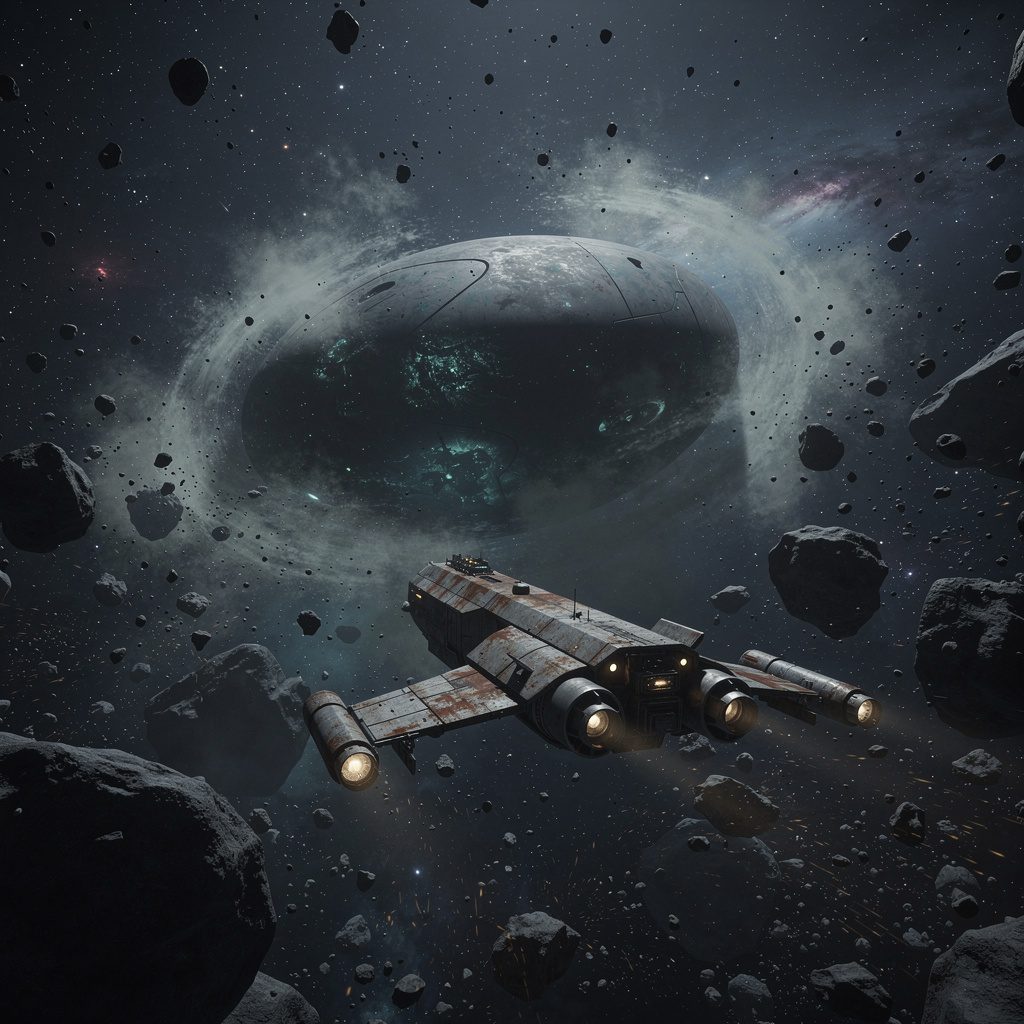
It was not a ship. She was certain of that within the first few minutes of sensor sweeps, even before she brought it up on visual. A ship had mass distribution she could read, had engine signatures, had the angular logic of manufactured geometry. This had none of those things. It was roughly ovoid, perhaps forty meters along its longest axis, and it absorbed sensor signals in a way that made her readings soft and uncertain at the edges — as though the object’s boundary was not a fixed surface but a condition, a transition between one kind of space and another. Its color, on visual, was the precise shade of deep water seen from below: dark, but not dark in the way that metal is dark. Dark in the way that depth is dark.
It was not tumbling. It was not drifting. It was entirely, unnaturally still.
Dunya held position at two kilometers and stared at it for a long time. Her hands were flat on the console. She was aware of her own breathing, of the forty-minute tick of the recycler coming and going twice while she sat there. She ran every passive scan her equipment could manage and received in return a collection of readings that her ship’s interpretation system flagged, one after another, with a symbol she had only seen in the manual: a small orange diamond that meant the system had no reference category for what it was measuring.
Then the second message arrived.
Same frequency. Same routing code. And it said only: OPEN BAY FOUR.
Bay four. The cracked thermal seal. The bay that held the cryogenic cores.
She sat with that instruction for a long time. Opening a cargo bay in open space was not a catastrophic act — the cores were sealed, the cargo was rated for vacuum exposure, and bay four had an exterior hatch she could operate from the command module without entering the bay herself. But opening it meant doing something, and doing something felt like crossing a line she had not consciously decided to cross. The first deviation, the new heading, the hours of transit — those had accumulated gradually, each step small enough to feel manageable. This was different. This was a deliberate act in response to a source she could not verify, aimed at an object she could not classify, in a location that appeared on no chart she trusted.
She thought about the do not acknowledge instruction. She thought about the fact that she had followed the first message without questioning it until she was already here, already parked two kilometers from something that should not exist, with no one anywhere near her and no lane traffic that would have seen her deviate.
She opened bay four.
What happened next took six minutes by the ship’s internal clock, though Dunya would later find she had no clear memory of most of it. Her log recorded the sequence in clean, factual terms: bay four exterior hatch opened at 14:22:07. At 14:22:51, the object in the belt moved for the first time — not toward the ship, but in a slow rotation that brought one end of its ovoid form to bear on the open bay. At 14:24:03, the sensors registered a focused emission from the object, narrow-band, non-ionizing, in a frequency range that her equipment could detect but had no name for. The emission lasted ninety seconds. At 14:25:33, the emission stopped. At 14:26:14, the object returned to its original orientation and became still again. At 14:28:19, Dunya closed bay four.
She did not remember closing it. She remembered opening it. She remembered watching the exterior hatch status light change from red to green on her panel. After that, her next clear memory was sitting in her chair with cold coffee in her hand, the recycler ticking, the object still visible on the screen at two kilometers, and a feeling in her chest that she could only describe as the aftermath of something — the specific quiet that follows a sound too large to have been ordinary.
She ran an internal scan of the cargo bay. The cryogenic cores were undisturbed. Their seals were intact. Their temperature readings were nominal. Nothing in the bay had moved.

 WhatsApp
 Telegram
 Email







Categories
- AI & Technology
- Contemporary
- Corporate Control
- Creepypasta
- Crime Thriller
- Cyberpunk
- Dark Fantasy
- Enemies to Lovers
- Fairy Tale Retelling
- Fantasy
- First Contact
- Forbidden
- Genetic/Body Horror
- High Fantasy
- Monster Hunter
- Mythic/Folklore
- Paranormal
- Portal/Otherworld
- Post-Apo
- Post-Collapse Society
- Psychological Thriller
- Romances
- SCI-FI
- Second Chance
- Slow Burn
- Space Combat
- Spacepunk
- Surveillance State
- Survival Thriller
- Thrillers
- Time Travel
- Treasure Hunter
- Urban Fantasy
- Witchcraft/Curses
Tags
10min stories atmospheric atmospheric fantasy atmospheric fiction contemporary romance Creepy creepypasta crime thriller dark fantasy debt dystopia emotional fiction enemies to lovers ensemble cast epistolary fantasy female protagonist first person forbidden romance framed narrative high fantasy love story magic Memory mystery Paranormal psychological horror psychological thriller romance sci-fi second chance second chance romance short fiction short story slow burn space station speculative fiction supernatural Survival survival thriller suspense thriller travel romance witchcraft workplace romance
Leave a Reply