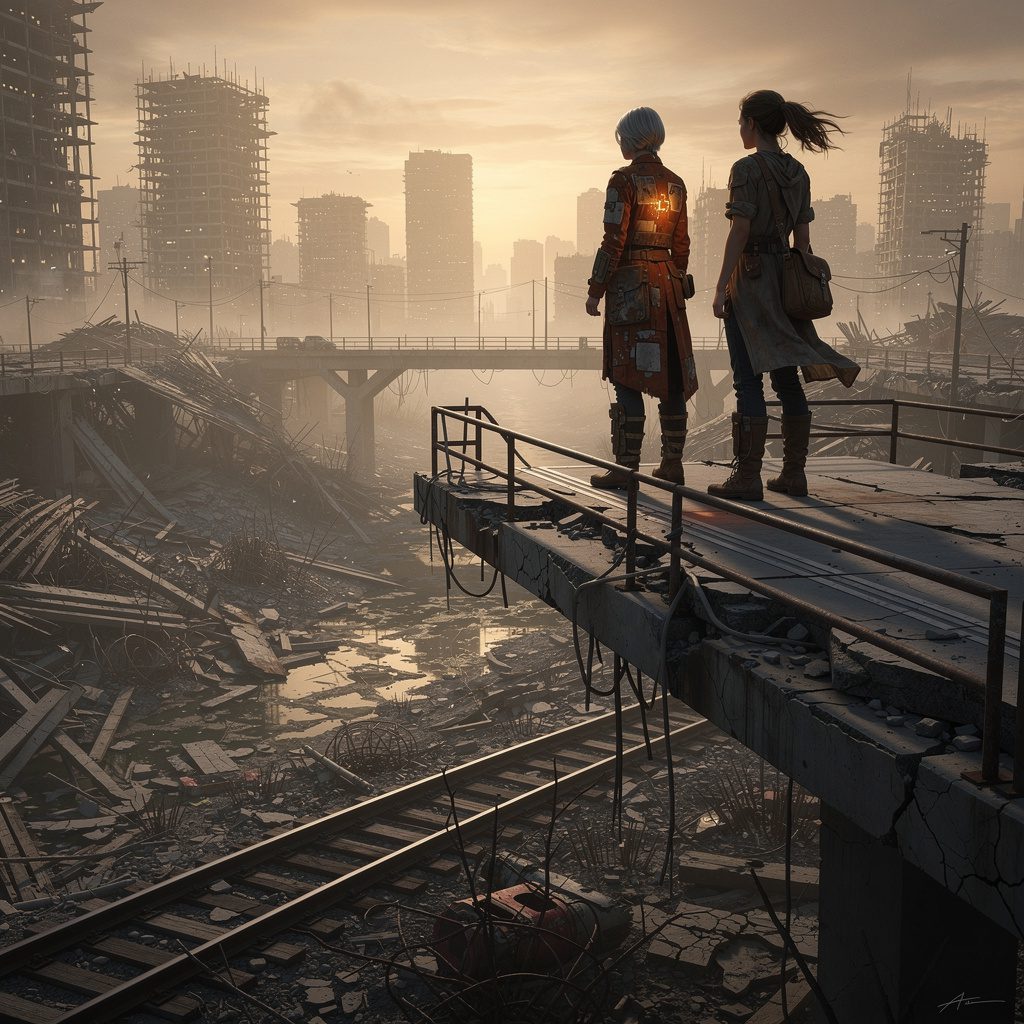
Akemi was quiet and efficient as we descended via a longer route through the hub’s interior stairwell, picking through collapsed ceilings and the fossilized debris of a world that had moved too fast and then stopped all at once. Old ticket machines. A child’s shoe. A motivational poster from some long-dead corporation, its colors bleached to pastels, still insisting that “together we rise.”
She told me about herself in fragments, the way everyone told their story now — not as a narrative but as a scatter of salvaged moments. She’d been in the northern research station when the Choke hit the cities. She’d walked south for two months. She’d been using the anchor to navigate not just space but probability, finding the paths with the best forward echoes.
“It’s not reliable,” she admitted. “The network is mostly dead. I get fragments. Impressions.”
“But you got enough to find me.”
“I got enough to find the platform. You were… a surprise.” She paused at a landing, listening. Silence, except for wind threading through broken glass somewhere above us. “In the echo, I didn’t see your face. I saw someone fall, and I saw myself not moving. Standing there. Watching.”
I understood then why she’d walked three days toward a stranger on a broken platform.
She wasn’t trying to save me.
She was trying to save herself from becoming someone who didn’t.
—
We made it to ground level without incident. The canal bed stretched west toward the water-cache I’d established in the basement of a collapsed school, and I’d already decided I was going to share it with her. The filters I was carrying could be reconfigured for two people. It wasn’t generosity, exactly. It was the arithmetic of survival — two people watch more angles than one.
That was when the anchor at her neck went suddenly, violently bright.
Not amber. White. A sustained pulse like a held breath.
Akemi stopped walking. Her hand went to the device and her face went very still in the way faces go still when the body is processing something the mind hasn’t caught up to.
“What is it?”
“Another echo,” she said. “Close. Very close. The anchor is picking up…” She trailed off. “Marisol. Do you have a chrono-anchor?”
I almost said no.
Then I thought about the device in the inner pocket of my coat. The one I’d pulled from the med-depot two weeks ago, still in its sealed case, still drawing power from its internal cell because I hadn’t known what it was and hadn’t wanted to open it until I could identify it properly.
I took it out.
The case was stamped with the same military surplus markings as hers. Inside, the device was identical — same housing, same amber pulse. Except this one’s pulse was now white too. And it was synchronized with hers. Beat for beat. Perfectly matched.
Akemi stared at it for a long time.
“That’s mine,” she said quietly.
I didn’t argue. The serial number was visible on the housing, and I could see her reading it against some internal memory, her lips pressed thin.
“How?” I asked.
“The med-depot,” she said. “I was there. Eight months ago, before I went north. I cached supplies. I cached the backup anchor.” She looked up at me. “I was going to go back for it. I never made it back.”
I turned the device over in my hands. Eight months in a sealed case in a collapsed building, waiting for someone who didn’t come. And then I’d found it, and carried it three kilometers, and met the woman it belonged to on the edge of a platform above a forty-foot drop.
“The echo,” I said slowly. “Three days ago, when you saw the platform — you said the network is mostly dead. But you got a clear image.”
“Clearer than anything in months,” she said.
“Because I was already carrying the second anchor. I was already in range.” I felt the shape of it settle into place, cold and exact. “You weren’t navigating toward a stranger. You were navigating toward your own device. I was just… attached to it.”
She didn’t deny it. She looked at the two anchors pulsing in perfect unison and she said nothing for a long time.
Then: “Does it matter?”
I thought about the cut cable. The fall that hadn’t happened. The three days she’d walked.
“No,” I said. “I suppose it doesn’t.”
I handed her the backup anchor. She held both of them, one in each hand, and the white pulse slowed back to amber as the two devices finished whatever conversation they’d been having across the dead air of the collapsed world.
We walked west toward the water-cache as the sky above Sector Twelve turned its familiar end-of-day color — a deep, bruised orange, beautiful in the way only ruined things can be.

 WhatsApp
 Telegram
 Email






Categories
- AI & Technology
- Contemporary
- Corporate Control
- Creepypasta
- Crime Thriller
- Cyberpunk
- Dark Fantasy
- Enemies to Lovers
- Fairy Tale Retelling
- Fantasy
- First Contact
- Forbidden
- Genetic/Body Horror
- High Fantasy
- Monster Hunter
- Mythic/Folklore
- Paranormal
- Portal/Otherworld
- Post-Apo
- Post-Collapse Society
- Psychological Thriller
- Romances
- SCI-FI
- Second Chance
- Slow Burn
- Space Combat
- Spacepunk
- Surveillance State
- Survival Thriller
- Thrillers
- Time Travel
- Treasure Hunter
- Urban Fantasy
- Witchcraft/Curses
Tags
10min stories atmospheric atmospheric fantasy atmospheric fiction contemporary romance Creepy creepypasta crime thriller dark fantasy debt dystopia emotional fiction enemies to lovers ensemble cast epistolary fantasy female protagonist first person forbidden romance framed narrative high fantasy love story magic Memory mystery Paranormal psychological horror psychological thriller romance sci-fi second chance second chance romance short fiction short story slow burn space station speculative fiction supernatural Survival survival thriller suspense thriller travel romance witchcraft workplace romance
Leave a Reply