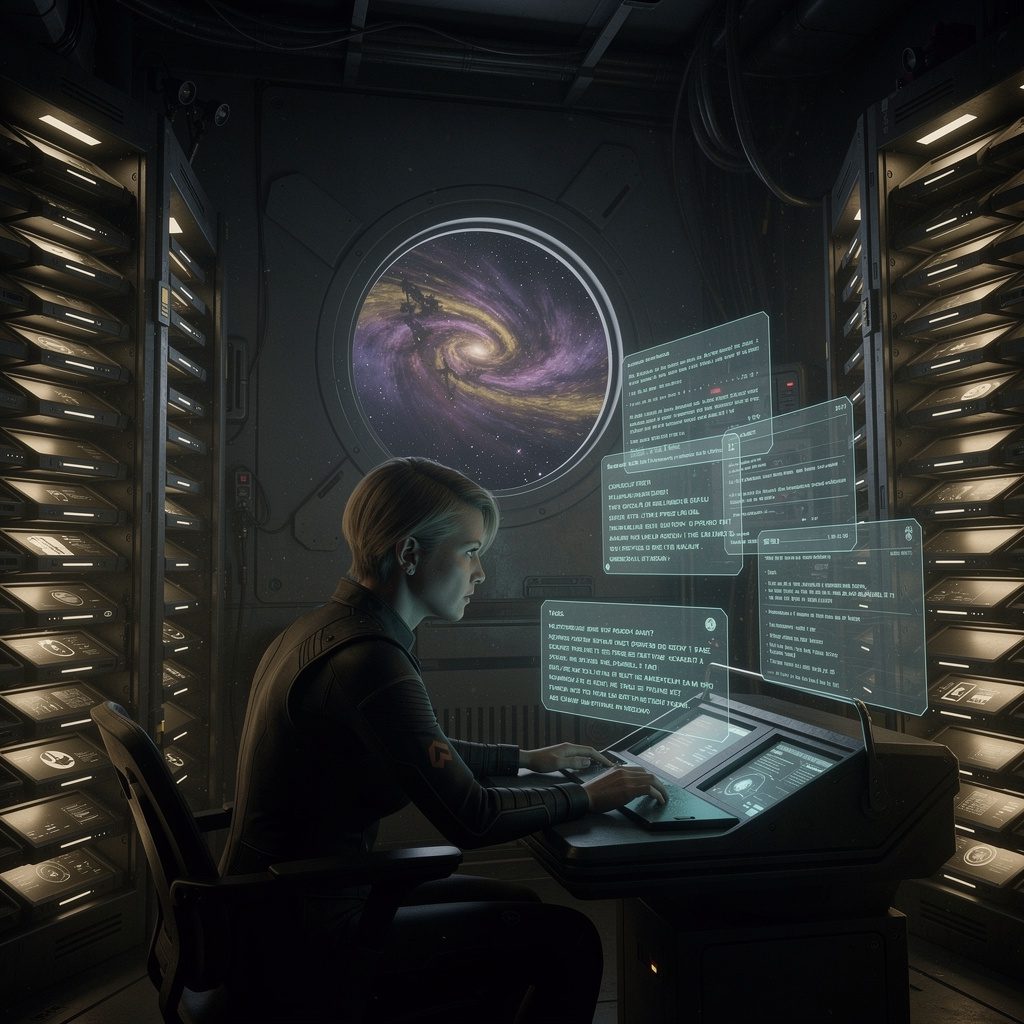
She had not told Sten yet about the second thing she’d found. She’d found it on the second day of reading, tucked inside the metadata of Entry 31—a compressed data packet, small enough to have been overlooked by any standard scan, containing a partial schematic. She’d recognized it immediately. It was the retrieval protocol. The one she had spent six years developing. The one she’d published in the Temporal Cartography Review eleven months ago, which meant it was now archived on Miravel-9’s main system, which meant it was, technically, accessible. The schematic in Fintan’s embedded packet was not identical to her published version. It was rougher, earlier, like a first draft written by someone working from intuition rather than completed theory. But the underlying architecture was the same. The logic was the same. It was her work. Written by a man who had been dead—or unreal, or displaced, or whatever the correct word was—for forty years.
She ran the protocol at 0340 hours, when the station was quiet and Sten was asleep and the only witness was the Rift itself, burning its slow orange on the spectral band.
The procedure took eleven minutes. The Caldris’s second voyage window was a well-documented temporal coordinate—she’d worked with it before in other contexts, and the retrieval architecture locked onto it cleanly. She watched the coherence index climb on the secondary display, moving through yellow and into green, and she thought about what it meant to make something real. She thought about the six years she’d spent building the theory that had made this moment possible—the late nights, the failed iterations, the version she’d nearly abandoned in year four before a single anomalous data point had redirected her thinking. She had always believed she’d arrived at the protocol through original research. Through her own mind, her own persistence, her own particular way of asking questions. And she had. She was certain of that. But she was also now certain that the questions she’d asked had been, in some way she couldn’t fully articulate, shaped by a blueprint that had been waiting in the archive for four decades. A blueprint written by the man whose existence she was now, in this moment, making true.
The coherence index reached 100%.
She ran the verification scan. The Caldris’s second voyage manifest now listed twelve crew members. Fintan Osei-Mensah, engineer’s mate, listed between two names she recognized from the original eleven. His bunk assignment was there. His meal records. His duty rotations. Every log entry she’d spent three days reading was still present, but now they were indexed alongside the others rather than embedded beneath them—no longer hidden, no longer anomalous. He was real. He had been real, in the only way the record could make him so.
Vibeke closed the verification scan and sat for a while in the quiet of the archive room. She was not sure what she had expected to feel. Relief, perhaps. The clean satisfaction of a procedure successfully completed. What she felt instead was something more complicated and harder to name—a sense that something had been taken from her even as something had been given to someone else. The protocol had always been hers. The years of work, the intellectual architecture, the particular stubbornness that had kept her at it past the point where most people would have stopped—all of that was still hers, and no version of events could unmake it. But the origin was no longer clean. The idea had come from somewhere, and that somewhere was a man she had never met and could not meet, a man who had needed her work to exist before she existed to do it.
She thought: that is what the Rift does. It does not destroy things. It displaces them. It puts them where they cannot be seen until someone builds the instrument to see them.
She turned off the console. She went to her bunk. She did not sleep for a long time, and when she finally did, she dreamed of a ship moving through orange light, and a man writing carefully in the dark, trusting that someone, somewhere in the future, would find what he had left behind.

 WhatsApp
 Telegram
 Email






Categories
- AI & Technology
- Contemporary
- Corporate Control
- Creepypasta
- Crime Thriller
- Cyberpunk
- Dark Fantasy
- Enemies to Lovers
- Fairy Tale Retelling
- Fantasy
- First Contact
- Forbidden
- Genetic/Body Horror
- High Fantasy
- Monster Hunter
- Mythic/Folklore
- Paranormal
- Portal/Otherworld
- Post-Apo
- Post-Collapse Society
- Psychological Thriller
- Romances
- SCI-FI
- Second Chance
- Slow Burn
- Space Combat
- Spacepunk
- Surveillance State
- Survival Thriller
- Thrillers
- Time Travel
- Treasure Hunter
- Urban Fantasy
- Witchcraft/Curses
Tags
10min stories atmospheric atmospheric fantasy atmospheric fiction contemporary romance Creepy creepypasta crime thriller dark fantasy debt dystopia emotional fiction enemies to lovers ensemble cast epistolary fantasy female protagonist first person forbidden romance framed narrative high fantasy love story magic Memory mystery Paranormal psychological horror psychological thriller romance sci-fi second chance second chance romance short fiction short story slow burn space station speculative fiction supernatural Survival survival thriller suspense thriller travel romance witchcraft workplace romance
Leave a Reply