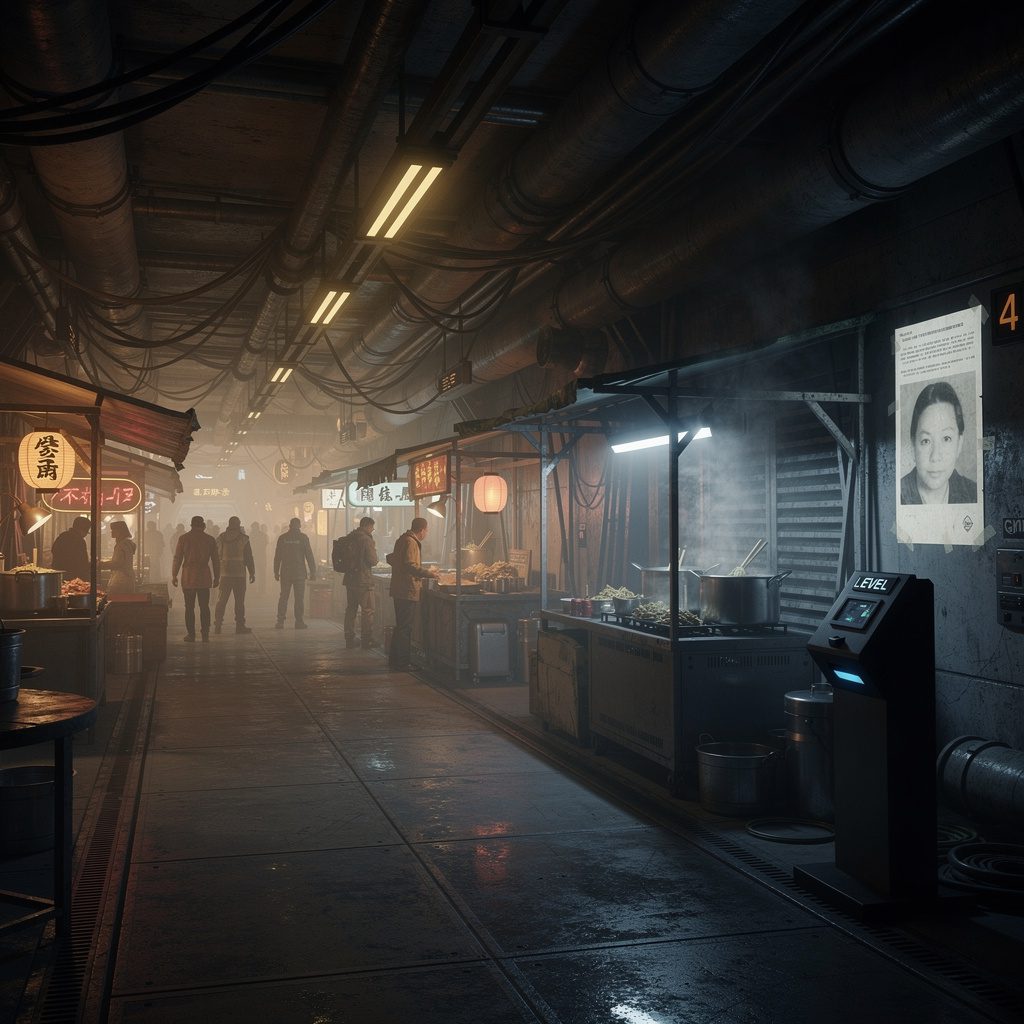
But her step changed, just for a fraction of a second. A micro-hesitation. The kind of thing that the Bureau’s automated flagging system would never catch, because automated systems looked for faces, not for the way a body remembered something it was trying to forget.
Sora caught it.
She had been catching things like that for sixteen years. It was the part of her work she couldn’t explain to anyone — the reading of bodies in motion, the tiny grammatical errors that people made in the language of trying to seem ordinary. She had learned it the hard way, in the years before she worked for the Bureau, in the years she preferred not to think about directly.
She opened a new file. Typed a name: MERRIWEATHER, GENEVIEVE.
Then she sat back and looked at both files side by side for a long time.
—
The thing about losing your face is that you don’t lose yourself.
I had expected to feel lighter. Free. The whole point of the modification had been to step out from under the warrant — a warrant I had not technically deserved, attached to a name that had been used without my knowledge to front a genetic data brokerage that trafficked in unlicensed genome maps. By the time I understood what had happened, the Bureau had already filed. The person who had used my identity had disappeared. I was left with a face on a list and a legal process that would take years and cost more than I had.
So I had made a different choice.
But I had not expected how strange it would feel to look at that wanted notice in the corridor and feel something close to grief. That face had been mine. It had been the face my mother knew, the face in every photograph from my childhood, the face that had looked back at me from mirrors for thirty-one years. And now it belonged to a file. To a crime I hadn’t committed.
I sat in my quarters on Level 4 and thought about that for a long time.
I had been careful. I had been so careful. But I knew, in the low-frequency way that careful people know things, that careful was never the same as safe.
—
On the eleventh day, Sora made a decision that was not in her contract.
She closed the secondary file — the one with the new name — without submitting it to the Bureau’s tracking queue. She flagged the Falconieri warrant as “active investigation, consultant-held.” That gave her seventy-two hours before the Bureau would ask for an update.
Then she put on her jacket and took the lift down to Level 4.
She found the woman — Livia, Genevieve, whatever name fit the moment — sitting at a small table outside the noodle stall, eating alone. Up close, the modification work was extraordinary. Sora had seen a lot of phenotypic restructuring, most of it sloppy, most of it detectable within thirty seconds if you knew what you were looking for. This was different. Whoever had done it had worked with real precision. The face was genuinely new.
And yet something remained. Not in the features themselves, but in the way the woman held her head, the angle at which she lifted her cup, the quality of stillness she had when she thought no one was watching. Identity, Sora had come to believe, was not housed in faces. Faces were just the address. The person lived somewhere deeper.
She sat down across from her.
The woman — Livia — looked up with the controlled expression of someone who had been expecting this moment and had decided, somewhere along the way, to meet it without running.
“You’re from the Bureau,” she said. Not a question.
“Consultant,” Sora said. “There’s a difference.”
“Is there.”
Sora set a data chip on the table between them. Small, matte grey, the kind used for encrypted document transfer. “I’ve been reviewing the Falconieri warrant for eleven days. I also reviewed the originating fraud case. The genome brokerage. The identity chain.” She paused. “You weren’t the operator. You were the substrate. They borrowed your profile to build the front.”
Livia said nothing. Her hands were very still around her cup.
“The Bureau’s automated system doesn’t make that distinction,” Sora continued. “It sees a face and a warrant and it closes the loop. But I’m not the automated system.”
“What’s on the chip?”

 WhatsApp
 Telegram
 Email






Categories
- AI & Technology
- Contemporary
- Corporate Control
- Creepypasta
- Crime Thriller
- Cyberpunk
- Dark Fantasy
- Enemies to Lovers
- Fairy Tale Retelling
- Fantasy
- First Contact
- Forbidden
- Genetic/Body Horror
- High Fantasy
- Monster Hunter
- Mythic/Folklore
- Paranormal
- Portal/Otherworld
- Post-Apo
- Post-Collapse Society
- Psychological Thriller
- Romances
- SCI-FI
- Second Chance
- Slow Burn
- Space Combat
- Spacepunk
- Surveillance State
- Survival Thriller
- Thrillers
- Time Travel
- Treasure Hunter
- Urban Fantasy
- Witchcraft/Curses
Tags
10min stories atmospheric atmospheric fantasy atmospheric fiction contemporary romance Creepy creepypasta crime thriller dark fantasy debt dystopia emotional fiction enemies to lovers ensemble cast epistolary fantasy female protagonist first person forbidden romance framed narrative high fantasy love story magic Memory mystery Paranormal psychological horror psychological thriller romance sci-fi second chance second chance romance short fiction short story slow burn space station speculative fiction supernatural Survival survival thriller suspense thriller travel romance witchcraft workplace romance
Leave a Reply