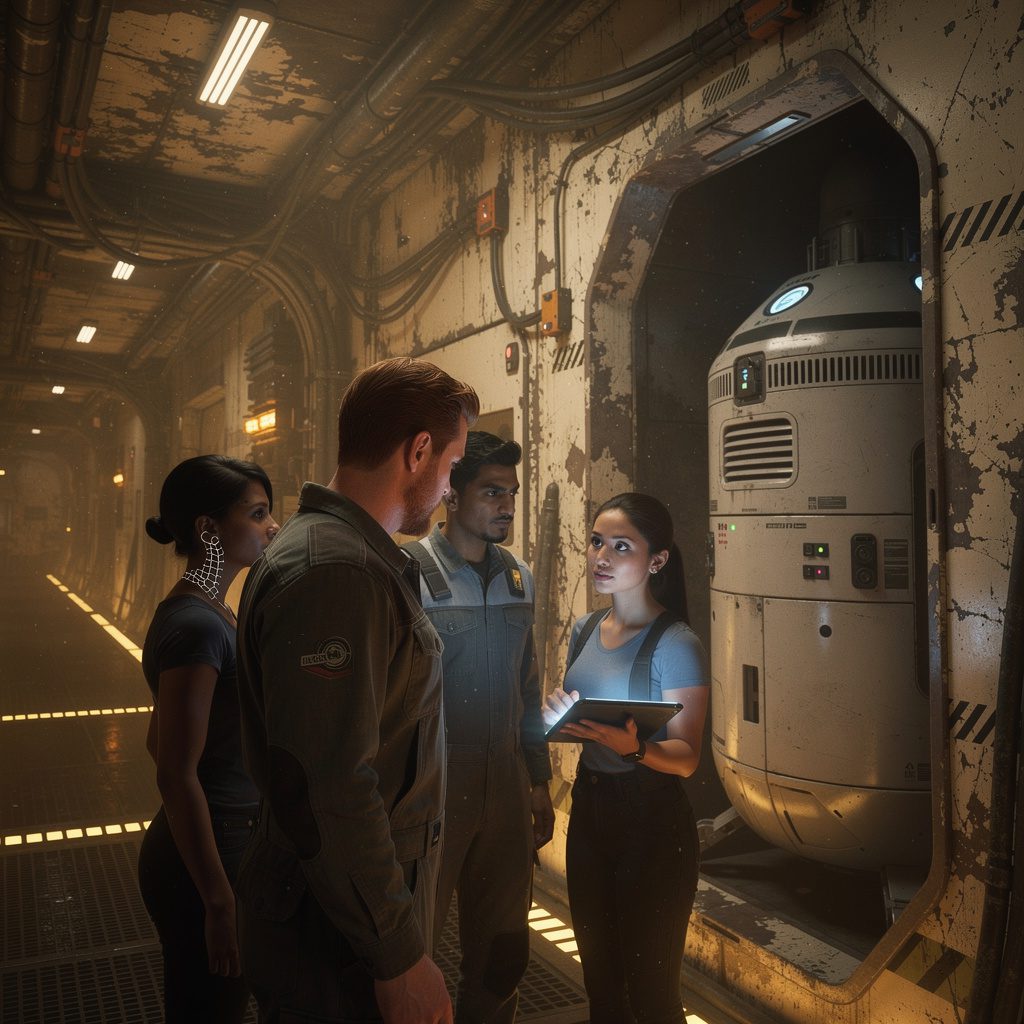
Because if Meridian was gone and Ilyandra-9 was dissolved, then the processor in Spoke Three’s atmospheric system was running unsupervised. And if it was still encoding — still releasing the pilot’s profile into the air we breathed every day — then at some point the accumulation would stop being background noise and start being something else. Riya said it carefully: at sufficient density, ambient neural encoding didn’t just transfer skills and memories. It transferred identity weighting. The original personality architecture began to take precedence over the host’s own.
Not possession. Nothing so dramatic. Just a slow, statistical drift toward someone else.
Alma had already pulled up the station’s maintenance schematic on her datapad. “The processor access is in Sub-Level Four. The same level where Diarmuid tested those docking codes.” She looked at him. “Which means you already know how to get in.”
He closed his eyes. “Yeah,” he said. “I do.”
Sub-Level Four was not a place the station’s management encouraged casual visits. It was the structural basement of Spoke Three, a low-ceilinged maze of conduit runs and pressure junctions where the original construction met four decades of improvised additions. The lighting was emergency amber, and the floor was a metal grating over a shallow drainage channel that smelled of rust and something chemical and faintly sweet.
The atmospheric processor housing was larger than I’d expected — a grey-white cylinder about two meters tall, set into an alcove between a water reclamation unit and a bundle of data conduits as thick as my arm. It looked entirely unremarkable. It looked like infrastructure. There was no branding, no warning label, nothing to suggest that inside its sealed chamber, encoded onto a substrate we couldn’t see, was the full experiential record of a human life.
Riya interfaced with the access panel — not through her mesh, which was still dead, but through a manual console she’d brought from the crew compartment, patched in with a cable. She worked quietly and quickly. The rest of us stood in the amber light and said nothing.
I found myself thinking about the Tethered Welcome. About what it would feel like to hear it played live, the deep brass instruments the dock workers used, the way the song apparently swelled on the final approach signal. I knew this the way I knew my own name. I knew it was played at dawn-cycle on Vekara-7 because dawn-cycle was when the long-haul ships came in, the ones that had been out for six months or more, and the workers who played it were the ones whose partners and children were on those ships.
I knew that because she had known it. The pilot. Whose name, I realized with a jolt, I also knew.
Ignacio.
His name had been Ignacio Mercado. He had flown long-haul cargo for nineteen years. He had a daughter on Vekara-7 who played the brass in the dock workers’ ensemble. He had a scar along his jaw from a pressure seal failure on his third run, and he moved through low gravity with the ease of someone who had spent more time weightless than grounded, and he had loved his work with a completeness that most people reserve for other people.
I hadn’t known any of this an hour ago. Or I had known it and not known I knew it.
The console chimed softly. Riya exhaled.
“It’s done,” she said. “The encoding cycle is terminated. The substrate will degrade on its own within a few days without the active dispersal mechanism.” She paused. “What we’ve already absorbed will fade. Maybe weeks, maybe months. But it won’t compound anymore.”
Diarmuid nodded slowly. Arjun said nothing, which was its own kind of answer.
Alma was the one who asked the question we were all sitting with. “His daughter. Does anyone know her name?”
We did. Of course we did. Elspeth. Elspeth Mercado, twenty-four years old, brass player, dock worker, Vekara-7.
“She doesn’t know where her father’s profile ended up,” Alma said. “Meridian would never have told her. Ilyandra-9 dissolved without disclosure. She probably doesn’t even know this technology existed.”
We climbed back up to Spoke Three in silence. The corridor still smelled of flux sealant. The walls were still the color of old teeth. But something had shifted in the quality of the silence between us — it was heavier and also, somehow, more honest.

 WhatsApp
 Telegram
 Email






Categories
- AI & Technology
- Contemporary
- Corporate Control
- Creepypasta
- Crime Thriller
- Cyberpunk
- Dark Fantasy
- Enemies to Lovers
- Fairy Tale Retelling
- Fantasy
- First Contact
- Forbidden
- Genetic/Body Horror
- High Fantasy
- Monster Hunter
- Mythic/Folklore
- Paranormal
- Portal/Otherworld
- Post-Apo
- Post-Collapse Society
- Psychological Thriller
- Romances
- SCI-FI
- Second Chance
- Slow Burn
- Space Combat
- Spacepunk
- Surveillance State
- Survival Thriller
- Thrillers
- Time Travel
- Treasure Hunter
- Urban Fantasy
- Witchcraft/Curses
Tags
10min stories atmospheric atmospheric fantasy atmospheric fiction contemporary romance Creepy creepypasta crime thriller dark fantasy debt dystopia emotional fiction enemies to lovers ensemble cast epistolary fantasy female protagonist first person forbidden romance framed narrative high fantasy love story magic Memory mystery Paranormal psychological horror psychological thriller romance sci-fi second chance second chance romance short fiction short story slow burn space station speculative fiction supernatural Survival survival thriller suspense thriller travel romance witchcraft workplace romance
Leave a Reply