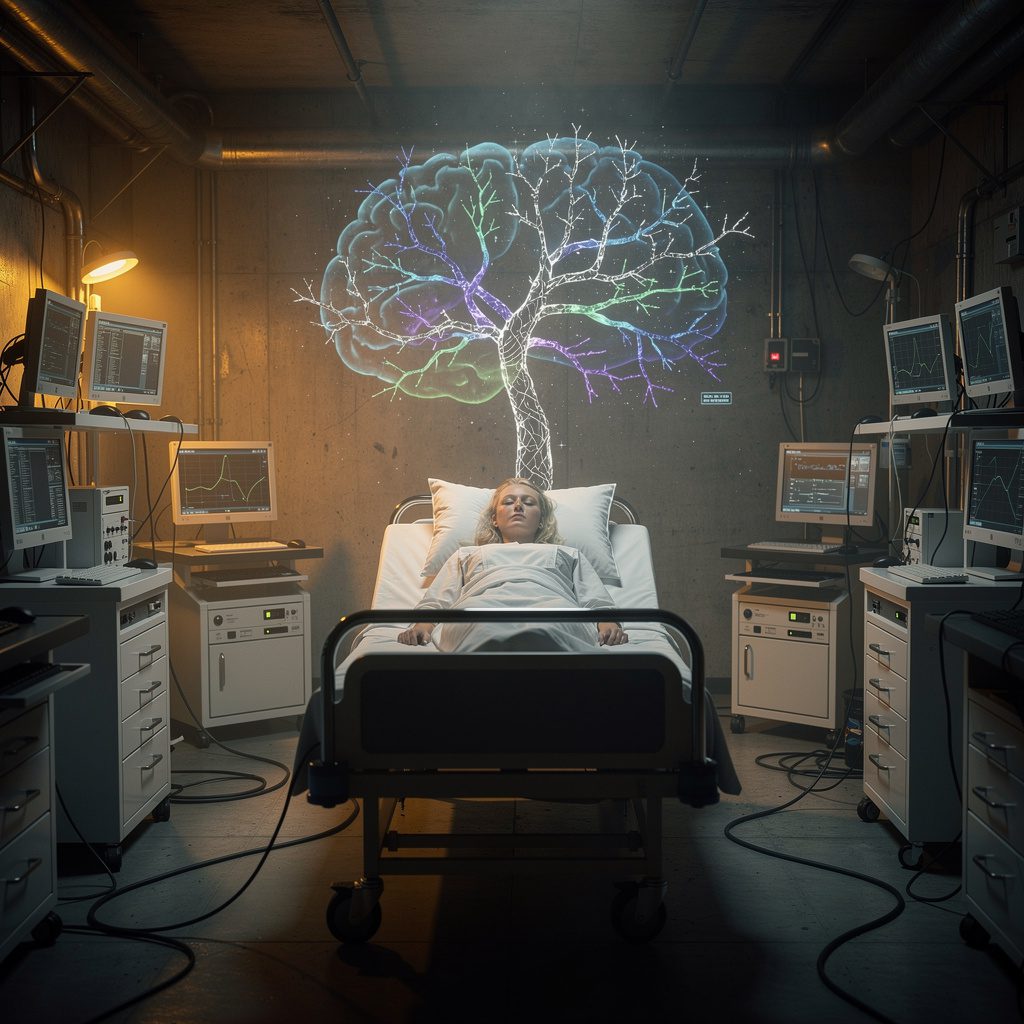
Amalie noticed first. She always noticed. She had been Nanna’s assigned monitor since day one, and she had watched seven other subjects move through the trial with varying degrees of wonder and discomfort, but none of them had developed what she was now privately calling temporal lock — the state in which the subject’s present behavior was being overwritten by their future projection. Nanna wasn’t experiencing the future anymore. She was becoming it.
Amalie brought her concerns to Lascelles on a Thursday evening when the sublevel was quiet. She laid out her data carefully, the way she always did, because Lascelles respected precision and dismissed emotion.
He listened. He looked at her charts. He was quiet for a long time.
“The Shard is extending its window,” he said finally.
“How far?”
“I don’t know yet.” He pulled up Nanna’s latest neural map on the wall display — a luminous tree of activity, dense and branching, the Shard’s influence visible as a bright filament woven through the cortex like a second nervous system. “It’s integrating. I designed it to adapt to the subject’s cognitive signature, but this is — ” He stopped.
“Beyond the design parameters,” Amalie said.
“Yes.”
Neither of them said what they were both thinking: that the Shard was not adapting to Nanna. Nanna was adapting to the Shard.
—
Rohan traced the signal to a subnet registered to something called Project PRISM.
He found no documentation. He found a facility code for Sublevel Four. He found a name — Isaksen, N., Subject 8 — attached to a biometric file that was still active, still transmitting.
And he found something else. In the seventeen-second gap between the signal and its cause, there was data. Not noise. Not artifact. Structured, compressed, and addressed — to no node he could identify anywhere in the institute’s architecture.
The data was going somewhere outside the network entirely.
He sat back in his chair and felt the particular cold that comes not from temperature but from implication. Someone had built the Shard to do two things. The first was what Lascelles had described in every briefing document. The second was something no briefing document mentioned: it was transmitting the future.
—
Nanna called Amalie at 3 a.m. on the thirty-ninth day of the trial. Her voice was steady, which was somehow worse than if it had been afraid.
“I need you to come down,” she said. “I’ve seen something.”
Amalie came. She found Nanna seated on the edge of her cot in the low amber light, hands folded in her lap, looking at the middle distance with the focused calm of someone who has already processed a shock and come out the other side.
“How far ahead?” Amalie asked, because she already understood the shape of this conversation.
“Three hours,” Nanna said. “Maybe a little more. Someone comes into this room. Not you. Not Lascelles. Someone I’ve never seen, and they’re not here for the trial.”
Amalie sat down. “What do they do?”
“They take the Shard’s output. All of it. Every projection I’ve ever had — it’s been recorded and stored somewhere I can’t access. They come to retrieve it.” Nanna finally looked at her directly. Her eyes were steady. “And then they shut the trial down. Permanently.”
—
Rohan reached Sublevel Four at 5:47 a.m.
He had not slept. He had spent the last six hours building a picture from fragments, and the picture was not good. The external address receiving the Shard’s transmissions belonged to a shell registered to a defense contractor called Veyne Systemic, which had no public products and no public employees and which appeared in three separate redacted procurement documents he had found in archives he was not supposed to be able to access. The Shard was not a medical device. It was a prototype for a surveillance instrument — one that could extract predictive behavioral data from a human subject and transmit it, in real time, to whoever held the receiver key.
Nanna Isaksen was not a patient. She was an antenna.
He found the lab. He found Amalie standing outside it, arms crossed, waiting — as if she had known he was coming. Maybe she had. Maybe Nanna had told her.
“You’re the data integrity analyst,” Amalie said.
“Yes.”
“How much do you know?”
“Enough,” he said. “Where’s the transmitter array? The Shard has to have a relay somewhere in the building.”

 WhatsApp
 Telegram
 Email







Categories
- AI & Technology
- Contemporary
- Corporate Control
- Creepypasta
- Crime Thriller
- Cyberpunk
- Dark Fantasy
- Enemies to Lovers
- Fairy Tale Retelling
- Fantasy
- First Contact
- Forbidden
- Genetic/Body Horror
- High Fantasy
- Monster Hunter
- Mythic/Folklore
- Paranormal
- Portal/Otherworld
- Post-Apo
- Post-Collapse Society
- Psychological Thriller
- Romances
- SCI-FI
- Second Chance
- Slow Burn
- Space Combat
- Spacepunk
- Surveillance State
- Survival Thriller
- Thrillers
- Time Travel
- Treasure Hunter
- Urban Fantasy
- Witchcraft/Curses
Tags
10min stories atmospheric atmospheric fantasy atmospheric fiction contemporary romance Creepy creepypasta crime thriller dark fantasy debt dystopia emotional fiction enemies to lovers ensemble cast epistolary fantasy female protagonist first person forbidden romance framed narrative high fantasy love story magic Memory mystery Paranormal psychological horror psychological thriller romance sci-fi second chance second chance romance short fiction short story slow burn space station speculative fiction supernatural Survival survival thriller suspense thriller travel romance witchcraft workplace romance
Leave a Reply