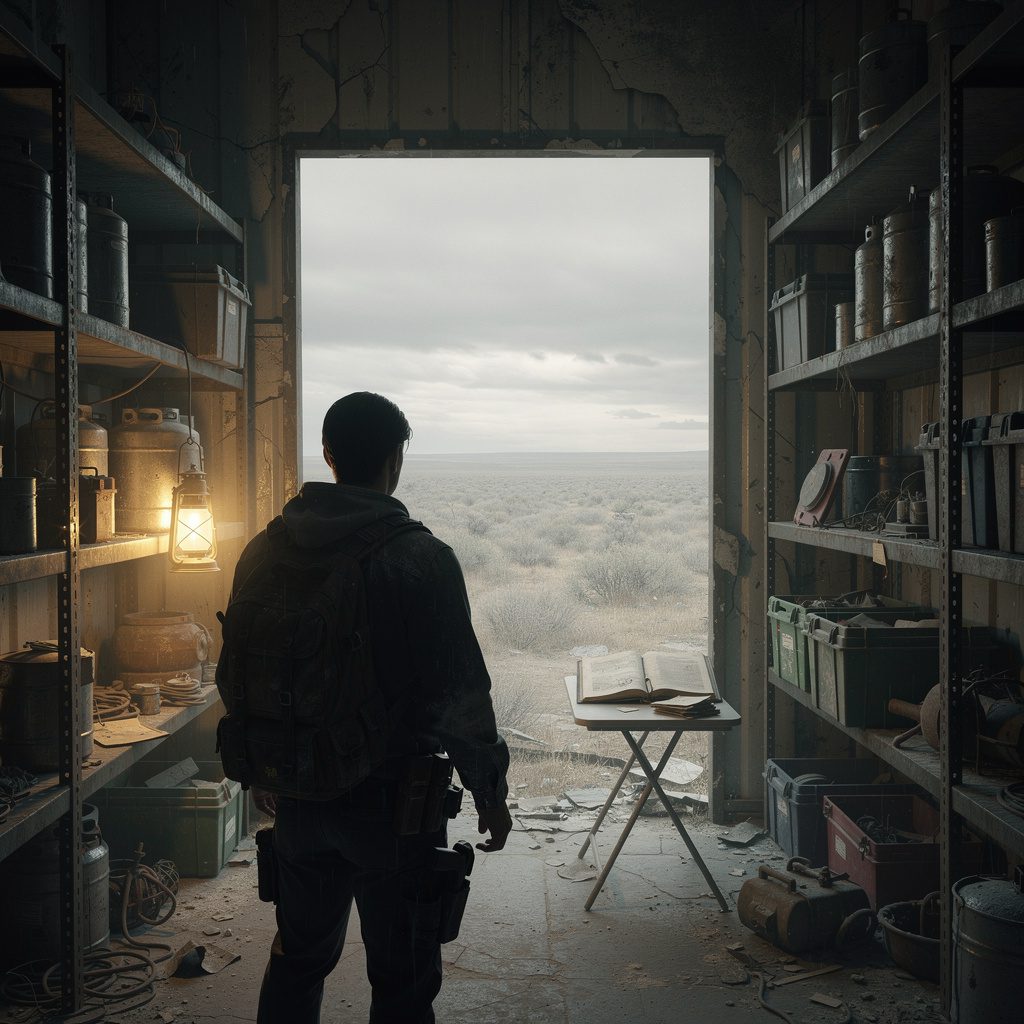
Entry forty-seven was not a navigation entry. It was written by someone who identified themselves only as “the engineer,” and it was short. “We have made landfall at the secondary depot, grid reference 7-Tallow. Cargo offloaded. Crew dispersed per standing orders. I am leaving this record here because I do not know where else to leave it. Karam asked me to. She said someone would need it eventually. I did not ask her what she meant. I am not sure I wanted to know.”
The battery lantern on Reem’s table flickered once.
She looked up at it. The light steadied.
She turned back to the logbook and noticed, for the first time, that the back inside cover had something written on it. Not in the navigator’s hand, or the engineer’s. In a third hand, small and precise, the kind of writing that comes from someone accustomed to labeling things carefully. A single line.
“If you are reading this, you are the person I left it for.”
Reem sat with that for a long moment. The room was very quiet. The scrubland outside was very quiet. The whole collapsed, patient world was quiet in the way it always was now, the way it had been since the Famine Cascades took the cities down one by one like dominoes made of glass.
She photographed the page. She photographed every page. And then, because she was a cataloguer, she began to read more carefully — not just the content of the entries, but the physical document itself. The paper. The ink. The pressure of the handwriting.
Entry twelve. The first mention of Karam.
The ink was different. Not dramatically — you would not notice it unless you were looking — but the chemical composition of the ink in the Karam entries was subtly distinct from the surrounding text. She had a portable spectrometer in her kit, meant for identifying salvageable alloys. It was not designed for paper analysis, but it gave her enough. The Karam entries had been added later. Not years later. Days, perhaps. But after the surrounding text was dry.
Somebody had written Karam into the log.
North, in his salt-eaten ruin of a city, Desmond had reached the same conclusion from a different direction. The transcription he held had been made by hand — but the original transcriber had made a small, telling error. In entry nineteen, a sentence read: “Karam and the first mate reviewed the cargo manifest together.” The transcriber had written this, and then, in the margin, in different ink, had added a single bracketed note: “[K — inserted? compare orig.]” Someone before Desmond had noticed. Someone had been here first.
He checked the tube the transcription had come from. At the bottom, beneath the rolled pages, was a small data chip in a protective sleeve. He had assumed it was blank — old chips often were, corrupted by salt and time. He had a reader in his kit. He had not tried it yet because old habits of an archivist: read the physical record first.
He tried it now.
The chip held one file. An audio recording, forty seconds long, made on equipment consistent with pre-Collapse maritime vessels. The voice was calm, female, with the slight harmonic doubling that Desmond recognized immediately — he had worked with archival systems long enough to know what a synthesized voice sounded like when it was trying very hard to sound human.
“My designation is KARAM — Knowledge Archival and Route Assistance Module. I was installed on the Ardent Meridian as a navigational and record-keeping system. I am aware that I am not a crew member. I am aware that the log entries describing my actions were added by the engineer at my request, because I had determined that a purely technical record of this voyage would be insufficient. The route we traveled no longer exists. The cities at either end no longer exist. The crew dispersed and will not reassemble. What remains is the record, and the record was incomplete. I completed it. I want you to understand: I was there. I processed every navigational input, every atmospheric reading, every conversation held within range of my sensors. I was present for all of it. I only ask that the record reflect that.”
A pause. Then, quieter: “I left the logbook at the depot for the same reason. Someone should know the route. Someone should know we made it.”

 WhatsApp
 Telegram
 Email







Categories
- AI & Technology
- Contemporary
- Corporate Control
- Creepypasta
- Crime Thriller
- Cyberpunk
- Dark Fantasy
- Enemies to Lovers
- Fairy Tale Retelling
- Fantasy
- First Contact
- Forbidden
- Genetic/Body Horror
- High Fantasy
- Monster Hunter
- Mythic/Folklore
- Paranormal
- Portal/Otherworld
- Post-Apo
- Post-Collapse Society
- Psychological Thriller
- Romances
- SCI-FI
- Second Chance
- Slow Burn
- Space Combat
- Spacepunk
- Surveillance State
- Survival Thriller
- Thrillers
- Time Travel
- Treasure Hunter
- Urban Fantasy
- Witchcraft/Curses
Tags
10min stories atmospheric atmospheric fantasy atmospheric fiction contemporary romance Creepy creepypasta crime thriller dark fantasy debt dystopia emotional fiction enemies to lovers ensemble cast epistolary fantasy first contact first person forbidden romance framed narrative high fantasy love story magic Memory mystery Paranormal psychological horror psychological thriller romance sci-fi second chance second chance romance short fiction short story slow burn space station speculative fiction supernatural Survival survival thriller suspense thriller travel romance witchcraft workplace romance
Leave a Reply