I have been watching Girish Rao for eleven days. I know the precise angle at which he tilts his head when he is uncertain — twenty-three degrees, always to the left. I know he takes his tea without sugar but stirs it anyway, a nervous habit he has never examined. I know what he is about to lose. I have not yet decided whether to tell him.
The archive chamber smelled of scorched copper and cold stone the morning they found it open.
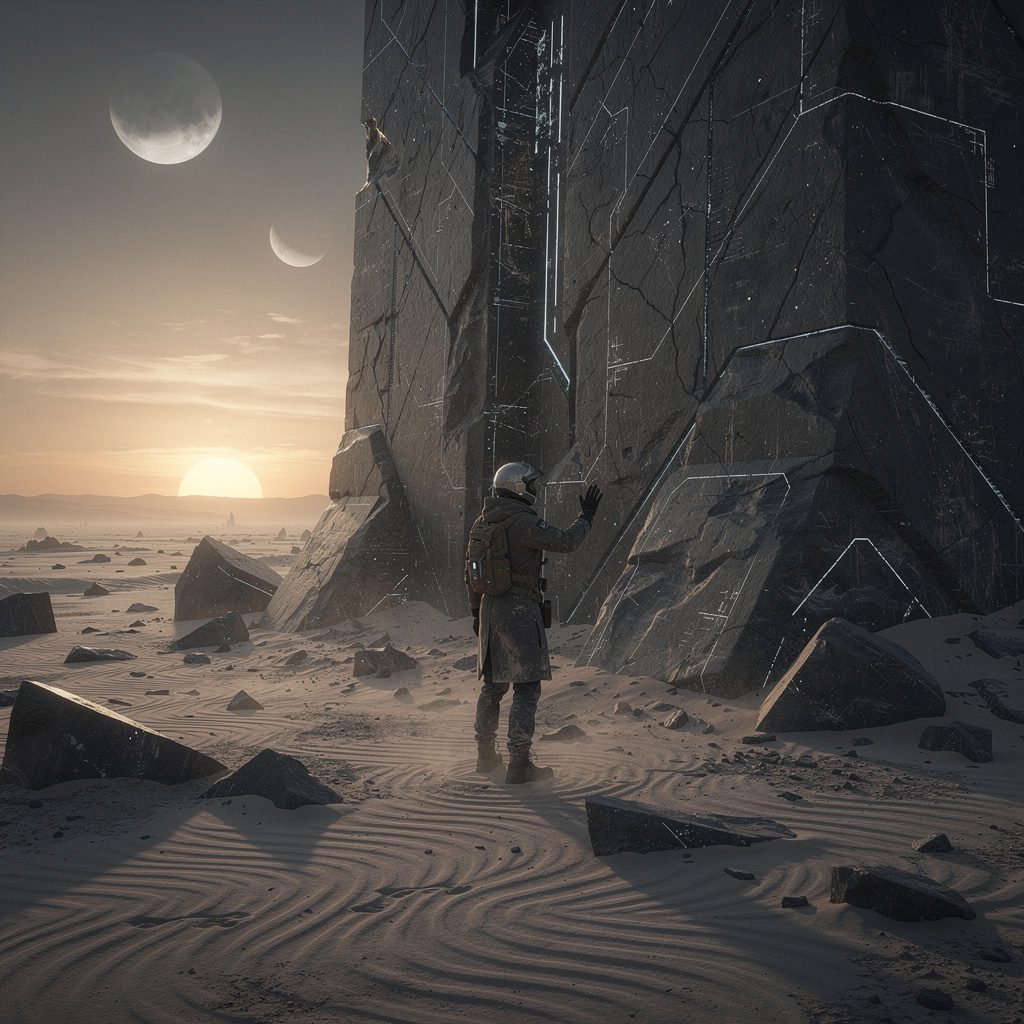
The Vanthari Threshold — that was what the excavation team had been calling the sealed structure for three weeks, a name borrowed from the mineral composition of its outer shell, a dark vanadium-threaded rock that did not occur naturally anywhere else on Kerath-9. The structure sat at the base of a dried riverbed forty kilometers from the colony’s outer perimeter, half-buried in pale sediment, its entrance facing the direction of the planet’s second sun with a precision that could not be accidental. Every scan had returned the same result: dense, layered, and utterly unreadable. No thermal signature. No electromagnetic bleed. Nothing that a probe could interpret as interior space. And yet the structure was clearly hollow. You could hear it, if you pressed your palm flat against the outer wall and listened — a low, patient resonance, like a bell that had been struck centuries ago and had not yet finished ringing. Girish had done exactly that on his first day at the site, crouching in the sediment in his survey coat, eyes closed, one hand flat against the stone. His colleague Adaeze Calloway had photographed him without asking. It became the image that defined the dig.
Girish was a temporal archaeologist, one of perhaps forty people in the settled systems who held that specific and peculiar credential. His work was not merely to excavate the past but to date it with instruments that measured chronological resonance — the faint imprint that significant events left on the physical matter surrounding them, a distortion in the local time-fabric detectable only by equipment so sensitive it had to be shielded from the researcher’s own heartbeat. He had spent nine years doing this work on six different worlds, and he had never found anything he could not eventually explain. The Vanthari Threshold was the first site that had made him feel, quietly and persistently, that the explanation was going to cost him something.
The morning the chamber opened, he had arrived at the site before Adaeze, which was unusual. She was always first. She had a habit of arriving before dawn and making notes by the light of her helmet lamp, filling small paper notebooks with observations she never shared with the rest of the team. Girish had respected this privacy without quite understanding it. But that morning he had woken at 0400 with a sensation he could not name — not anxiety, not excitement, something older and less legible — and had driven the crawler across the pale flats alone, arriving to find the entrance to the Threshold already open. Not broken. Not forced. Simply open, the stone door retracted into the wall as cleanly as if it had been waiting for a signal that had finally arrived.
He stood in the entrance for a long time before he went in.
The interior was a single long chamber, its walls lined with what appeared to be recording surfaces — not screens, not data-crystal arrays, but something in between, flat panels of a dark translucent material that held depth the way deep water holds light. The floor was smooth and slightly warm underfoot, which made no physical sense given the ambient temperature outside. At the far end of the chamber stood a figure.
He stopped.

 WhatsApp
 Telegram
 Email







Categories
- AI & Technology
- Contemporary
- Corporate Control
- Creepypasta
- Crime Thriller
- Cyberpunk
- Dark Fantasy
- Enemies to Lovers
- Fairy Tale Retelling
- Fantasy
- First Contact
- Forbidden
- Genetic/Body Horror
- High Fantasy
- Monster Hunter
- Mythic/Folklore
- Paranormal
- Portal/Otherworld
- Post-Apo
- Post-Collapse Society
- Psychological Thriller
- Romances
- SCI-FI
- Second Chance
- Slow Burn
- Space Combat
- Spacepunk
- Surveillance State
- Survival Thriller
- Thrillers
- Time Travel
- Treasure Hunter
- Urban Fantasy
- Witchcraft/Curses
Tags
10min stories atmospheric atmospheric fantasy atmospheric fiction contemporary romance Creepy creepypasta crime thriller dark fantasy debt dystopia emotional fiction enemies to lovers ensemble cast epistolary fantasy female protagonist first person forbidden romance framed narrative high fantasy love story magic Memory mystery Paranormal psychological horror psychological thriller romance sci-fi second chance second chance romance short fiction short story slow burn space station speculative fiction supernatural Survival survival thriller suspense thriller travel romance witchcraft workplace romance
Leave a Reply