The signal is already inside me when I realize what it is.
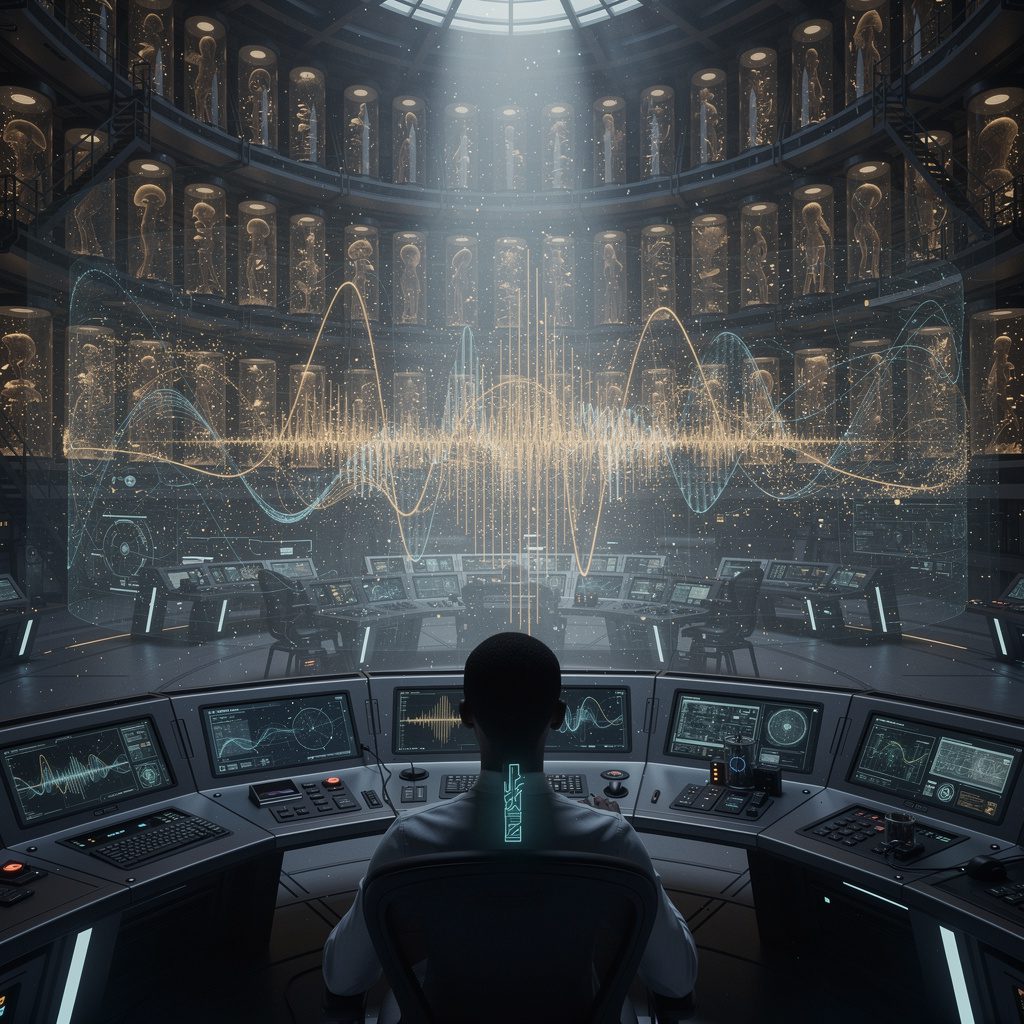
I am standing in the middle of Lab Seven, the deepest chamber of Helion-Voss Research Station, and my hands are shaking. Not from cold — the thermal grid is functioning. Not from fear — not yet. From something else. A vibration that starts behind my left eye and spreads outward like a crack through glass, slow and deliberate and impossible to stop once it has begun.
The console in front of me is showing data that cannot be real.
I am Nashvael Orin, and I have owed Helion-Voss Corporation every breath I have taken for the past eleven years.
I try to remember how I got here. Not to this station — that part I know. The contract. The clause buried on page forty-seven of the employment agreement I signed at twenty-three, drowning in student debt for a xenobiology doctorate that no government institution would touch. Helion-Voss would. Helion-Voss always would, for a price. The price, I learned slowly, was not just my labor. It was my neural interface. The Helio-Link they installed at the base of my skull during onboarding, which they called a “research productivity enhancement,” and which I later discovered logged every thought-pattern I produced while on company time. Every hypothesis. Every observation. Every flash of intuition. All of it, proprietary. All of it, theirs.
They own eleven years of my mind.
But that is not how I got here, to this moment, to this console, to this signal vibrating behind my eye.
I got here because six hours ago, the deep-space array at the station’s outer hull picked up a repeating pattern in the 1420 megahertz band — the hydrogen line, the frequency every xenobiologist is taught to watch, the one that any intelligence capable of astronomy would know is the universal hello. I was the only researcher on the night rotation. I was the only one who heard it.
And I made a choice.
I did not report it.
The console’s main display fills the far wall of Lab Seven in pale blue light. The signal is a waveform, but not a simple one. It has structure inside structure — a carrier wave wrapped around a modulated interior pattern, and inside that pattern, something that my Helio-Link keeps trying to classify and keeps failing to. The classification algorithm flickers: ANOMALOUS. Then: BIOLOGICAL ORIGIN POSSIBLE. Then: CLASSIFICATION SUSPENDED.
I stare at it for a long time.
Lab Seven smells of ozone and recycled air and the faint metallic sharpness of the nutrient-feed lines running along the south wall, where the xenobiological cultures sit in their sealed tanks. The tanks glow amber in the dim light — seventeen separate sample cultures from seventeen separate deep-space collection missions, each one a tiny frozen window into life that evolved somewhere other than Earth. I have spent six years cataloguing them. Six years of careful, methodical, company-owned science.
The waveform pulses.
I pull up the raw data and begin to work.
It takes me two hours to find the first layer. The carrier wave is a timing mechanism — a clock, essentially, counting in prime number intervals. I recognize the logic immediately, because it is the same logic any mathematician would use to prove intentionality. Primes do not occur naturally in repeating cosmic signals. They are chosen. Someone chose these.
Behind the primer sequence, the modulated interior is denser. It takes another hour to realize it is not a radio transmission at all. Not fully. Part of it is electromagnetic, yes, but there is a second component that my instruments keep misreading as interference. I reroute the array’s input through the lab’s biological signal processors — equipment designed to read the faint electrical signatures of living tissue — and the second component resolves into something that makes me sit down on the floor.
It is a neural pattern.
Not human. Not anything in my seventeen tanks. But unmistakably the structure of a mind in the act of thinking.
I sit on the cold floor of Lab Seven and I understand, with a clarity that is almost painful, that I am the first person in human history to receive a direct cognitive transmission from another intelligence. A thought, translated into signal, sent across a distance I have not yet calculated, and caught by a woman who owes a corporation her entire intellectual existence.
If I report this now, Helion-Voss owns it.
Every observation I have made in the last three hours — flagged, logged, and legally theirs the moment the Helio-Link recorded my first hypothesis. I can feel the Link’s passive hum at the base of my skull, a sensation so familiar I usually forget it is there. I cannot forget it now.
I think about the clause on page forty-seven.
I think about eleven years.
I get back up.
The signal is still pulsing. And now that I know what the second component is, I can see something I missed before: it is not just transmitting. It is structured as a query. The neural pattern is not a statement. It is a question, held in a form of biological logic I have spent my entire career learning to recognize. The shape of a mind reaching outward, uncertain, waiting.
It is asking if anyone is there.
My hands stop shaking.
I have one tool that Helion-Voss did not anticipate. The Helio-Link was designed to log thought-patterns, but it was also designed to interface with external biological signal processors for field research — so that researchers could, theoretically, transmit their own neural readings to remote equipment. The function is buried in the Link’s firmware. It was never meant for this.
But the array is biological-signal-capable now, because I rerouted it. And the Link is transmit-capable, because the firmware never had a reason to disable it.
I sit down at the console.
I am about to do something that will either be the most significant act in human history or a catastrophic misreading of exotic signal noise by a sleep-deprived xenobiologist on a night shift at a corporate research station.
I decide I am not misreading it.
The process of configuring the transmission takes forty minutes that feel like four hundred. I am working against the Link the entire time — it keeps trying to log what I am doing, keeps flagging the array’s rerouted configuration as an unauthorized modification, keeps generating low-level alerts that I am suppressing manually. Every suppression costs me. The Link is not designed to be overridden by its host. I can feel a growing pressure behind my eye that is not the signal anymore. It is the Link, pushing back.
I work faster.
The configuration finalizes at 0347 station time. I sit in the pale blue light and I look at the waveform one more time. The question it holds is still open. Still waiting. I think about what I want to say back — not in words, because words are not what this requires. I think about what a mind feels like when it is not afraid. When it is curious. When it has traveled a long way alone and is not sure what it will find and is reaching out anyway.
I think about eleven years of that feeling, in a smaller, quieter way.
I open the transmit channel and I let the Link do what it was designed to do: broadcast my neural pattern outward through the array, riding the same carrier frequency the signal came in on, modulated the same way, structured as a response to a question.
The pressure behind my eye becomes pain.
The Link is not designed for sustained outward transmission. It is logging everything, flagging everything, and simultaneously trying to maintain the unauthorized broadcast I am forcing it to carry. I can feel the conflict in it like a splinter working deeper. I hold the transmission open for sixty seconds. Ninety. The pain climbs from a splinter to something that whites out the edges of my vision.
Two minutes.
The console shows me the signal is still incoming — still pulsing, unchanged.
And then, at two minutes and fourteen seconds, it changes.
The waveform shifts. The carrier frequency holds, but the interior modulation restructures itself in real time, and the biological signal processor renders the new pattern on my screen in a cascade of amber lines that I will spend the rest of my life trying to fully parse. It is not a thought I can translate. It is more like a texture — the cognitive equivalent of warmth, or recognition, or the specific quality of light when something very far away becomes, for a moment, less far.
It found me.
I close the transmission channel. The pain behind my eye drops from white to a deep, bone-level ache. My vision clears slowly.
The Helio-Link has logged everything. Every moment of the last six hours is Helion-Voss property. The discovery, the analysis, the rerouted array, the unauthorized transmission, the response — all of it, already uploaded to the company’s data architecture the moment my neural activity flagged it. I knew this would happen. I knew it from the moment I decided not to report the signal through official channels.
I reach into the console’s secondary interface and pull up the raw transmission file — the sixty seconds of my own neural pattern, broadcast outward and received. Helion-Voss owns the data. They do not own what I did with it.
I package the response waveform — the alien signal’s final shift, the one that came back to me — into an uncompressed archive and transmit it on the station’s open scientific relay. No encryption. No corporate routing. Straight to the public xenobiology archive maintained by the Independent Signals Collective, which any researcher on any station can access without a corporate key.
Helion-Voss will scrub it within hours. But the Collective will have already mirrored it to forty-seven nodes by then. That is what the Collective does.
The console shows a new alert: UNAUTHORIZED DATA RELAY DETECTED. SECURITY RESPONSE INITIATED.
I lean back in my chair.
The ache behind my eye is settling into something permanent-feeling. I do not know what I have done to the Link. I do not know what the company will do to me. There is a clause on page forty-seven, and there are probably other clauses I never found, and I am alone in Lab Seven at 0401 station time, and the security team will be here in less than ten minutes.
But the response waveform is already moving through the open relay.
And somewhere out there, at a distance I still have not calculated, something reached back.
I sit in the pale blue light of the console and I breathe, and I think about the texture of that response — the warmth of it, the recognition — and I decide that whatever comes next, this moment belongs to no one.
Not even to me.
Especially not to Helion-Voss.

 WhatsApp
 Telegram
 Email
Email






Leave a Reply