At the seven-minute mark, the Folake in the video turned and looked directly into the camera. Not toward a camera she seemed to notice. Directly into it. As though she had known it was there. As though she had done this before.
And she said: “You have to break the collector.”
Then the file ended.
Folake sat with that for a long time. The settlement outside continued its morning. The breakfast drum rang a second time.
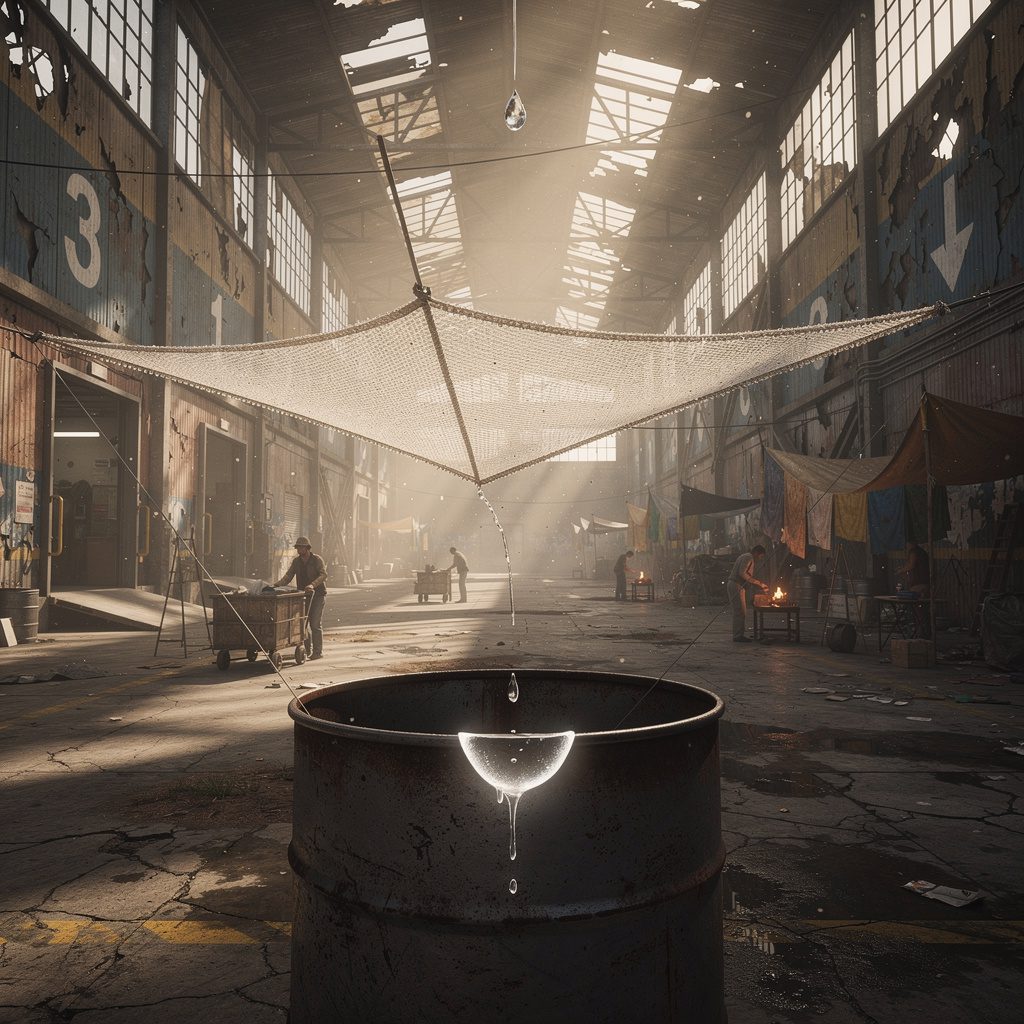
She thought about the water collector. The one with the condensation pattern she had noticed that morning. The crescent, the thumbprint smear, the three suspended drops. She had noticed it because it was unusual. She noticed it, she now realised, every morning. She had assumed it was simply a feature of the drum’s surface, the way water always found the same channels. But the drops should have fallen. They never fell.
She left the archive.
The collector stood in the eastern bay, a cylindrical drum four metres tall connected to the settlement’s primary cistern by a network of pipes that had been laid by the founding generation and repaired so many times the original material was now a minority. It gathered atmospheric moisture through a mesh of hygroscopic fabric stretched over a frame above it. In the dry season, it was the settlement’s second most important water source after the solar-still array.
Folake stood in front of it and looked at the condensation. Crescent. Thumbprint. Three drops.
She put her hand on the drum.
The metal was warm. Not sun-warm — the eastern bay was still in shadow. Warm the way something is warm when it has been running.
She found the access panel on the drum’s lower third. Standard maintenance hatch, sealed with a quarter-turn latch. She opened it.
Inside, nestled among the legitimate filtration components — the ceramic membranes, the UV element, the flow regulator — was something that did not belong. A secondary device, compact and deliberate, attached to the outflow pipe with a bracket that had been painted to match. It had a small display, currently dark, and what appeared to be a wireless transmitter.
Her hands were steady now. Steadier than they had any right to be.
She had seen devices like this in salvaged technical documents. Dosing units. Originally designed for agricultural water treatment — mineral supplementation, pH adjustment. Repurposed, they could introduce almost anything into a water supply in quantities too small to taste, too diffuse to produce immediate symptoms. Something accumulative. Something that worked slowly.
She thought about the dreams. The same dream, the door already warm. How long had she been having it? Months. She had assumed stress. She had assumed grief — her mother had died two winters ago, and grief has long roots.
She thought about the memory lapses she had not admitted to anyone. Small ones. Arriving somewhere and not remembering the walk. Logging items in the archive she later found she had logged before, differently, as though she were cataloguing the same reality from two slightly different positions.
A loop that resets the moment you learn the truth.
Not metaphorical. Pharmacological. Something in the water that interfered with memory consolidation — not erasing it entirely, but preventing the kind of deep encoding that turns experience into permanent knowledge. You could discover something. You could understand it completely. And then, over the following days, the understanding would simply fail to stick. You would be returned, gently, to not knowing.
She pulled the device free from its bracket. It came away with a sound like a held breath releasing.
That was when the door at the far end of the eastern bay opened.
The man who came through it was not rushing. He walked with the deliberate pace of someone who had calculated that running would make things worse. She recognised him — Adnan Homsi, who ran the settlement’s maintenance crews, who had been here since before Folake arrived, who was trusted and competent and had a laugh that filled whatever room he was in.
He stopped ten metres away. He looked at the device in her hands. He looked at her face.
“How far did you get this time?” he said. His voice was tired. Not threatening. Tired in the way of someone carrying something for too long.
“Far enough,” she said.

 WhatsApp
 Telegram
 Email







Categories
- AI & Technology
- Contemporary
- Corporate Control
- Creepypasta
- Crime Thriller
- Cyberpunk
- Dark Fantasy
- Enemies to Lovers
- Fairy Tale Retelling
- Fantasy
- First Contact
- Forbidden
- Genetic/Body Horror
- High Fantasy
- Monster Hunter
- Mythic/Folklore
- Paranormal
- Portal/Otherworld
- Post-Apo
- Post-Collapse Society
- Psychological Thriller
- Romances
- SCI-FI
- Second Chance
- Slow Burn
- Space Combat
- Spacepunk
- Surveillance State
- Survival Thriller
- Thrillers
- Time Travel
- Treasure Hunter
- Urban Fantasy
- Witchcraft/Curses
Tags
10min stories atmospheric atmospheric fantasy atmospheric fiction contemporary romance Creepy creepypasta crime thriller dark fantasy debt dystopia emotional fiction enemies to lovers ensemble cast epistolary fantasy first person forbidden romance found text framed narrative high fantasy love story magic Memory mystery Paranormal psychological horror psychological thriller romance sci-fi second chance second chance romance short fiction short story slow burn space station speculative fiction supernatural Survival survival thriller suspense thriller travel romance witchcraft workplace romance
Leave a Reply