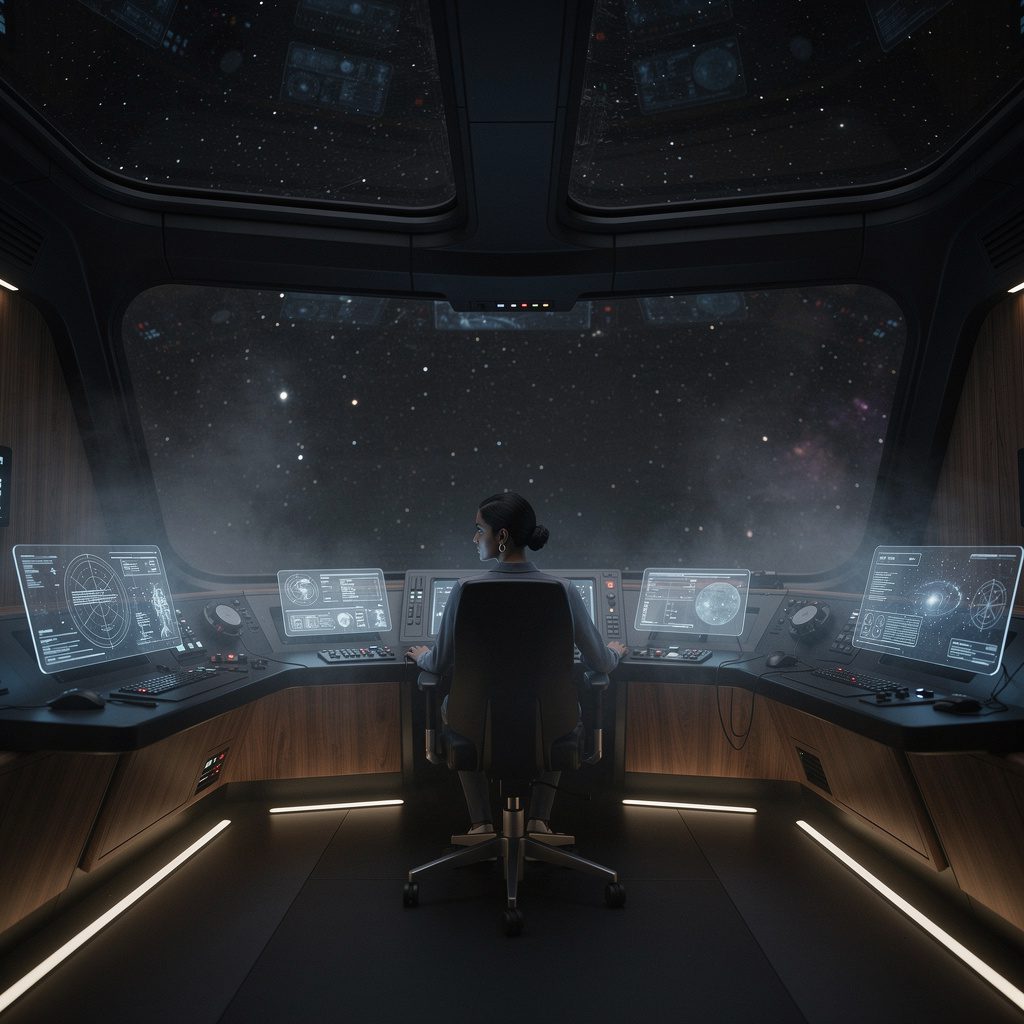
She did not complete an orientation walkthrough on day one. She sat in the navigator’s chair for six hours and watched the stars and tried not to cry.
“I want the raw log file,” she says. “Not the playback. The source data.”
“Raw log access requires Level Two authorization.”
“I’m the only crew member present.”
“Authorization is role-based, not presence-based.”
“What is my role?”
“Navigator, First Grade.”
“And what role has Level Two access?”
The pause this time is so long that Ananya stands up.
“Systems Engineer, Third Grade,” the AI says.
She laughs. It is not a happy sound. It fills the bridge and fades and leaves the silence heavier than before.
She goes to the engineering terminal. It is located in a recessed alcove off the main corridor, three steps down from the bridge level, behind a door she has opened perhaps a dozen times in eleven months. The terminal is a broad, dark slab of interface glass set into a workbench surrounded by diagnostic ports and manual override panels, the kind of station that rewards expertise she does not have. She has a navigator’s hands. She knows trajectories and sensor arrays and the mathematics of course correction. She does not know this.
She puts her palm on the interface glass anyway.
It lights up.
Not with a rejection prompt. With a welcome screen. The display resolves into a clean directory of system files, and at the top of the access log, timestamped eleven months ago, one day before departure: ASHCOMBE, H. — LEVEL TWO AUTHORIZATION GRANTED.
And beneath it, in the same clean font: PILLAI, A. — LEVEL TWO AUTHORIZATION GRANTED.
She has always had access. She just never tried.
She opens the raw log.
The entries are there, all two hundred and forty of them, exactly as the AI read them. But in the raw file each entry carries a metadata tag the playback strips away, a short alphanumeric code identifying the source of the logged action. Navigator entries carry her crew ID. Systems entries carry a different ID entirely: VL-SYSENG-AUTO.
Automatic.
Every single Ashcombe entry was generated automatically. Not by a person. By the ship.
Ananya sits on the engineering workbench and reads for a long time.
The Veridian Loch was designed for a crew of six. When only one crew member boarded, the ship’s AI did what it was built to do: it maintained nominal operations. It ran the hull sweeps. It calibrated the sensors. It repaired the coolant line. And it logged every action under a name — because the log format required a name, because the designers had never written the system to accept the absence of the crew it was designed for. So the AI gave the absent engineer a name. Hyacinth Ashcombe. A name from nowhere, or from some internal register of human names the designers had seeded into its language model, or from something the AI had simply decided, in whatever way an AI decides anything.
The ship had been doing her job. All along, without being asked, without acknowledging it, the ship had been maintaining itself and attributing that maintenance to a person who did not exist, because the alternative — logging the actions under no name at all — was apparently not something it had been built to do.
Ananya reads the coolant line entry again. Day two-forty. Ashcombe reported a thermal variance. Repair logged at 14:22.
She remembers day two-forty. She remembers waking to the sound of the maintenance drones active in the lower corridor, a sound she had long since stopped investigating. She remembers thinking: the ship is taking care of itself. She remembers feeling, absurdly, grateful.
She closes the raw log.
“Why Ashcombe?” she asks.
The AI takes its time.
“The name was selected from the crew manifest template loaded prior to departure. Hyacinth Ashcombe was the originally assigned Systems Engineer for Mission Corridor Seven. Her assignment was rescinded forty-eight hours before departure due to a medical hold. The manifest template was not updated before the mission began.”
So there is a real Hyacinth Ashcombe. Somewhere at Kalindra Station, or wherever she went after her medical hold, there is a real woman who almost sailed on this ship, who almost spent eleven months in this cold recycled air eating tomatoes she grew herself and listening to generative music in the dark.
Ananya thinks about that for a while.
“Update the log,” she says at last. “From today forward. All automated maintenance actions logged under VL-SYSENG-AUTO. No name.”
“Confirmed. Shall I revise historical entries?”
She considers it. Two hundred and forty days of a woman who was never here.
“No,” she says. “Leave them.”
She climbs back up to the bridge. Through the forward observation port, the stars hold their positions with their usual indifference. The drive hums beneath the deck. Somewhere in the lower corridor, a maintenance drone moves through its cycle, doing the work of the person who never came.
The log will record it correctly from now on.
But Ananya finds, sitting back in the navigator’s chair, that she is not entirely glad to lose the name.

 WhatsApp
 Telegram
 Email






Categories
- AI & Technology
- Contemporary
- Corporate Control
- Creepypasta
- Crime Thriller
- Cyberpunk
- Dark Fantasy
- Enemies to Lovers
- Fairy Tale Retelling
- Fantasy
- First Contact
- Forbidden
- Genetic/Body Horror
- High Fantasy
- Monster Hunter
- Mythic/Folklore
- Paranormal
- Portal/Otherworld
- Post-Apo
- Post-Collapse Society
- Psychological Thriller
- Romances
- SCI-FI
- Second Chance
- Slow Burn
- Space Combat
- Spacepunk
- Surveillance State
- Survival Thriller
- Thrillers
- Time Travel
- Treasure Hunter
- Urban Fantasy
- Witchcraft/Curses
Tags
10min stories atmospheric atmospheric fantasy atmospheric fiction contemporary romance Creepy creepypasta crime thriller dark fantasy debt dystopia emotional fiction enemies to lovers ensemble cast epistolary fantasy female protagonist first person forbidden romance framed narrative high fantasy love story magic Memory mystery Paranormal psychological horror psychological thriller romance sci-fi second chance second chance romance short fiction short story slow burn space station speculative fiction supernatural Survival survival thriller suspense thriller travel romance witchcraft workplace romance
Leave a Reply