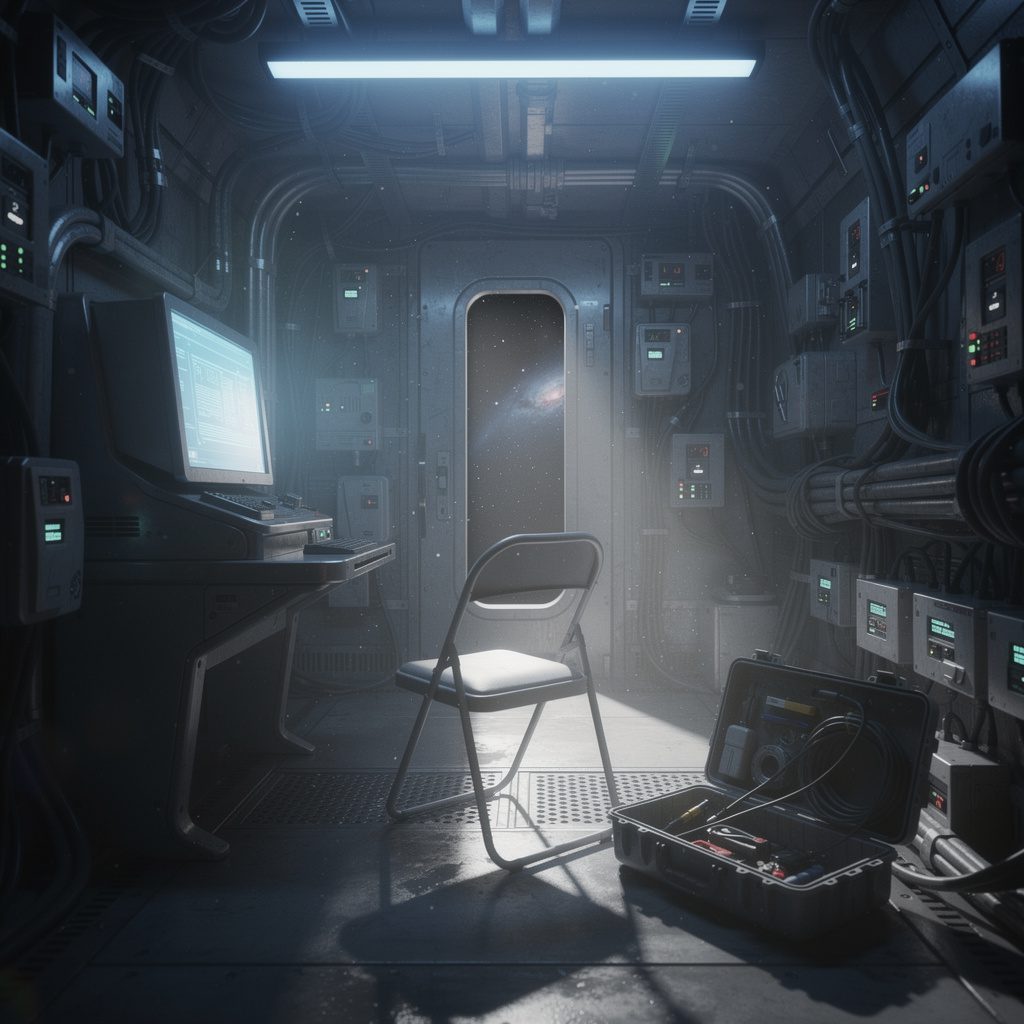
The voice was mine. I do not mean it sounded like me, or that it was a convincing imitation. I mean it was my voice in the way that a mirror is your face — the exact resonance, the specific way I flatten my vowels, the pause I always leave before a sentence I am not sure how to finish. The recordings were mundane. Observations about the cargo hold humidity. A note about a card game with Brecht that I had apparently lost. A short, almost tender entry about watching the mining platforms from the observation port at 0300 hours, when the rest of the crew was asleep, and how the lights on the platforms looked like a second set of stars below the real ones. I had never been to the observation port. I had never played cards with anyone named Brecht. But I felt, listening, the specific exhaustion and quiet pleasure in those words, and I recognized it the way you recognize your own handwriting even when you cannot remember writing the note.
I was still sitting there when the records room door opened.
She was tall, with close-cropped silver hair and the particular stillness of someone who has spent a long time in low-gravity environments, where every movement must be deliberate or you drift. Her eyes were pale grey and her left arm from the elbow down was a prosthetic — not the sleek cosmetic kind, but a working model, matte black with articulated finger joints and a faint blue charge indicator strip along the forearm. She wore a Nuno Angelopoulos contractor badge, which told me nothing, because those badges are sold in bulk at the parts markets on Level 30. She looked at my screen and then at me with an expression I could not read.
“You found the shadow record,” she said. Not a question.
I asked her who she was. She told me her name was Aliyah Winters, and that she was the person who had built the shadow record. She sat down on the floor — there was only one chair — and she explained it to me with the flat efficiency of someone who has explained a complicated thing too many times and has stopped caring whether the listener is impressed.
The shadow record was a proof-of-life insurance mechanism, she said. Illegal, yes, but elegant. Someone — she did not name them, and I did not push — had needed a real, auditable identity to ghost-crew a vessel for fourteen months. Not to actually be there, but to exist in the record as though they had been, with biometrics robust enough to survive a Tier-4 compliance audit. They had purchased my neural mesh signature from a broker who had purchased it from a clinic I had visited three years ago for a routine firmware update. The clinic had sold patient data. The broker had sold it on. The signature had been embedded into SERIN as a passenger layer, a ghost that rode the ship’s records without ever boarding, eating, sleeping, or breathing its recycled air.
The reason it mattered — the reason she was here now, in this closet with me — was that the insurance policy attached to the shadow record had paid out six weeks ago. The Perihelion Sable had filed a partial crew loss claim during a docking incident at the Lagrange platforms. Vasco Karras, Crew Member Seven, was listed among the missing. Which meant that somewhere in the financial architecture of Nuno Angelopoulos Logistics, there was now a death benefit, a missing-person settlement, and a legal record of my death, all of it clean and certified and signed off by SERIN’s own timestamped logs.
I was, on paper, a dead man.
Aliyah Winters had not come to threaten me. She had come, she said, because the broker who had sold my data had been arrested two days ago on an unrelated charge, and was cooperating with corporate investigators, and my name — my real name, my living name — would surface within a week. She had come to give me the burner address of a data-rights lawyer she trusted, and to tell me that the shadow record could be unwound if I moved quickly, that the legal framework existed, that it had been done before. She handed me a chip the size of a fingernail and stood up and left, and I heard her footsteps in the corridor for a moment and then I did not.

 WhatsApp
 Telegram
 Email






Categories
- AI & Technology
- Contemporary
- Corporate Control
- Creepypasta
- Crime Thriller
- Cyberpunk
- Dark Fantasy
- Enemies to Lovers
- Fairy Tale Retelling
- Fantasy
- First Contact
- Forbidden
- Genetic/Body Horror
- High Fantasy
- Monster Hunter
- Mythic/Folklore
- Paranormal
- Portal/Otherworld
- Post-Apo
- Post-Collapse Society
- Psychological Thriller
- Romances
- SCI-FI
- Second Chance
- Slow Burn
- Space Combat
- Spacepunk
- Surveillance State
- Survival Thriller
- Thrillers
- Time Travel
- Treasure Hunter
- Urban Fantasy
- Witchcraft/Curses
Tags
10min stories atmospheric atmospheric fantasy atmospheric fiction contemporary romance Creepy creepypasta crime thriller dark fantasy debt dystopia emotional fiction enemies to lovers ensemble cast epistolary fantasy female protagonist first person forbidden romance framed narrative high fantasy love story magic Memory mystery Paranormal psychological horror psychological thriller romance sci-fi second chance second chance romance short fiction short story slow burn space station speculative fiction supernatural Survival survival thriller suspense thriller travel romance witchcraft workplace romance
Leave a Reply