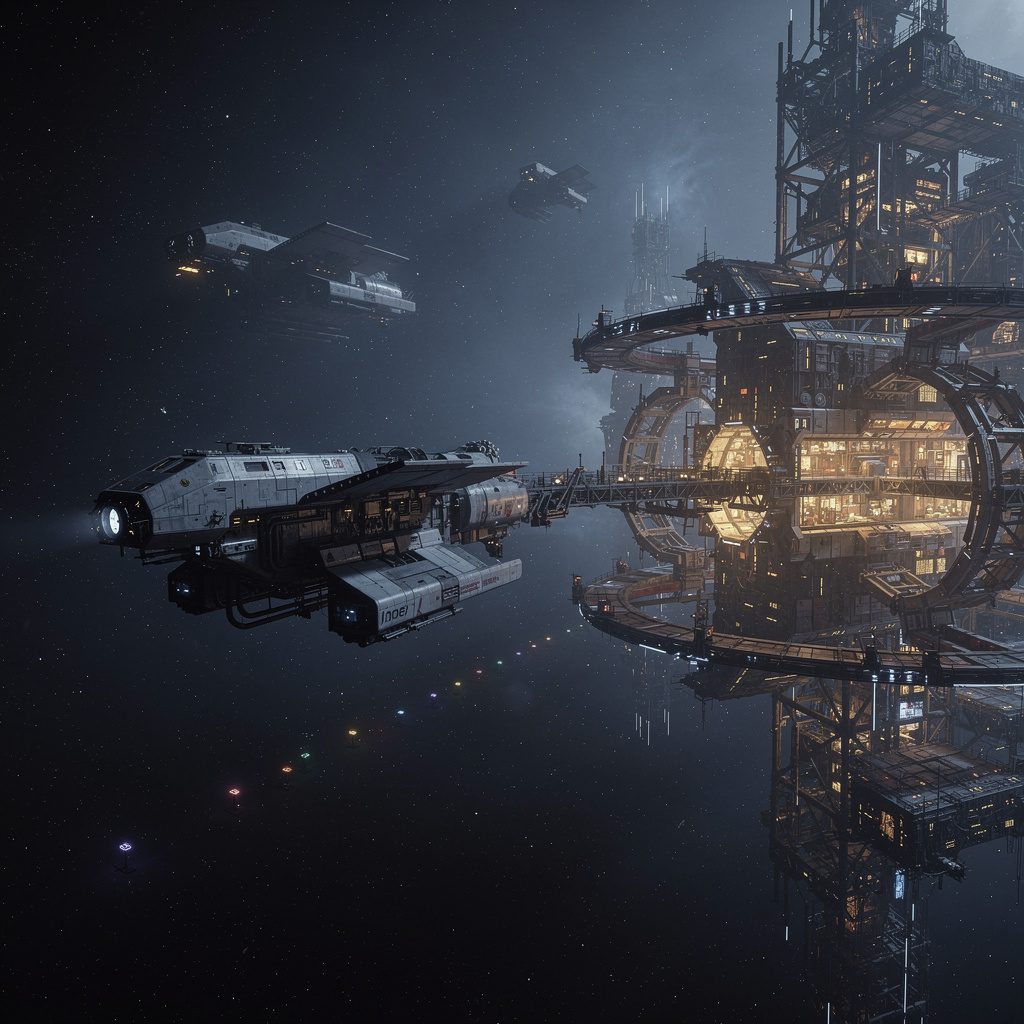
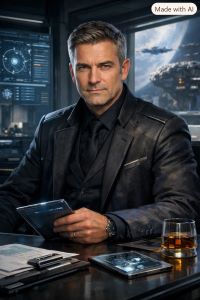
He looked at me for a moment — not long, but long enough. “Helios-Kaur executive compliance. The relay station at Jura-9. And one other party, I believe, for independent verification.”
“Which party?”
He smiled. “Above my clearance level.”
I left him there.
Back at my station, I pulled the “Ordinal Drift’s” own sensor logs — not the navigation data, the passive EM sweeps we’d been running since departure. Standard practice on any approach to a flagged site. The data was dense and dry, the kind of readout that looks like noise until you know what the noise should look like.
It didn’t look right.
The electromagnetic signature around Vethara’s orbital approach corridor showed three anomalous mass readings, each one consistent with a mid-to-heavy class vessel running minimal power output. Cold-running. Waiting.
Not Helios-Kaur vessels. The transponder profiles were wrong — or rather, they were absent. Clean absence, not signal failure. Deliberate.
I notified the ship’s captain, a compact, precise woman named Soledad Gallardo who had the particular stillness of someone who processes danger in real time without showing it on her face. She looked at my readout for exactly four seconds — I was counting again — and then she said, “Battle stations. Quiet.”
The ship changed around me without a sound. Corridor lights shifted to amber. Crew moved to stations without running. The gun-rail arrays powered up in increments, drawing energy slowly enough that the power signature wouldn’t spike on an external sweep. Gallardo knew her ship.
Then Bautista appeared at the bridge threshold.
“Captain,” he said, “I need to advise you to hold your current heading and stand down any tactical preparation.”
Gallardo didn’t look at him. “On whose authority?”
“Helios-Kaur executive compliance. The situation at Vethara is — being managed.”
I understood it then. The whole structure of it, the way you understand a balance sheet when the final number finally resolves. The three cold vessels in the approach corridor weren’t a threat to Helios-Kaur. They were a Helios-Kaur asset. A rival firm — or a Helios-Kaur subsidiary operating at arm’s length, which amounted to the same thing — had moved on Vethara’s ore supply. Nineteen thousand people on that station, and somewhere above the clearance level of everyone in this room, someone had decided the extraction contract was worth more than the extraction workers.
Sofia Ferreira’s voice came back to me. Calm. We are proceeding as directed.
She hadn’t been warning us. She’d been telling us it was already done.
“Captain Gallardo,” I said, and I kept my voice level, “the passive sweep shows three unregistered vessels in cold-run configuration at Vethara approach. Under Colonial Resource Authority emergency protocol, that constitutes an unresolved threat to a registered colonial workforce. Your legal obligation is to proceed and report.”
Bautista started to speak.
“My legal obligation,” Gallardo said quietly, cutting him off without raising her voice at all, “is exactly that.”
She opened the ship-wide channel. “All stations. Full power. We are going in.”
What followed was not a battle in the way that word suggests chaos and noise. It was a negotiation conducted in the language of gun-rail trajectories and blocking formations. The “Ordinal Drift” came in hot and loud, broadcasting on every Colonial Resource Authority emergency frequency simultaneously, lighting up the approach corridor like a signal flare. The three cold vessels — caught between the exposure of engagement and the legal liability of being identified at a flagged colonial site by a CRA-credentialed auditor — made the only rational choice available to corporate assets.
They withdrew. Slow, deliberate, without a single shot fired. The math had changed.
Bautista was escorted to a secure cabin for the duration. He didn’t resist. He understood math too.
We docked at Vethara six hours later.
Sofia Ferreira met us at the docking collar. She was a solid, weathered woman with close-cropped gray hair and the particular exhaustion of someone who had been holding a station together through sheer organizational will. She looked at my CRA credentials, then at the ship behind me, and something in her face that had been very tightly held came quietly undone.
She didn’t say anything for a moment.
Then: “We sent seven transmissions.”
“I know,” I said. “I listened to the last one.”

 WhatsApp
 Telegram
 Email






Categories
- AI & Technology
- Contemporary
- Corporate Control
- Creepypasta
- Crime Thriller
- Cyberpunk
- Dark Fantasy
- Enemies to Lovers
- Fairy Tale Retelling
- Fantasy
- First Contact
- Forbidden
- Genetic/Body Horror
- High Fantasy
- Monster Hunter
- Mythic/Folklore
- Paranormal
- Portal/Otherworld
- Post-Apo
- Post-Collapse Society
- Psychological Thriller
- Romances
- SCI-FI
- Second Chance
- Slow Burn
- Space Combat
- Spacepunk
- Surveillance State
- Survival Thriller
- Thrillers
- Time Travel
- Treasure Hunter
- Urban Fantasy
- Witchcraft/Curses
Tags
10min stories atmospheric atmospheric fantasy atmospheric fiction contemporary romance Creepy creepypasta crime thriller dark fantasy debt dystopia emotional fiction enemies to lovers ensemble cast epistolary fantasy female protagonist first person forbidden romance framed narrative high fantasy love story magic Memory mystery Paranormal psychological horror psychological thriller romance sci-fi second chance second chance romance short fiction short story slow burn space station speculative fiction supernatural Survival survival thriller suspense thriller travel romance witchcraft workplace romance
Leave a Reply