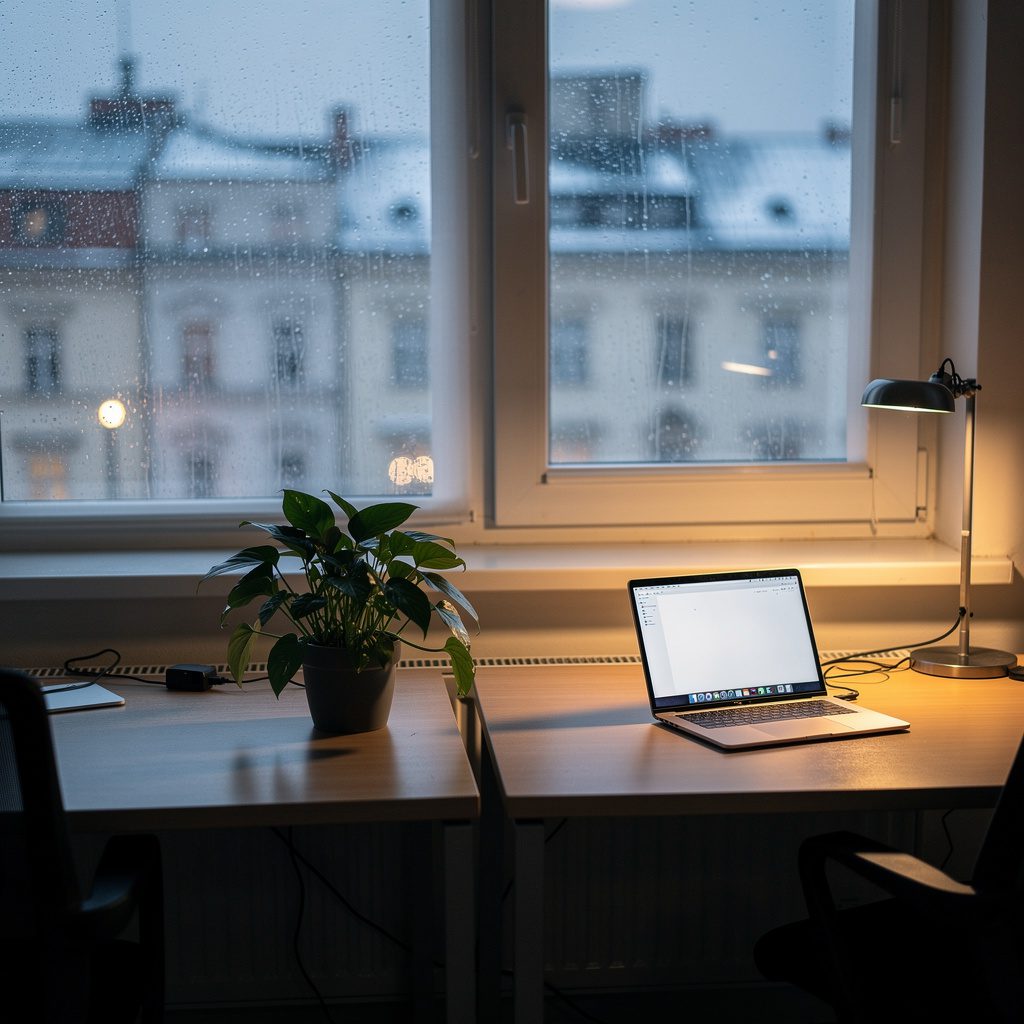
November arrived and the days shortened. The office lights came on earlier and the windows fogged with condensation by four o’clock. People started wearing scarves at their desks. Someone brought in a box of vánoční cukroví three weeks too early and nobody complained.
Filip and I had developed, without discussing it, a kind of routine. He arrived seven minutes after me every morning. I always had my coffee before he got there; he always had his within ten minutes of sitting down. We didn’t speak much, but the silence between us had changed texture — it was no longer the silence of two people ignoring each other. It was the silence of two people who were paying attention.
One evening I stayed late to finish a report. The floor emptied gradually around me — coats pulled on, goodnights exchanged, the elevator dinging in the distance. I assumed Filip had gone. I was so sure of it that when I finally looked up, stretching my neck, and found him still there — jacket off, sleeves pushed up, frowning at something on his screen — I made a small, involuntary sound.
He looked over.
“Sorry,” I said, which was ridiculous, because I hadn’t done anything.
“Don’t be.” He leaned back in his chair. “I thought you’d left.”
“I thought you had.”
A pause. Outside, Prague was dark and cold and full of its own business. The radiator had stopped clanging for once. The office felt very quiet.
“The Ostrava proposal,” he said, nodding at his screen. “I keep thinking I’ve got it and then I read it back and it’s wrong somewhere.”
I hesitated for only a moment. “What kind of wrong?”
He turned his laptop slightly toward me. I leaned in — closer than I normally would have, because the floor was empty and the hour was late and something in the room had shifted — and read the paragraph he was pointing at.
He was right. It was wrong. And I knew exactly why, because I had made the same mistake on a similar brief eighteen months ago and had spent a week untangling it.
I told him. I didn’t plan to; it simply came out, the explanation, the fix, the specific logic of it. He listened without interrupting, which was rarer than it should have been. When I finished, he was quiet for a moment, and then he said, “You wrote the Brno counter-proposal. In March. Two years ago.”
It wasn’t a question.
“Yes,” I said.
“I read it four times,” he said. “I couldn’t figure out how you’d anticipated the third objection.”
I looked at him. He looked at me. The distance between us was small — the width of a shared desk, a turned laptop, an evening that had gone longer than either of us intended.
“I guessed,” I said, which was the truth.
He laughed. It was a real laugh, unguarded, and it changed his face entirely.
I gathered my things slowly after that. He did the same. We rode the elevator down together without speaking, and at the building’s front door he held it open, and I stepped out into the cold night air of Wenceslas Square, and he stepped out beside me, and for a moment we both just stood there, breathing visible breath into the dark.
“Goodnight, Hana,” he said.
“Goodnight, Filip.”
I walked to the tram stop. I didn’t look back. But I was aware, with a certainty I couldn’t quite explain, that he stood there a moment longer before he turned and walked the other way.
The next morning he arrived seven minutes after me, as always. He set his coffee down. He opened his laptop. And then, without a word, he moved Gerald back from the windowsill to the corner of his desk — the corner closest to mine — and positioned him carefully so the plant caught the thin winter light coming through the glass.
I looked at Gerald. I looked at Filip. He was already reading something, his thumb tapping its quiet rhythm against his knee.
I turned back to my screen.
But something in the room felt different — warmer, maybe, or simply more settled — the way a space feels when something that has been held at a careful distance is finally allowed, without ceremony or announcement, to simply be close.

 WhatsApp
 Telegram
 Email







Categories
- AI & Technology
- Contemporary
- Corporate Control
- Creepypasta
- Crime Thriller
- Cyberpunk
- Dark Fantasy
- Enemies to Lovers
- Fairy Tale Retelling
- Fantasy
- First Contact
- Forbidden
- Genetic/Body Horror
- High Fantasy
- Monster Hunter
- Mythic/Folklore
- Paranormal
- Portal/Otherworld
- Post-Apo
- Post-Collapse Society
- Psychological Thriller
- Romances
- SCI-FI
- Second Chance
- Slow Burn
- Space Combat
- Spacepunk
- Surveillance State
- Survival Thriller
- Thrillers
- Time Travel
- Treasure Hunter
- Urban Fantasy
- Witchcraft/Curses
Tags
10min stories atmospheric atmospheric fantasy atmospheric fiction contemporary romance Creepy creepypasta crime thriller dark fantasy debt dystopia emotional fiction enemies to lovers ensemble cast epistolary fantasy female protagonist first person forbidden romance framed narrative high fantasy love story magic Memory mystery Paranormal psychological horror psychological thriller romance sci-fi second chance second chance romance short fiction short story slow burn space station speculative fiction supernatural Survival survival thriller suspense thriller travel romance witchcraft workplace romance
Leave a Reply