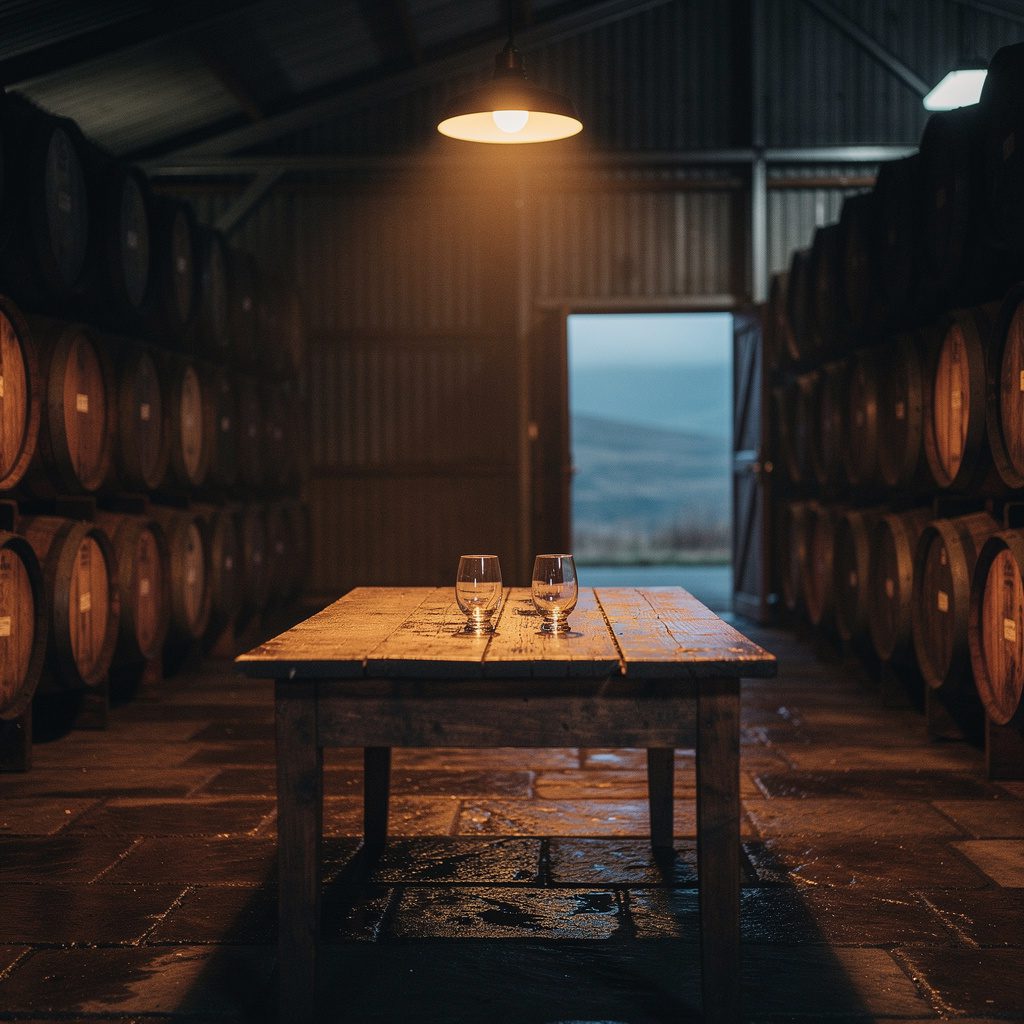
The barrels had been resting for twelve years.
Simone Garvey liked that about the distillery. She liked that things here were allowed to sit undisturbed, sealed against the world, changing slowly in the dark. She had been the head cooper for three years now, and she moved through the warehouse with the particular ease of someone who had finally, carefully, built a life that fit.
She ran her palm along a cask near the far wall. The wood was cool and slightly damp, the air around it thick with the ghost of peat and vanilla. Outside, the Highland wind was pressing against the corrugated roof, making it tick and groan. It was a Tuesday in late October, and the distillery was quiet between tours. Just the barrels. Just the low amber light from the single bulb above the tasting table. Just Simone, who was, by all outward appearances, perfectly fine.
She had been perfectly fine for two years.
She told herself that again, the way she sometimes did when the distillery was this quiet and the air smelled like this — like earth and time — and her mind went places she had trained it not to go.
The door at the far end of the warehouse opened.
She assumed it was Callum, the afternoon guide, coming to set up for the four o’clock tasting. She didn’t look up immediately. She was marking a cask with chalk, and she finished the number before she turned.
It wasn’t Callum.
Massimo Ricci stood in the doorway with his coat still damp from outside, his dark hair pushed back from his forehead the way it always was when he’d been walking in wind. He looked the same. He looked completely, unfairly the same. And he was holding a letter — her letter, the one she’d sent to his old address in Edinburgh eight months ago, the one she’d convinced herself had never arrived.
The chalk snapped in her hand.
—
Massimo had rehearsed this.
Not the words exactly, but the shape of it — the measured, reasonable shape of a conversation between two adults who had once loved each other and had, through a failure of timing and courage, stopped. He had rehearsed the calm. He had not rehearsed the way the warehouse would smell, or the way the light would catch the side of her face, or the way she would look at him for exactly half a second before her expression closed like a shutter.
He’d found the letter three weeks ago, forwarded twice, the envelope soft at the corners. He’d read it standing in a car park in Inverness and then sat in his car for twenty minutes without starting the engine.
She’d written it the previous February. Eight months ago. She’d written that she thought about him sometimes, and that she wasn’t saying that to open anything back up, only because it felt dishonest not to say it after everything. She’d written that she hoped he was somewhere warm.
He’d driven here from Inverness without fully deciding to.
“Simone,” he said. His voice came out steadier than he expected.
She set the broken chalk on the cask. Slowly. Deliberately. “You weren’t supposed to get that.”
“I know.”
“The address was wrong. I sent it to the flat in Stockbridge.”
“I know that too.” He held the letter slightly toward her, not as an accusation, just as evidence of the thing that had happened. “It found me anyway.”
She looked at it for a moment, then looked away, toward the long row of barrels receding into the dark. He watched her jaw tighten and then release. He knew that movement. He had spent four years learning her face.
—
The worst of it, Simone thought, was that she wasn’t angry.
She had a right to be angry. He had come here without warning, on a Tuesday, in the middle of her workday, holding a letter she’d written during a February that had been long and grey and weak-willed. She had a right to be composed and a little cold and to ask him to leave.
Instead she felt the two years of careful distance dissolving at the edges, the way the peat smoke in this room clung to everything — quietly, without asking permission.
She moved to the tasting table and poured two measures of the twelve-year single malt without asking if he wanted one. Old habit. He stepped closer and accepted the glass without a word.

 WhatsApp
 Telegram
 Email







Categories
- AI & Technology
- Contemporary
- Corporate Control
- Creepypasta
- Crime Thriller
- Cyberpunk
- Dark Fantasy
- Enemies to Lovers
- Fairy Tale Retelling
- Fantasy
- First Contact
- Forbidden
- Genetic/Body Horror
- High Fantasy
- Monster Hunter
- Mythic/Folklore
- Paranormal
- Portal/Otherworld
- Post-Apo
- Post-Collapse Society
- Psychological Thriller
- Romances
- SCI-FI
- Second Chance
- Slow Burn
- Space Combat
- Spacepunk
- Surveillance State
- Survival Thriller
- Thrillers
- Time Travel
- Treasure Hunter
- Urban Fantasy
- Witchcraft/Curses
Tags
10min stories atmospheric atmospheric fantasy atmospheric fiction contemporary romance Creepy creepypasta crime thriller dark fantasy debt dystopia emotional fiction enemies to lovers ensemble cast epistolary fantasy female protagonist first person forbidden romance framed narrative high fantasy love story magic Memory mystery Paranormal psychological horror psychological thriller romance sci-fi second chance second chance romance short fiction short story slow burn space station speculative fiction supernatural Survival survival thriller suspense thriller travel romance witchcraft workplace romance
Leave a Reply