There was a particular smell to old paper that I had never been able to shake. Not the clean, library kind — the other kind. The kind that carries a room with it. A season. A version of yourself you thought you’d outgrown.
I noticed it the moment Torvald set the cardboard box on the café table, nudging aside my espresso with the casual carelessness of an older brother who has never once in his life asked permission.
“Maman found it in the attic,” he said, dropping into the chair across from me. “She wants you to go through it before the rehearsal dinner. Says she’s not hauling forty years of family sentiment back up those stairs.”
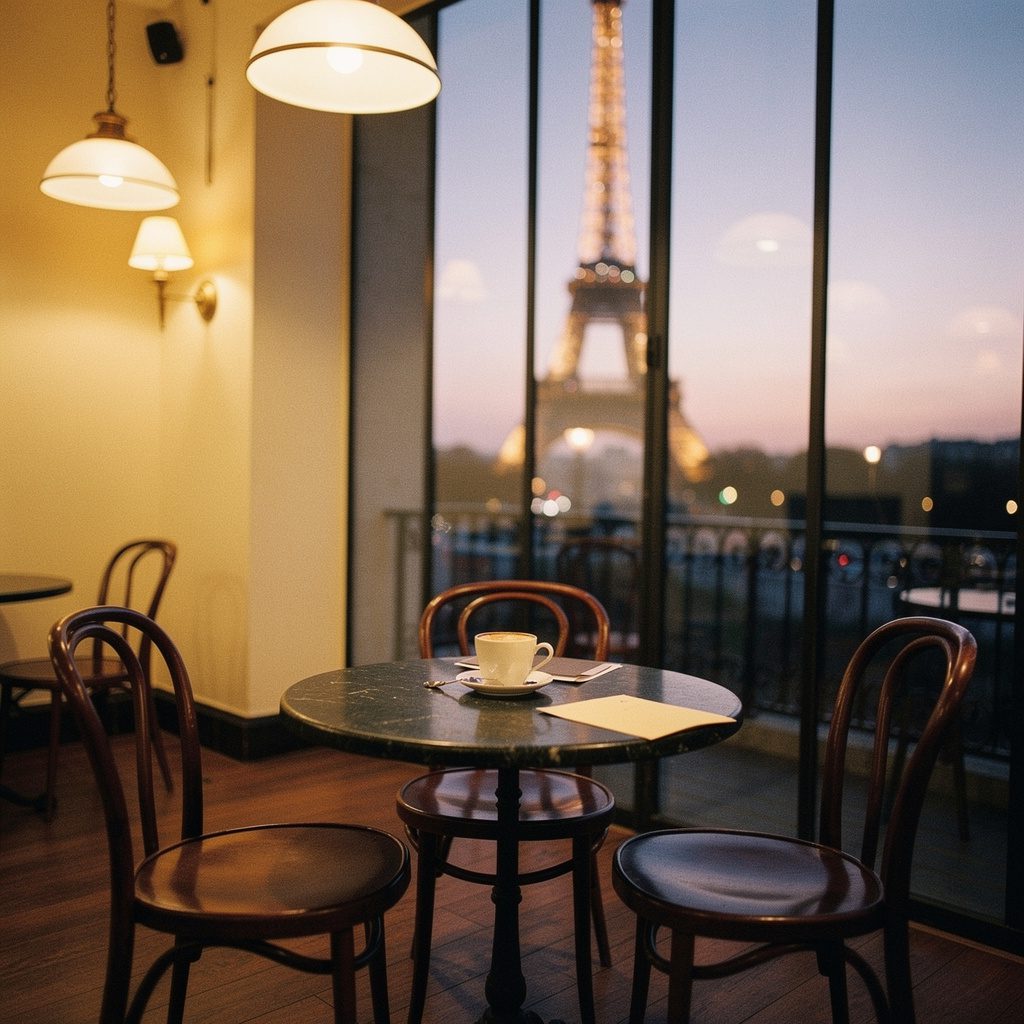
Outside the tall windows, Paris moved at its afternoon pace — tourists drifting toward the tower, pigeons negotiating the cobblestones, a woman in a yellow coat laughing at something on her phone. The café was warm and close, smelling of butter and dark roast, and I had been perfectly content here alone for the last twenty minutes before my brother arrived and complicated everything.
I looked at the box. The box looked back.
“Just look through it, Luca,” Torvald said, flagging down the server. “It won’t kill you.”
I wasn’t so sure.
Odalys Grant was getting married tomorrow. She was marrying a perfectly decent man named Philippe who worked in urban architecture and apparently made her laugh. I knew this because Torvald had told me, repeatedly, with the studied casualness of someone delivering news they believe might detonate something. Odalys, who had been my closest friend for four years and then — briefly, brilliantly, disastrously — something more. Odalys, who I had let walk out of my life in Lyon six years ago because I was twenty-six and afraid and too proud to say so.
She was the reason I was in Paris at all. She’d invited Torvald to the wedding, and Torvald had invited me, and I had said yes before I’d had time to construct a reasonable excuse not to.
I started going through the box.
Most of it was ordinary. Old photographs. A birthday card in my mother’s handwriting. A receipt from a restaurant in Marseille that made me smile briefly before I set it aside. Torvald was talking — something about the seating chart, something about Philippe’s mother being particular about flowers — and I was half-listening the way you do when a familiar voice fills a room.
Then my fingers found the envelope.
It was tucked between two photographs, slightly bent at one corner, unsealed. My name was on the front in handwriting I recognized immediately. The letters were careful, deliberate — the handwriting of someone who had started over more than once before committing ink to paper.
I went very still.
Torvald was still talking.
I pulled the letter out slowly, the way you handle something you already know is going to cost you.
It was dated six years ago. Three weeks after Lyon.
She had written it. She had written it and never sent it — or had sent it and it had gone astray, or had given it to someone for safekeeping and forgotten, or a hundred other explanations that didn’t matter at all because the words were here now, in my hands, in a café with the Eiffel Tower visible through the glass like some elaborate joke the universe was telling at my expense.
I read it.
The letter was not angry. That was the first thing that struck me — I had braced for anger, the kind I probably deserved. Instead it was quiet and careful and heartbreakingly honest. She wrote that she hadn’t understood, at first, why I’d pulled back. That she’d spent two weeks convincing herself she’d imagined the whole thing — imagined the night in Lyon, imagined the way I’d looked at her on the bridge, imagined the particular silence between us that had felt, to her, like the beginning of something. She wrote that she was not writing to ask me to change my mind. She was writing because she needed, for herself, to say that it had been real. That she had felt it. And that she hoped, wherever I ended up, I would let myself feel things fully. That I wouldn’t keep standing just outside the door of my own life.
That last line.
I folded the letter carefully. Set it on the table. Picked up my espresso, which had gone cold.
“You’ve gone completely white,” Torvald said.
“I’m fine.”
“You’re not fine. What’s in that — ” He leaned forward and saw the envelope. His expression shifted. Something guilty moved through it and was quickly packed away. “Ah,” he said.
“You knew it was in there.”
He had the grace not to lie. “Maman found it years ago. We didn’t know what to do with it. We thought — ” He paused. “We thought it wasn’t our place.”
“And now?”
He looked out the window. “Now she’s getting married tomorrow. So maybe it’s still not our place. But at least you’d know.”
I sat with that for a long moment. The café noise continued around us — the soft percussion of cups and conversation, someone laughing near the door, the hiss of the milk steamer. Paris, entirely indifferent to the small earthquake happening at our table.
I went to the rehearsal dinner that evening not knowing what I intended to do.
The venue was a courtyard restaurant three streets from the tower, strung with warm Edison bulbs, full of Philippe’s architecture colleagues and Odalys’s family and a handful of shared friends who greeted me with the particular enthusiasm of people who didn’t know they were watching something complicated unfold. Torvald stayed close, which I appreciated and resented in equal measure. Philippe’s sister, Justyna, appointed herself the evening’s social director and swept through the tables with a clipboard and a radiant, slightly terrifying energy that kept redirecting conversations before they could get too heavy.
I saw Odalys across the courtyard before she saw me.
She was wearing something dark blue, her hair loose, and she was listening to something Philippe’s mother was saying with the particular expression she had always worn when she was being patient and kind and privately counting to ten. That expression hadn’t changed. I felt the recognition of it somewhere behind my sternum.
She turned, and her eyes found mine the way eyes sometimes do across a crowded room — not searching, just arriving.
She went still for just a moment. Then she smiled. Not the social smile she’d been wearing a second before. The other one. The one that had always meant: you, specifically, here, specifically.
I crossed the courtyard.
“Luca,” she said.
“Odalys.”
We did the thing — the cheek kisses, the brief and slightly formal embrace — and then we stood there, and the party moved around us like water around two stones.
“I didn’t know if you’d come,” she said.
“Torvald is persuasive.”
She laughed softly. “He is.” A pause. “I’m glad you’re here.”
I wanted to say a hundred things. I had the letter folded in my jacket pocket — I’d brought it without deciding to, the way you carry something that belongs to someone else. The weight of it was specific and constant.
“I found something,” I said. “In a box my mother had in the attic. It belongs to you, I think. Or — it was meant for me, but it belongs to you.”
Her expression shifted. Something careful and old moved behind her eyes.
“Odalys.” Justyna appeared at her elbow like a very cheerful comet. “Philippe’s uncle wants a photograph, and he’s decided you’re the only one who can make him look dignified.”
Odalys glanced at her, then back at me. “One minute,” she told Justyna.
Justyna looked between us with the rapid assessment of someone who reads rooms for sport. “Two minutes,” she said, and withdrew with notable tact.
Odalys turned back to me fully.
I took the letter from my pocket and held it out. She looked at it for a long moment before she took it. She didn’t open it — she didn’t need to, I understood then. She knew exactly what it was.
“I wrote it,” she said quietly. “And then I couldn’t decide. So I gave it to Torvald’s wife to hold for me, and then I moved, and I suppose I just — left it behind.”
“You were right,” I said. “About Lyon. About all of it. I was standing outside the door.”
She was quiet for a moment. The Edison bulbs cast everything in amber. Somewhere behind us, Torvald was telling a story that was making three people laugh.
“I know,” she said. Simply. Without bitterness. “I think I always knew you’d figure it out eventually. I just didn’t know when.”
There was nothing to say to that which wouldn’t cost one of us something. So I didn’t say it.
She looked down at the letter in her hands, then tucked it into her small evening bag with a kind of finality that was also, somehow, a kind of tenderness. Like pressing a flower between book pages. Keeping it not because you need it anymore, but because it was once true.
“I’m happy, Luca,” she said. “I want you to know that.”
“I know,” I said. And I meant it.
Justyna reappeared, this time with Philippe’s uncle in tow, and Odalys was swept gently back into the current of her own evening. I watched her go. I felt Torvald materialize beside me with the quiet solidarity of someone who has been paying attention all night.
He handed me a fresh glass of wine. Said nothing.
Later, much later, when the party had thinned and the bulbs had dimmed and Philippe was dancing with his mother to something slow and old, I stood at the edge of the courtyard and looked up. The tower was lit against the dark sky, its iron lattice glowing, patient and enormous and entirely unbothered by the smallness of human hearts.
I thought about the smell of old paper. I understood it now — what it had been trying to tell me since the moment Torvald set that box on the table. Not grief. Not regret, exactly.
Just the particular ache of a feeling that had been true once, and still was, in its own finished way.
I turned my collar up against the night air and let the city hold me for a while.

 WhatsApp
 Telegram
 Email
Email





Leave a Reply