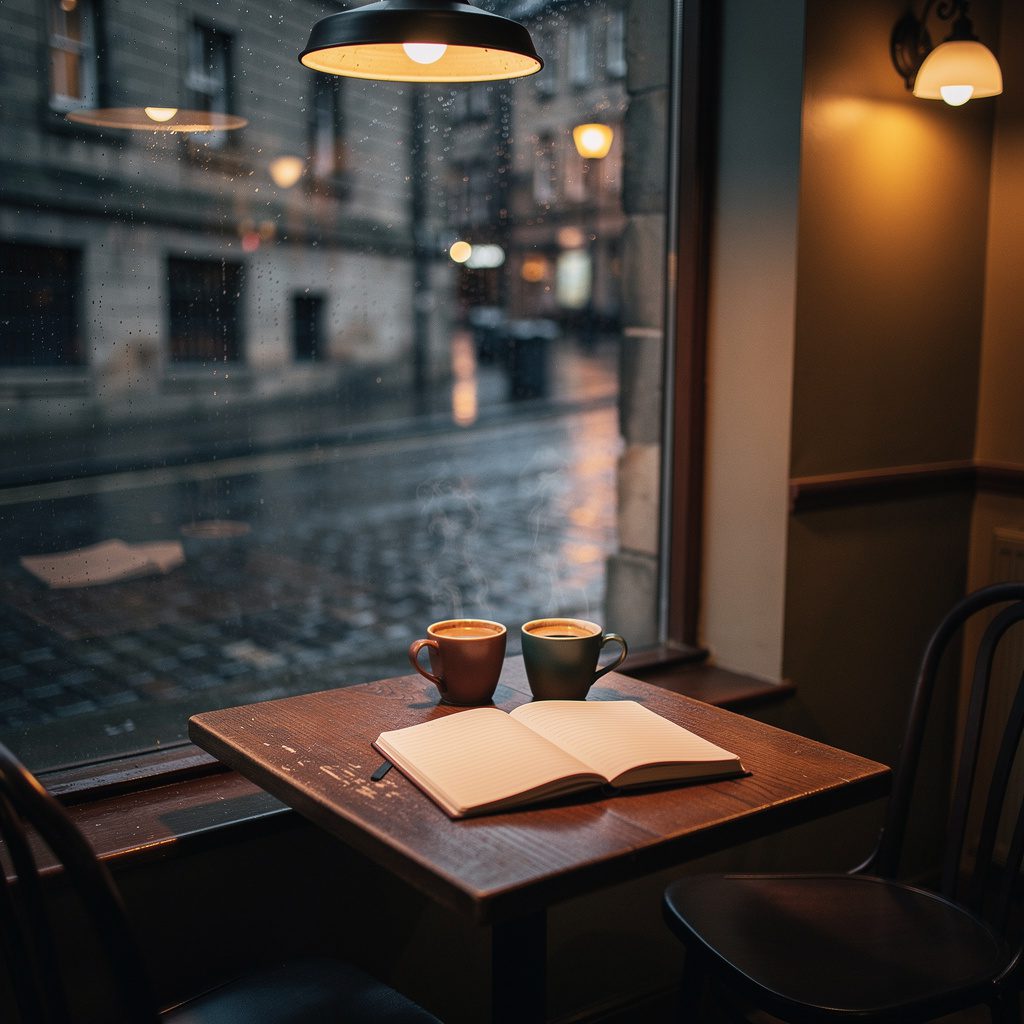
They worked in companionable silence for most of the morning. Occasionally one of them would say something — he asked what she was illustrating, she asked what the Georgian house had looked like before the fire that had damaged its east wing. The conversation came in small, comfortable waves, never forced, never rushed.
Nora realized, somewhere around her second flat white, that she had not thought about her careful distances once.
But then Daniel’s phone buzzed. He glanced at it, and something in his expression shifted — not dramatically, but enough. He set the phone face-down on the table.
“Sorry,” he said. “Ex-girlfriend. We’re still… working out the logistics of being in the same city.”
Nora nodded. She recognized that particular kind of tiredness in his voice. She knew what it felt like to be still untangling yourself from someone, to be technically free but not yet quite light.
She almost pulled back then. Almost rebuilt the fortress.
Instead she said, quietly: “I had one of those. Eighteen months ago. It takes longer than you think it will.”
Daniel looked at her — really looked, for the first time, in the way that means someone is actually seeing you rather than the surface of you.
“Does it get easier?”
“It gets quieter,” she said. “And then one day you realize the quiet is actually… fine. Better than fine.”
He was silent for a moment. Outside, the rain had softened to a fine mist, and the café windows had fogged at the edges, making the Grassmarket beyond look like a watercolor painting.
“I’m glad you took the table,” he said finally.
“You offered it,” she reminded him.
“I know. I’ve been trying to think of a reason to talk to you for two weeks.”
Nora felt warmth rise to her cheeks. She looked down at her sketchbook, and with a lurch of her stomach, realized the page was open to one of her unconscious drawings — his profile, his curling hair, the small crease between his brows.
She moved to close it. His hand — gently, briefly — touched the edge of the page.
“Is that… me?”
There was no good answer to that, so she told him the truth.
“I draw what I notice,” she said. “I can’t help it. It’s just how I see things.”
He studied the sketch for a long moment. Then he turned his own spiral notebook toward her, and she saw, tucked in the margins of his architectural drawings, a small repeated detail she hadn’t expected: the outline of a corner table, a lamp overhead, a figure bent over notebooks with her hair falling forward.
“I draw what I notice too,” he said quietly.
Nora laughed — a real laugh, the kind that comes from somewhere unguarded. And Daniel laughed with her, and the sound of it filled the warm, coffee-scented air of Brew & Stone like something long overdue.
They stayed until the afternoon light changed and the tour group had long since gone. When they finally packed up their notebooks and pulled on their coats, Daniel held the door open and the cold Edinburgh air rushed in, sharp with the smell of rain on old stone.
“Same time tomorrow?” he asked.
Nora looked at him — at his open expression, his lopsided smile, the spiral notebook tucked under his arm — and felt the last of her careful distances dissolve like sugar in something warm.
“I’ll save you the chair,” she said.
And she meant it in every way that mattered.

 WhatsApp
 Telegram
 Email







Categories
- AI & Technology
- Contemporary
- Corporate Control
- Creepypasta
- Crime Thriller
- Cyberpunk
- Dark Fantasy
- Enemies to Lovers
- Fairy Tale Retelling
- Fantasy
- First Contact
- Forbidden
- Genetic/Body Horror
- High Fantasy
- Monster Hunter
- Mythic/Folklore
- Paranormal
- Portal/Otherworld
- Post-Apo
- Post-Collapse Society
- Psychological Thriller
- Romances
- SCI-FI
- Second Chance
- Slow Burn
- Space Combat
- Spacepunk
- Surveillance State
- Survival Thriller
- Thrillers
- Time Travel
- Treasure Hunter
- Urban Fantasy
- Witchcraft/Curses
Tags
10min stories atmospheric atmospheric fantasy atmospheric fiction contemporary romance Creepy creepypasta crime thriller dark fantasy debt dystopia emotional fiction enemies to lovers ensemble cast epistolary fantasy female protagonist first person forbidden romance framed narrative high fantasy love story magic Memory mystery Paranormal psychological horror psychological thriller romance sci-fi second chance second chance romance short fiction short story slow burn space station speculative fiction supernatural Survival survival thriller suspense thriller travel romance witchcraft workplace romance
Leave a Reply