“Yes,” she said. “I did. I’m sorry.”
He was quiet for a moment. Outside, a light rain had begun against the windows.
“It doesn’t matter,” he said finally. “Clara and I — that was a long time ago. She moved to Dublin. We were better as friends, in the end.” He said it without bitterness, which she found she respected enormously.
“You write beautifully,” Nora said, before she could stop herself.
He looked at her again. Something in his expression shifted — softer, more open. “Thank you,” he said. “I wasn’t sure anyone would ever say that.”
“Because you never planned for anyone to read it.”
“No.” He almost smiled. “I didn’t.”
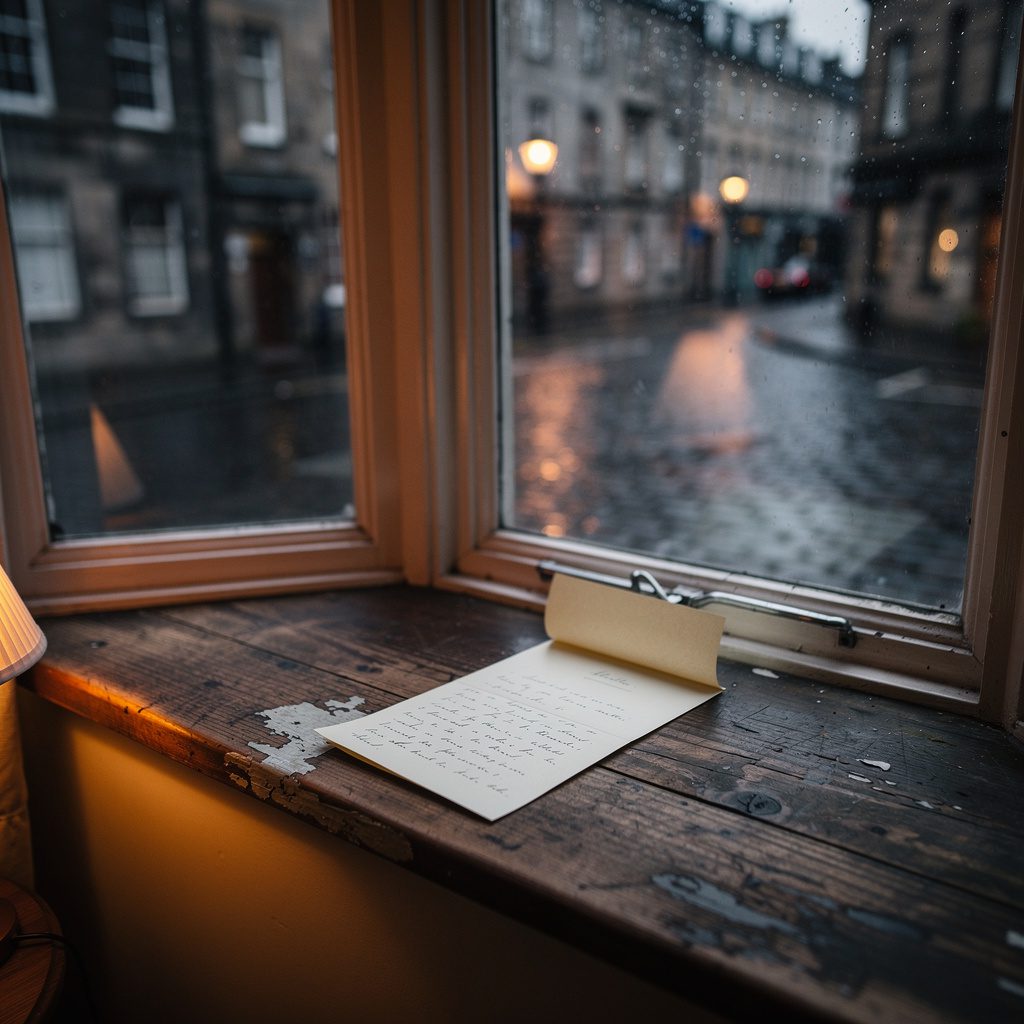
She took the letter from her bag and held it out to him. He looked at it for a moment without taking it.
“Keep it,” he said.
She blinked. “What?”
“It was in your flat. It found you.” He picked up his coffee again. “Maybe that means something.”
She was not sure if he was being philosophical or flirting. She suspected, from the faint warmth at the edge of his voice, that he was not entirely sure either.
They ended up talking for forty minutes in that common room, long past when the other faculty had drifted away. He told her about Edinburgh in winter, which she had not yet experienced. She told him about her research into the way language carries emotional memory — how certain words hold feeling the way old wood holds scent.
“Like cedar,” he said.
She looked at him. “The letter smelled like cedar.”
“I kept it in a box,” he said simply.
Something about that small detail — the care of it, the cedar box, the unhurried handwriting — settled into her chest like a key finding a lock she had not known was there.
They had coffee again on Thursday. And the following Tuesday. The third time, he walked her home along the Meadows as the last of the autumn light turned the grass a deep, burnished gold, and she realized she had begun to look forward to the sound of his voice with a specificity that surprised her.
At the door of the flat on Marchmont Road, he paused.
“I’m glad it was you,” he said. “Who found it.”
She looked up at him. The streetlamp caught the edge of his face. The city was quiet around them, the cobblestones damp and gleaming.
“Me too,” she said.
He smiled then — fully, without reservation — and it was the kind of smile that rewrites the atmosphere of a moment entirely.
He did not kiss her that evening. But when she went inside and stood in the bay window and watched him walk back up the street, hands in his coat pockets, she held the letter to her chest and felt, with a warmth she had not expected to find in this city, that some things are lost for exactly the right amount of time — and found at exactly the right moment.

 WhatsApp
 Telegram
 Email







Categories
- AI & Technology
- Contemporary
- Corporate Control
- Creepypasta
- Crime Thriller
- Cyberpunk
- Dark Fantasy
- Enemies to Lovers
- Fairy Tale Retelling
- Fantasy
- First Contact
- Forbidden
- Genetic/Body Horror
- High Fantasy
- Monster Hunter
- Mythic/Folklore
- Paranormal
- Portal/Otherworld
- Post-Apo
- Post-Collapse Society
- Psychological Thriller
- Romances
- SCI-FI
- Second Chance
- Slow Burn
- Space Combat
- Spacepunk
- Surveillance State
- Survival Thriller
- Thrillers
- Time Travel
- Treasure Hunter
- Urban Fantasy
- Witchcraft/Curses
Tags
10min stories atmospheric atmospheric fantasy atmospheric fiction contemporary romance Creepy creepypasta crime thriller dark fantasy debt dystopia emotional fiction enemies to lovers ensemble cast epistolary fantasy female protagonist first person forbidden romance framed narrative high fantasy love story magic Memory mystery Paranormal psychological horror psychological thriller romance sci-fi second chance second chance romance short fiction short story slow burn space station speculative fiction supernatural Survival survival thriller suspense thriller travel romance witchcraft workplace romance
Leave a Reply