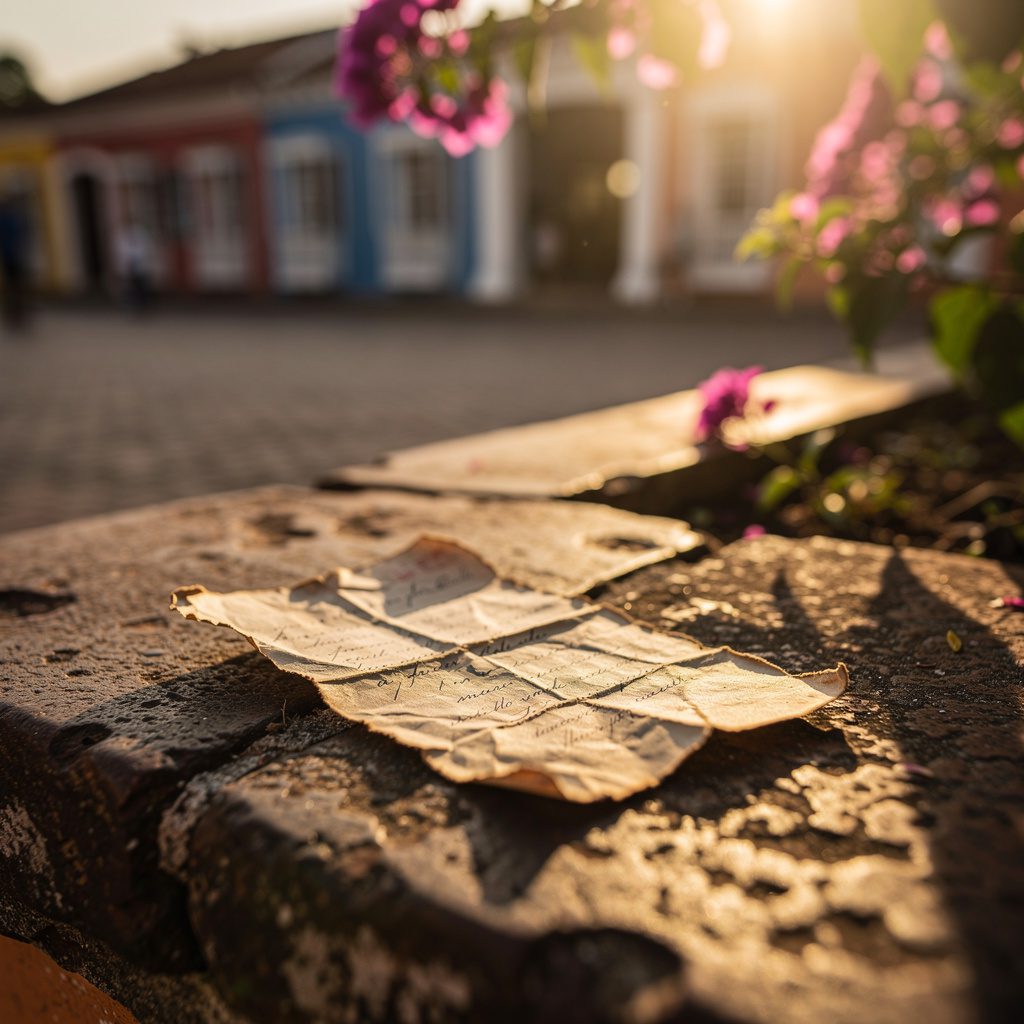
He’d written that he’d been trying to find the right moment to say something and kept losing his nerve. He’d written that Cartagena felt different with me in it, quieter and louder at the same time, which he knew didn’t make sense but was the only way he could describe it. He’d written that he wasn’t sure what I felt, and he was afraid to ask, and that fear was making him stupid.
The last line.
“If you find this after you’ve gone, then I waited too long. But I needed you to know anyway.”
He’d slipped it into my journal. He must have. Some afternoon when I’d left it on the café table. And I’d never found it. I’d carried it across an ocean and through three years of silence, and I’d never known.
I’d sat on the edge of the bed and felt something crack open in my chest.
—
I’d almost not come to the plaza.
I’d almost gone straight to the airport, letter in my bag, grief in my throat, telling myself it was three years ago and people moved on and I didn’t even know where he was.
But my feet had brought me here anyway. To the yellow-shuttered café and the bougainvillea and the cobblestones that still smelled like sea salt and something older than either of us.
I was being sentimental and foolish and I knew it.
I checked my phone again. Three hours and forty minutes.
Then I heard someone say my name.
—
The first sharp moment was the sound of his voice.
Not tentative. Not surprised. Just—certain. Like he’d been expecting to find me here, or like finding me here was simply the next thing that was going to happen and he’d made his peace with it.
I stood up too fast and nearly knocked over my carry-on.
Adonis was crossing the plaza toward me. He looked almost exactly the same—same unhurried way of moving, same quiet gravity. A little older around the eyes. He was carrying a small paper bag from the bakery on the corner, as though he’d just been doing an ordinary errand and had simply turned a corner and found three years collapsed into nothing.
“I heard you were back,” he said, stopping a few feet away. “Paolo at the guesthouse mentioned it.”
“Paolo talks too much,” I said.
A corner of his mouth moved. Not quite a smile. Almost.
“You’re leaving,” he said. He looked at the carry-on.
“Four hours. Three and a half now.”
He nodded slowly, like he was absorbing that. Like he was deciding something.
We stood in the sun and the bougainvillea fell around us and the plaza went on being the plaza—unhurried, indifferent, ancient—and I thought: I have the letter in my bag and I don’t know what to do with it.
—
We sat at the café. He ordered for both of us without asking, and got it right, and I felt that land somewhere tender.
We talked about small things first. My book. His work—he’d been consulting on a restoration project in the old city, which explained why he was still here. The way the plaza had been repaved and how it had changed the acoustics slightly, which was the kind of observation only someone who’d spent a great deal of time listening to a place would make.
I kept the letter in my bag.
Then he said, quietly, “Aoife got married last spring.”
I looked at him.
“In Dublin,” he said. “She’s very happy. I went to the wedding.” He paused. “I think she came here that time to make sure she wasn’t making a mistake. Choosing someone else over—” He stopped. “Over what we’d been.”
“And was she?” I asked. “Making a mistake?”
“No,” he said simply. “She wasn’t.”
The second sharp moment was the silence after that. The way it sat between us not as absence but as something filling in.
I put my hand into my bag.
—
I set the letter on the table between us.
He went very still.
I watched his face as he recognized it—the paper, the fold, his own handwriting on the outside. Something moved behind his eyes. Not surprise exactly. More like a door he’d thought was closed forever swinging open on a hinge that still worked.
“I found it this morning,” I said. “In the journal. The back pocket. I never knew it was there.”
He didn’t pick it up. He just looked at it.

 WhatsApp
 Telegram
 Email







Categories
- AI & Technology
- Contemporary
- Corporate Control
- Creepypasta
- Crime Thriller
- Cyberpunk
- Dark Fantasy
- Enemies to Lovers
- Fairy Tale Retelling
- Fantasy
- First Contact
- Forbidden
- Genetic/Body Horror
- High Fantasy
- Monster Hunter
- Mythic/Folklore
- Paranormal
- Portal/Otherworld
- Post-Apo
- Post-Collapse Society
- Psychological Thriller
- Romances
- SCI-FI
- Second Chance
- Slow Burn
- Space Combat
- Spacepunk
- Surveillance State
- Survival Thriller
- Thrillers
- Time Travel
- Treasure Hunter
- Urban Fantasy
- Witchcraft/Curses
Tags
10min stories atmospheric atmospheric fantasy atmospheric fiction contemporary romance Creepy creepypasta crime thriller dark fantasy debt dystopia emotional fiction enemies to lovers ensemble cast epistolary fantasy first person forbidden romance found text framed narrative high fantasy love story magic Memory mystery Paranormal psychological horror psychological thriller romance sci-fi second chance second chance romance short fiction short story slow burn space station speculative fiction supernatural Survival survival thriller suspense thriller travel romance witchcraft workplace romance
Leave a Reply