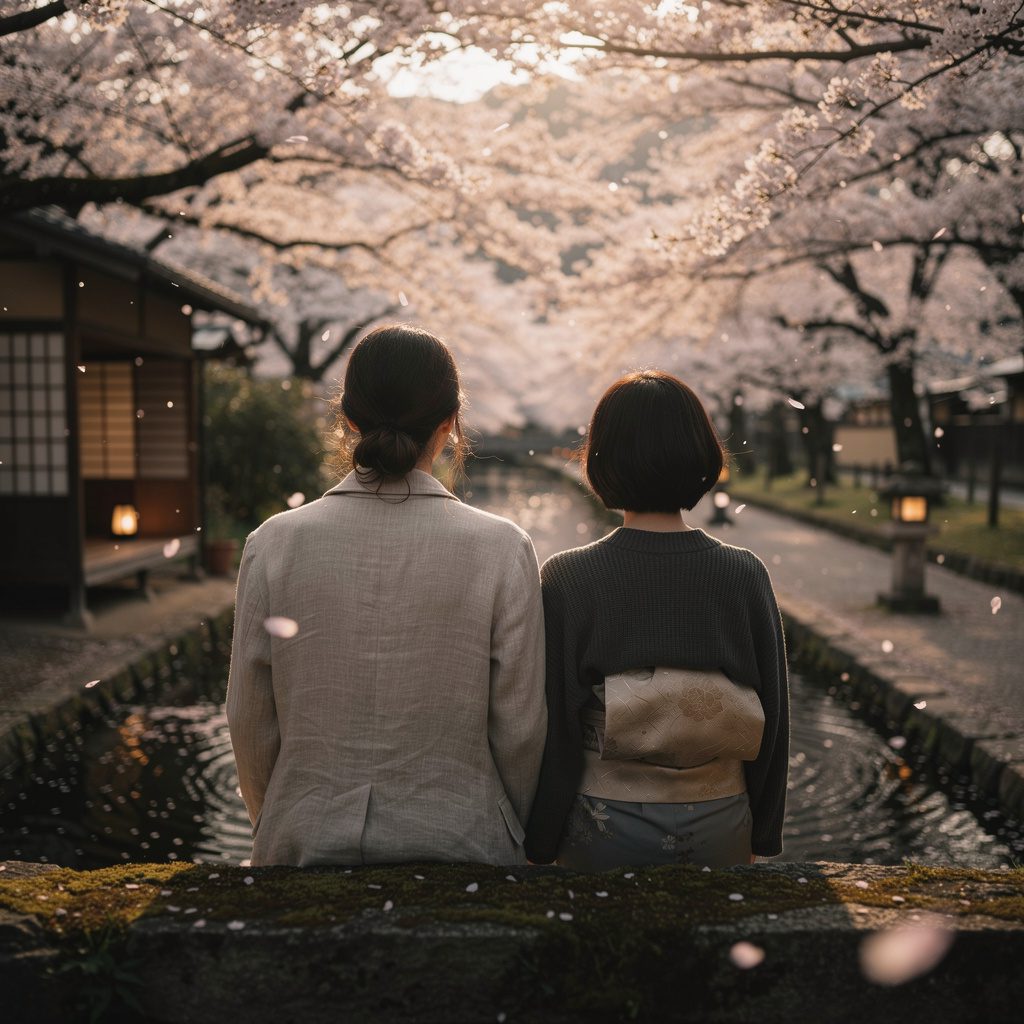
“I’m looking at the garden,” I said.
“The garden is behind you, Eamon.”
I didn’t have anything to say to that. She finally glanced at me, just briefly, and I saw the edge of a smile before she looked away again.
The tea arrived. Small ceramic bowls, matte and grey-green, holding something vivid and grassy. The ritual of it — the way the host set each bowl down with both hands, the slight bow — made everyone go quiet for a moment, even Emiliano.
I wrapped my hands around the bowl and thought about the rooftop in Milan. I thought about the way she’d laughed when I’d made that promise. I thought about all the months I’d spent being too careful, too slow, and then too late.
“This is the place,” I said. I hadn’t planned to say it out loud.
Rosa looked up.
“The painting,” I said. “The one I owed you.”
Something shifted in her face. Not dramatically — Rosa never did anything dramatically, it was one of the things about her — but I saw it. A small, careful rearranging. Like she was deciding something.
“You remember that,” she said.
“I remember all of it.”
Miroslav chose this exact moment to announce that he wanted to walk to the garden behind the tea house and that everyone was coming. It was not a question. Emiliano was already standing. Keiko was already putting on her jacket. Rosa and I both looked at the door, then back at each other, and I saw the flicker of something — relief, maybe, or its opposite.
“Shall we,” she said. It was not quite a question either.
The garden was small and immaculate, a gravel path winding between two cherry trees that arched over it like they were leaning in to hear a secret. Petals were everywhere — on the gravel, on the low hedge, drifting past us in the cold-clean air. The sky had gone a deeper grey, the kind that makes colors look more saturated, and the blossoms were almost aggressively beautiful.
Miroslav strode ahead with purpose. Emiliano had apparently resolved his storage issue and was photographing again. Keiko drifted toward a stone lantern at the far end. Rosa and I walked slowly, slightly behind the others, and for a while neither of us said anything.
I had rehearsed this, in some abstract way, for two years. Not the words — I never had the right words — but the intention. The willingness to stop being careful.
“I should have said something,” I started. “Before Dublin. I should have —”
“Eamon.”
“Let me say it.”
She stopped walking. I stopped too. A petal landed on her shoulder and she didn’t brush it away.
“I was afraid,” I said. “Not of you leaving. Of being wrong about what I thought we were. And I convinced myself that silence was the safe option, and it wasn’t. It was just the coward’s option. And I’ve thought about that a lot.”
She looked at me for a long moment. The sounds of the others — Miroslav’s commentary, Emiliano’s occasional exclamations — felt very far away.
“Dublin was good,” she said finally. “I needed it. I needed to go somewhere and be my own thing for a while.” A pause. “But I thought about the rooftop too. More than I wanted to.”
Something loosened in my chest. Not all at once — more like a knot that had been pulled in the wrong direction for years and was finally, slowly, releasing.
“I’m back in London now,” she said. “Since January.”
“I know.”
“You knew?”
“Miroslav told me. He thought it was funny that I went very quiet.”
That made her laugh — a real one, not the polite version. And that sound, that specific sound, did something to me that I don’t quite have language for.
“He’s terrible,” she said, still smiling.
“He’s the reason we’re in Kyoto.”
“Fair point.”
We started walking again, slower than before. The path curved and for a moment we were out of sight of the others, just the two of us under the arching trees, petals falling in the grey afternoon light.
She reached out and caught one — a single blossom, caught clean from the air — and held it in her palm for a second before the breeze took it again.
“It does look like a painting,” she said quietly.
“I owed you one.”
She didn’t say anything to that. She didn’t need to.

 WhatsApp
 Telegram
 Email







Categories
- AI & Technology
- Contemporary
- Corporate Control
- Creepypasta
- Crime Thriller
- Cyberpunk
- Dark Fantasy
- Enemies to Lovers
- Fairy Tale Retelling
- Fantasy
- First Contact
- Forbidden
- Genetic/Body Horror
- High Fantasy
- Monster Hunter
- Mythic/Folklore
- Paranormal
- Portal/Otherworld
- Post-Apo
- Post-Collapse Society
- Psychological Thriller
- Romances
- SCI-FI
- Second Chance
- Slow Burn
- Space Combat
- Spacepunk
- Surveillance State
- Survival Thriller
- Thrillers
- Time Travel
- Treasure Hunter
- Urban Fantasy
- Witchcraft/Curses
Tags
10min stories atmospheric atmospheric fantasy atmospheric fiction contemporary romance Creepy creepypasta crime thriller dark fantasy debt dystopia emotional fiction enemies to lovers ensemble cast epistolary fantasy female protagonist first person forbidden romance framed narrative high fantasy love story magic Memory mystery Paranormal psychological horror psychological thriller romance sci-fi second chance second chance romance short fiction short story slow burn space station speculative fiction supernatural Survival survival thriller suspense thriller travel romance witchcraft workplace romance
Leave a Reply