FROM: Nadia Chukwu
TO: Anders Iversen
DATE: 14 March, ten years ago
“I’m leaving on the morning ferry. Don’t try to change my mind. You’ve been doing that since we were sixteen, and I’m done letting you win. The cabin, the summers, all of it — I’m done. Have a good life, Anders. I mean that. I actually do.”
The note had been folded into quarters and pressed between two pages of a waterlogged field journal. Nadia found it on Thursday afternoon, an hour after arriving at her cousin Ingrid’s fjord-side cabin for the wedding weekend. She didn’t remember tucking it there. She didn’t remember keeping it at all.
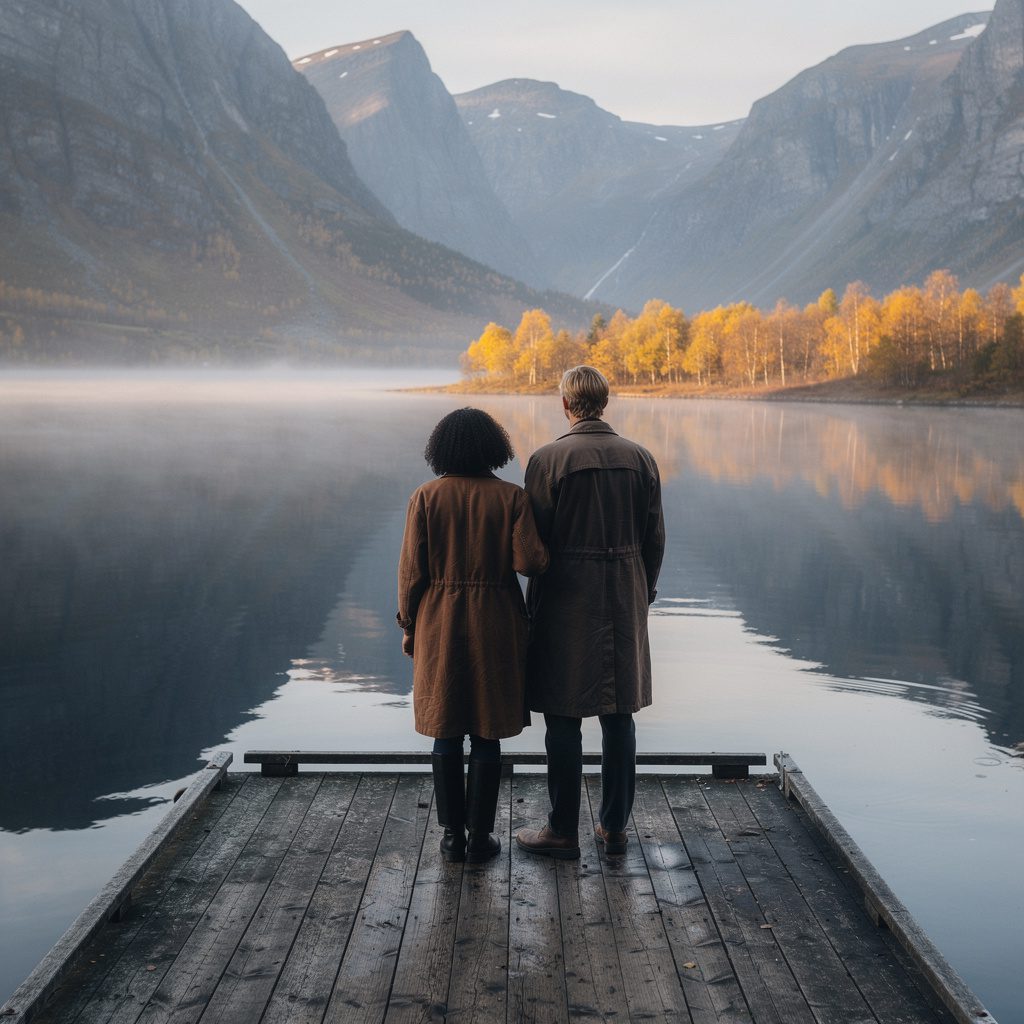
She stood at the cabin window with the note open in both hands, the fjord grey and enormous beyond the glass. The water was the color of old pewter, and the birch trees along the far bank had gone that particular shade of early-autumn gold that she associated with Norway in a way she associated with nowhere else on earth. Ten years. She had photographed fjords in four other countries since then. None of them had felt like this one.
Ingrid appeared in the doorway with a glass of aquavit in each hand and the cheerful ruthlessness of a woman who had planned every detail of her own wedding weekend down to the breakfast pastries. “You’re doing the staring-at-water thing,” she said. “You only do that when something’s wrong.”
“Nothing’s wrong.” Nadia folded the note again. “I found an old letter.”
“Anders is coming tomorrow,” Ingrid said, as though this were a perfectly ordinary piece of news to deliver while handing someone aquavit. “He’s Sten’s best man. I did mention this.”
She had. Nadia had simply chosen not to think about it.
The cabin held nine people that weekend: Ingrid and her fiancé Sten, his enormous and good-natured family, a photographer from Oslo who kept asking everyone to move slightly to the left, and Nadia, who was the maid of honor and had been telling herself for three weeks that she was absolutely fine. When Anders Iversen arrived Saturday morning with a duffel bag over one shoulder and a bottle of wine under his arm, the first thing he did was nearly walk into her on the narrow porch steps.
He stopped. She stopped.
The bottle of wine survived.
Anders was taller than she remembered, or maybe she had just spent ten years compressing him in her memory into something more manageable. He had the same jaw, the same way of going very still when he was caught off guard. His hair was shorter. There were new lines at the corners of his eyes. He looked, she thought with some irritation, like someone who had grown into himself while she wasn’t watching.
“Nadia.”
“Anders.”
Sten appeared behind him with the timing of a man who had absolutely been warned. “Good, you’ve met. Or — re-met. Come in, there’s coffee.”
Anders knew, from the moment he saw her, that the weekend was going to be harder than he’d prepared for. He had prepared. He’d had a speech ready, something brief and civil about how much time had passed and how people changed and how he hoped she was well. He had lost the speech somewhere between the ferry dock and the porch steps. What he had instead was the memory of that letter, which he had read so many times in the first year that he could still recite it, and the knowledge that she had been right to write it.
That was the part he’d never said out loud to anyone.
The wedding preparations moved around them like weather. Ingrid’s future mother-in-law, a small fierce woman named Britt, organized everyone into tasks with military efficiency. The photographer from Oslo gave up on asking people to move and started photographing the fjord instead. Sten’s younger brother Erik made increasingly bad jokes that somehow landed every time. Nadia arranged wildflowers in glass jars. Anders carried firewood. They worked in the same small spaces without speaking, a careful choreography of avoidance that fooled no one.
“You’re being weird,” Ingrid told Nadia that evening, low-voiced, while Britt demonstrated a traditional folk song nobody had asked for.
“I’m being perfectly normal.”
“You arranged the same table twice.”
Nadia looked at the table. The wildflowers were, in fact, arranged twice.

 WhatsApp
 Telegram
 Email







Categories
- AI & Technology
- Contemporary
- Corporate Control
- Creepypasta
- Crime Thriller
- Cyberpunk
- Dark Fantasy
- Enemies to Lovers
- Fairy Tale Retelling
- Fantasy
- First Contact
- Forbidden
- Genetic/Body Horror
- High Fantasy
- Monster Hunter
- Mythic/Folklore
- Paranormal
- Portal/Otherworld
- Post-Apo
- Post-Collapse Society
- Psychological Thriller
- Romances
- SCI-FI
- Second Chance
- Slow Burn
- Space Combat
- Spacepunk
- Surveillance State
- Survival Thriller
- Thrillers
- Time Travel
- Treasure Hunter
- Urban Fantasy
- Witchcraft/Curses
Tags
10min stories atmospheric atmospheric fantasy atmospheric fiction contemporary romance Creepy creepypasta crime thriller dark fantasy debt dystopia emotional fiction enemies to lovers ensemble cast epistolary fantasy female protagonist first person forbidden romance framed narrative high fantasy love story magic Memory mystery Paranormal psychological horror psychological thriller romance sci-fi second chance second chance romance short fiction short story slow burn space station speculative fiction supernatural Survival survival thriller suspense thriller travel romance witchcraft workplace romance
Leave a Reply