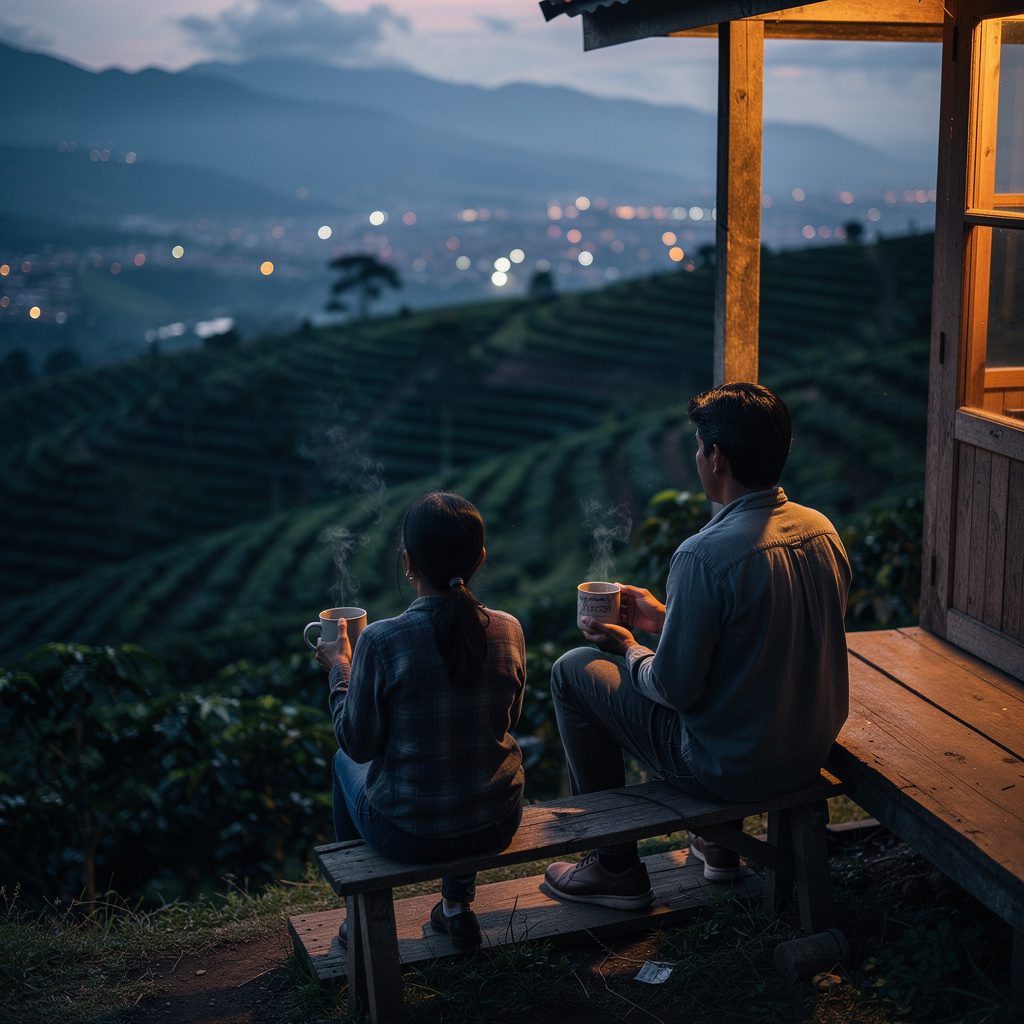
*Carmela, now:*
We walk the lower sector together.
Jin crouches at a plant near the edge of the row and turns a leaf over, examining the rust spots — the orange-brown lesions that spread when the humidity sits too long. He doesn’t say anything for a while. He just looks.
I watch him look.
He had the same quality ten years ago — this absolute patience with problems. He would sit with a question until it opened up for him. I used to find it restful. I used to sit beside him in the evenings on the farmhouse steps and feel the particular quiet of being near someone who isn’t in a hurry.
I’d forgotten that.
No. That’s not true. I’d just stopped letting myself remember it.
“You’ve been applying copper,” he says.
“Yes. It’s helping in the upper rows.”
“Down here the drainage is the real problem. The rust is a symptom.” He stands, brushes soil from his knees. “You need to regrade this section. Improve the runoff.”
“I know.”
“But?”
“But it’s expensive and I’ve been managing other things.”
He nods, no judgment in it. “I can write up a phased plan. Something that works with what you have.”
“You don’t have to do that either.”
He looks at me then. Really looks.
“Carmela. I’m here. Let me help.”
The morning has warmed. The fog is burning off the lower rows, and the plantation is settling into its workday sounds — the distant voices of the pickers who come up from the village, the creak of the equipment shed, a radio playing somewhere below the ridge.
I say, “Okay.”
It’s a small word. It costs me something anyway.
—
*Jin, now:*
Dolores brings lunch to the farmhouse at noon.
She sets out arepas, avocado, a pot of something that smells like cilantro and slow heat, and she does it all with the deliberate cheerfulness of someone who has absolutely no intention of leaving.
“Sit,” she tells us both, like we are children, and we sit.
The farmhouse table is the same one I remember. Thick wood, scarred from decades of use, a ceramic vase in the center with a single yellow flower that Dolores has clearly just picked from the garden. She is not subtle. She is not trying to be.
We eat.
For a while it’s easy — Dolores fills the silences with plantation gossip, news from the village, a story about the collective’s last meeting that makes Carmela laugh, and that laugh does something to the room.
Then Dolores says, very casually, “Jin, do you remember the harvest festival? The year you two stayed up until three in the morning fixing the pulping machine?”
Carmela goes still.
I go still.
“I remember,” I say.
“I was thinking about it recently,” Dolores continues, absolutely merciless. “How you both came to breakfast covered in coffee pulp and neither of you would explain why it had taken so long.”
“The machine was complicated,” Carmela says.
“Mm,” says Dolores.
Carmela meets my eyes across the table. There is a war happening in her expression — something that wants to laugh and something that wants to look away.
She doesn’t look away.
—
*Carmela, now:*
After lunch, Dolores disappears with suspicious efficiency.
I show Jin the rest of the plantation — the drying beds, the new shade-tree planting along the north slope, the place near the eastern ridge where my grandmother used to sit in the late afternoon with her notebook and a thermos of coffee.
I show him that last part without meaning to. We just end up there.
The view from the ridge is the thing that makes visitors cry. The hills fold down toward Medellín in layers — green and gold in the afternoon light, the city glittering faintly far below, the sky enormous above the valley.
We stand at the edge of it.
“It’s the same,” Jin says quietly.
“Mostly.” I point to a gap in the tree line to the south. “That section burned two years ago. We replanted, but it’ll be a few years before you can’t see the scar.”
He’s quiet for a moment. Then: “I should have come back sooner.”

 WhatsApp
 Telegram
 Email







Categories
- AI & Technology
- Contemporary
- Corporate Control
- Creepypasta
- Crime Thriller
- Cyberpunk
- Dark Fantasy
- Enemies to Lovers
- Fairy Tale Retelling
- Fantasy
- First Contact
- Forbidden
- Genetic/Body Horror
- High Fantasy
- Monster Hunter
- Mythic/Folklore
- Paranormal
- Portal/Otherworld
- Post-Apo
- Post-Collapse Society
- Psychological Thriller
- Romances
- SCI-FI
- Second Chance
- Slow Burn
- Space Combat
- Spacepunk
- Surveillance State
- Survival Thriller
- Thrillers
- Time Travel
- Treasure Hunter
- Urban Fantasy
- Witchcraft/Curses
Tags
10min stories atmospheric atmospheric fantasy atmospheric fiction contemporary romance Creepy creepypasta crime thriller dark fantasy debt dystopia emotional fiction enemies to lovers ensemble cast epistolary fantasy first contact first person forbidden romance framed narrative high fantasy love story magic Memory mystery Paranormal psychological horror psychological thriller romance sci-fi second chance second chance romance short fiction short story slow burn space station speculative fiction supernatural Survival survival thriller suspense thriller travel romance witchcraft workplace romance
Leave a Reply