“I need to tell you something,” he said, “and I need you to let me finish before you ask anything.”
She let him in.
He told her that the jar had been brought to the valley by her great-great-grandmother, a woman named Ishaan who had come from the eastern wetlands three generations before Elspeth was born. Ishaan had been a keeper — not a word Gordon used lightly, he said — which meant she had been entrusted with holding something that could not be destroyed and could not be released until the land itself gave permission. The jar did not contain an object. It contained a voice. The voice of a spirit that had once moved through the rivers and the root systems of the eastern wetlands and had been bound into the jar during a great drying, a season of catastrophic loss, so that it would not dissipate into nothing when its home was gone.
“How do you know this?” Elspeth asked.
Gordon looked at his hands. “Because I was the one who bound it.”
I told you my role would become clearer.
He was not a man, exactly. He had been a man, once, in the way that a river is water — the form changes, but the substance persists. He had worn this shape for sixty years because the jar needed a watcher, and watchers needed to be trusted, and to be trusted in a village you had to be unremarkable. He had been unremarkable for sixty years with considerable patience.
The spirit in the jar was waking because the eastern wetlands had come back. Not all of them. Not yet. But enough. Three seasons of rain, a government decision about flood plains, a rewilding effort that had begun quietly and spread. The roots were reconnecting. The water was finding its old paths. And the voice inside the jar was recognizing something it had not felt in a hundred years.
Home.
“What happens if I open it?” Elspeth asked.
“It returns,” Gordon said. “To the water. To the roots. It completes itself.”
“And if I don’t?”
“It will hum until the jar breaks. And then it returns anyway, but in pieces, and pieces of something like that don’t travel well.”
She thought about her mother’s hands, how they had always rested near the dresser when she stood at the stove. She thought about her grandmother saying it’s not time, and understood now that her grandmother had simply known it wasn’t time yet — not that it would never come. She thought about great-aunt Rocio and the expression on her face that was older than fear or reverence. It was readiness, Elspeth realized. Rocio had been ready. She had just not been the one.
Elspeth reached up to the second shelf.
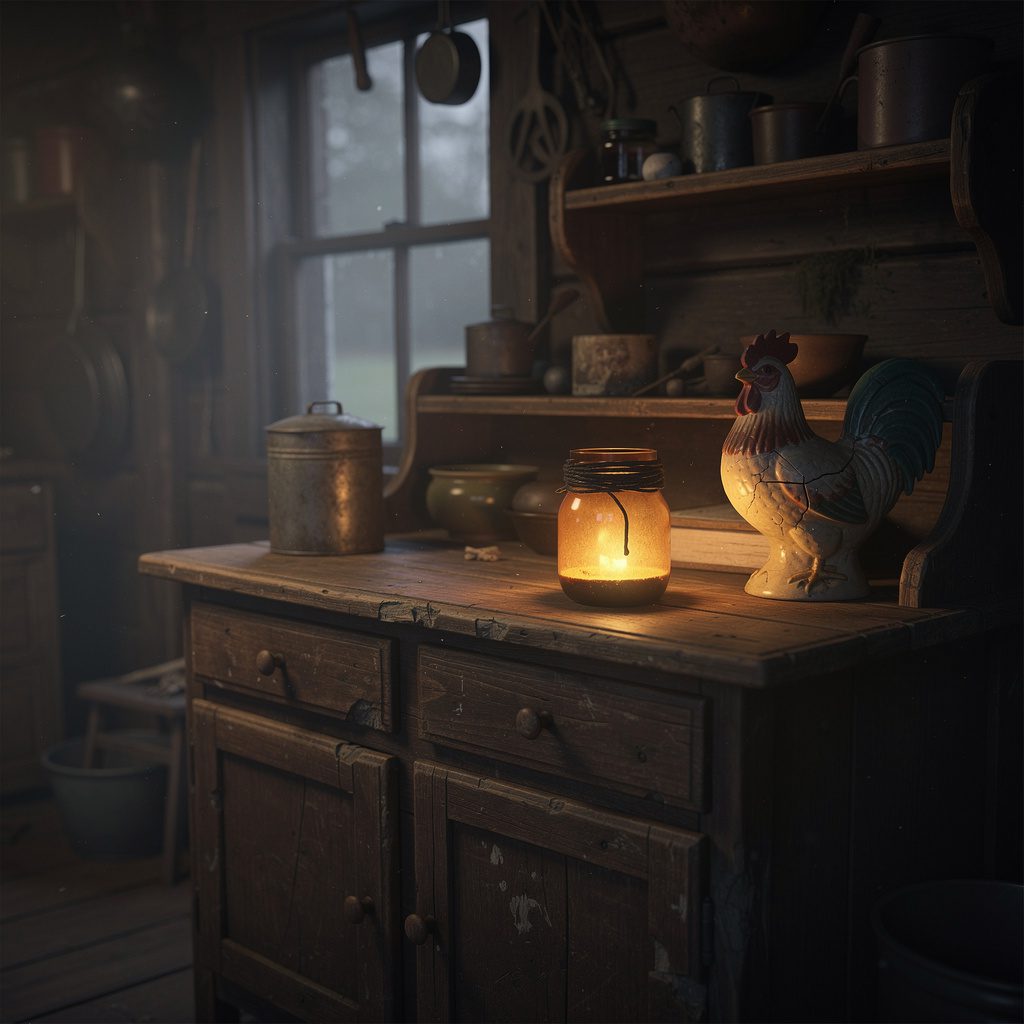
The jar was warm in a way that had nothing to do with the kitchen air. The amber glaze caught the afternoon light and held it, and for a moment she could see something moving inside — not a creature, not a shape, but a quality of motion, like the surface of a slow river seen from above. The thread around the stopper was old and dark and had held for three generations. She unwound it carefully, out of respect for Ishaan, who had wound it in the first place.
The cork came free without effort.
There was no explosion, no rush of wind, no dramatic surge of light. There was only a sound — low, resonant, and deeply relieved — that moved through the kitchen and through the walls of the house and out into the lane and beyond, traveling south and east, following something invisible but certain, like water finding the fastest way downhill.
Gordon stood very still. His edges, Elspeth noticed for the first time, were slightly uncertain in the afternoon light, as though he were a sketch that had not quite been finished. He was watching the window. His face held an expression she recognized now, because it matched the one she felt in her own chest: the particular, quiet grief of something long-held finally let go.
“Will you stay?” she asked.
He considered this for what felt like a long time. “For a little while,” he said. “I think I’ve gotten rather used to the lane.”
She set the empty jar back on the shelf, between the fennel and the rooster. It looked lighter now, though it weighed exactly the same. The amber glaze had gone a clearer color, like shallow water over pale stone, and the morning light, when it came through the window, would find it easily.

 WhatsApp
 Telegram
 Email







Categories
- AI & Technology
- Contemporary
- Corporate Control
- Creepypasta
- Crime Thriller
- Cyberpunk
- Dark Fantasy
- Enemies to Lovers
- Fairy Tale Retelling
- Fantasy
- First Contact
- Forbidden
- Genetic/Body Horror
- High Fantasy
- Monster Hunter
- Mythic/Folklore
- Paranormal
- Portal/Otherworld
- Post-Apo
- Post-Collapse Society
- Psychological Thriller
- Romances
- SCI-FI
- Second Chance
- Slow Burn
- Space Combat
- Spacepunk
- Surveillance State
- Survival Thriller
- Thrillers
- Time Travel
- Treasure Hunter
- Urban Fantasy
- Witchcraft/Curses
Tags
10min stories atmospheric atmospheric fantasy atmospheric fiction contemporary romance Creepy creepypasta crime thriller dark fantasy debt dystopia emotional fiction enemies to lovers ensemble cast epistolary fantasy female protagonist first person forbidden romance framed narrative high fantasy love story magic Memory mystery Paranormal psychological horror psychological thriller romance sci-fi second chance second chance romance short fiction short story slow burn space station speculative fiction supernatural Survival survival thriller suspense thriller travel romance witchcraft workplace romance
Leave a Reply