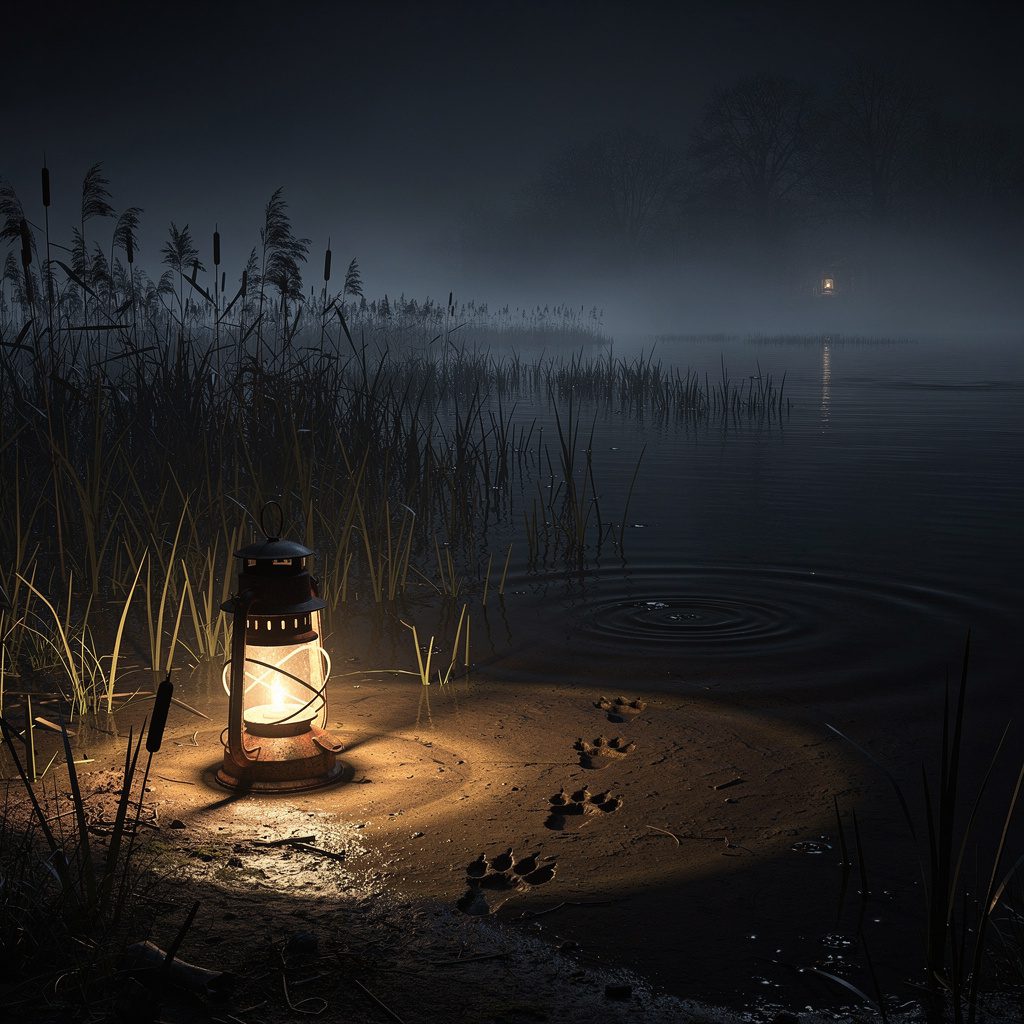
The tracks ended at the waterline, and that was wrong.
I crouched at the edge of the Mirewash, one knee in the black mud, my lamp held low. The prints were there — four-toed, deep, spaced wide apart the way a heavy thing moves when it thinks no one is watching. Then the water, still and dark as a held breath. And nothing beyond.
Things that leave tracks do not simply stop.
I had been in the Mirewash for six hours. I knew this because Sylvester had told me so when I checked in with him at the tree line, and Sylvester was meticulous about time. He kept a brass pocket-watch that he wound every morning before he spoke a single word to anyone. I had always found that admirable. I was beginning to find it unsettling.
The village of Corrow’s Bend had hired me three weeks ago. A creature, they said. Something moving through the wetlands south of the village, taking livestock, breaking fences, leaving those same four-toed impressions in every soft patch of ground between the reed beds and the mill road. Two children had seen it from a distance. They described something tall. Something that moved with its shoulders hunched forward, like a man carrying a weight he could not set down.
I was a tracker. That was the honest word for what I did. Not a hunter — I had never liked that word. Hunters kill. I find things. What happens after the finding depends on what I find.
Sylvester had come with the contract. He was the one who had negotiated the fee, presented the evidence, drawn the map of the sightings. He said he was the village alderman’s assistant. He was well-dressed for a wetland village. His boots were always clean.
I noticed that the second day. I did not say anything.
Now I lifted my lamp and swept it slowly across the water’s surface. The Mirewash was not deep here — knee-height at most, the locals said — but the water was the color of old iron, and you could not see the bottom.
Something had gone into it. Something had not come out.
I stood and listened.
The wetlands at night have their own language. Reed-rustle. Frog-call. The distant, hollow knock of a heron settling its wings. I had learned to read that language over fifteen years of work in places like this — marshes, fens, the drowned forests at the edge of the Caldric Mountains. You listen for what is missing as much as what is there.
The frogs had stopped.
Not gradually. All at once, the way they go silent when something large moves through the water.
I turned off my lamp.
Darkness pressed in, immediate and total. The moon was behind cloud. I stood still and let my eyes adjust, let the wetland sounds come back, or not come back.
They did not come back.
I heard breathing instead.
It was not close. Maybe thirty feet out, somewhere in the reeds to my left. Slow breathing. Measured. Almost deliberate, as if the thing making it had decided that hiding was no longer worth the effort.
I did not move.
The breathing continued.
I thought about the children’s description again. Tall. Shoulders hunched forward. Like a man carrying a weight.
I had assumed they meant it moved like a man. Children anthropomorphize. They make the strange familiar by mapping it onto the human shape.
But what if they had meant it literally?
What if it was a man?
The breathing shifted. Closer now. Still slow. Still deliberate.
I reached into my coat and closed my fingers around the small iron disc I kept there — not a weapon, just a focus object, something to hold when my hands wanted to shake. My mentor, a woman named Daya who had tracked things in the salt marshes of the eastern coast for forty years, had given it to me. She said the iron didn’t do anything magical. She said it just reminded you that you had weight. That you were solid. That whatever was out there in the dark had to deal with the fact of you.
I held the disc.
I waited.
The thing in the reeds exhaled, long and slow, and then said, very quietly: “You should not have come alone.”
The voice was rough. Low. Not quite human in its register, the way a voice sounds when it has not been used for speaking in a very long time.

 WhatsApp
 Telegram
 Email






Categories
- AI & Technology
- Contemporary
- Corporate Control
- Creepypasta
- Crime Thriller
- Cyberpunk
- Dark Fantasy
- Enemies to Lovers
- Fairy Tale Retelling
- Fantasy
- First Contact
- Forbidden
- Genetic/Body Horror
- High Fantasy
- Monster Hunter
- Mythic/Folklore
- Paranormal
- Portal/Otherworld
- Post-Apo
- Post-Collapse Society
- Psychological Thriller
- Romances
- SCI-FI
- Second Chance
- Slow Burn
- Space Combat
- Spacepunk
- Surveillance State
- Survival Thriller
- Thrillers
- Time Travel
- Treasure Hunter
- Urban Fantasy
- Witchcraft/Curses
Tags
10min stories atmospheric atmospheric fantasy atmospheric fiction contemporary romance Creepy creepypasta crime thriller dark fantasy debt dystopia emotional fiction enemies to lovers ensemble cast epistolary fantasy female protagonist first person forbidden romance framed narrative high fantasy love story magic Memory mystery Paranormal psychological horror psychological thriller romance sci-fi second chance second chance romance short fiction short story slow burn space station speculative fiction supernatural Survival survival thriller suspense thriller travel romance witchcraft workplace romance
Leave a Reply