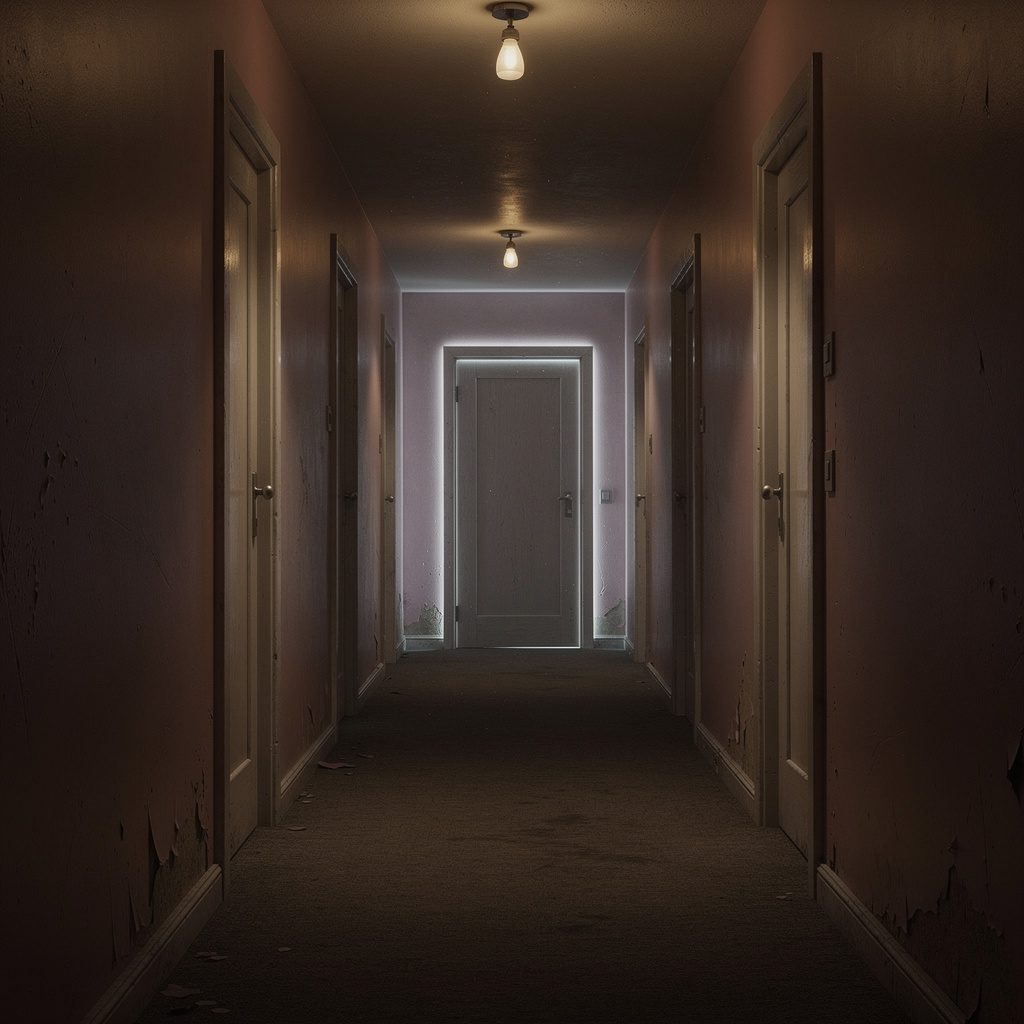
I tell this the way I remember it, which is to say imperfectly, and with the full knowledge that the door is gone now. Both doors. I checked this morning, pressing my palm flat against the wallpaper where the frame had been, feeling nothing but old plaster and the faint smell of someone else’s cooking from the floor below. Gone. Which means I can finally talk about it.
The building on Ashveil Lane had seven floors and forty-two flats, and I had lived in flat 14 for three years without incident. I knew every creak in the hallway, every water stain on the ceiling of the stairwell, the exact pitch of the boiler when it decided to throw a fit at two in the morning. I knew that wall. The wall at the end of the second-floor corridor, past the fire extinguisher and the peeling noticeboard, had always been a wall. Painted magnolia. Scuffed at knee height from decades of passing luggage. No door.
Then, on a Tuesday in late autumn, there was a door.
I noticed it on my way back from a night shift. Pale wood, almost white, with a handle made of something dark and ridged that I first mistook for wrought iron but which felt, when I touched it — and I did touch it, because I was tired and stubborn and half convinced I was dreaming — like bone. Not cold like metal. Warm. The grain of it ran in spirals. There was no number on it. No keyhole. Just the handle, and the faint sound of wind coming from beneath the gap at the bottom, though I was on the second floor of a sealed building at four in the morning and there was no wind.
I did not open it that night. I went to bed. I told myself I’d imagined it.
I had not imagined it.
Here is what I did not know then: on the sixth floor, in flat 38, a woman named Adanna Reid had found the same door.
Hers appeared in the wall of her kitchen, between the refrigerator and the window that overlooked the back alley. She told me later that she had stood in front of it for twenty minutes with a mug of tea going cold in her hand, cataloguing everything wrong about it: the way the frame was set too deep into the plaster, as though it had always been there and the building had simply grown around it; the faint luminescence along the edge of the door where it met the frame, a thin line of silver light that pulsed, very slowly, like breath; and the smell. She described the smell as rain on hot stone, mixed with something floral she couldn’t name. I knew exactly what she meant. I had smelled it too, seeping under my door.
Adanna was a structural engineer. Her first instinct was to check whether someone had renovated overnight and forgotten to tell the residents. She emailed the building manager. She photographed the door. She measured the frame with a tape measure she kept in her kitchen drawer, and she noted that the depth of the reveal was eleven inches — impossible given the thickness of an external wall. The wall, by her calculation, should have been eight inches at most.
She did not open it either. Not on the first night.
I opened mine on the third day.
I am not proud of the logic I used. It went something like: if it were dangerous, something would have happened by now. This is, in retrospect, the kind of reasoning that gets people into extraordinary trouble. But I was curious in a way that had become physically uncomfortable, and the door was there every time I passed it, and the sound of wind beneath it had begun to carry something else — not quite music, not quite voices, but a texture of sound that pulled at something behind my sternum.
I turned the handle. It gave without resistance, silently, and swung inward.
What was on the other side was not a room.

 WhatsApp
 Telegram
 Email







Categories
- AI & Technology
- Contemporary
- Corporate Control
- Creepypasta
- Crime Thriller
- Cyberpunk
- Dark Fantasy
- Enemies to Lovers
- Fairy Tale Retelling
- Fantasy
- First Contact
- Forbidden
- Genetic/Body Horror
- High Fantasy
- Monster Hunter
- Mythic/Folklore
- Paranormal
- Portal/Otherworld
- Post-Apo
- Post-Collapse Society
- Psychological Thriller
- Romances
- SCI-FI
- Second Chance
- Slow Burn
- Space Combat
- Spacepunk
- Surveillance State
- Survival Thriller
- Thrillers
- Time Travel
- Treasure Hunter
- Urban Fantasy
- Witchcraft/Curses
Tags
10min stories atmospheric atmospheric fantasy atmospheric fiction contemporary romance Creepy creepypasta crime thriller dark fantasy debt dystopia emotional fiction enemies to lovers ensemble cast epistolary fantasy female protagonist first person forbidden romance framed narrative high fantasy love story magic Memory mystery Paranormal psychological horror psychological thriller romance sci-fi second chance second chance romance short fiction short story slow burn space station speculative fiction supernatural Survival survival thriller suspense thriller travel romance witchcraft workplace romance
Leave a Reply