The village of Ashveil had not changed in three hundred years, and that, more than anything, was the first sign that something was wrong.
It sat at the hem of the Greywood Forest like a moth-eaten cuff on an old coat — humble, persistent, quietly proud of its own smallness. The houses were built from pale limestone quarried out of the hillside to the east, their roofs thatched with sedge grass that turned silver in autumn and gold in spring, as though the seasons had agreed to be generous here and nowhere else. Smoke rose from chimneys in the early morning in soft, unhurried columns. Children chased geese along the creek. Old women hung bundles of dried lavender and wormwood from their lintels — not for fragrance, the elders always said, but for memory. A thing that remembers its name cannot be taken by the dark. The market square held the same six stalls it had held for generations: the bread-seller, the herb-merchant, the tallow-chandler, the woman who sold river-clay pots, the boy who sold river-clay pots when the woman was ill, and, at the far corner beneath a canvas the color of old moss, the Chauhan table, where Riya and her grandmother sold tinctures, poultices, and pressed-flower remedies that smelled of pine resin and something older that no one could name. The cobblestones in the square were worn smooth as river stones. The fountain at its center had not run with water since before anyone’s grandmother’s grandmother could remember, but it was never dry either — a thin, dark film of liquid clung to its basin always, gleaming faintly, neither quite water nor quite not. No one touched it. No one spoke of it directly. That, too, was part of Ashveil.
Riya Chauhan had grown up learning to read the village the way a navigator reads weather — not by what was said, but by what shifted.
This morning, what shifted was the light.
It came in through the east-facing window of the workroom behind the Chauhan stall, that familiar amber flood of early sun, and then it simply stopped. Not like clouds. Not like a curtain drawn. It stopped the way a held breath stops — with intention. Riya looked up from the pestle she had been working, a blend of dried ashroot and pale moth-wing fungus that her grandmother called a “listening paste” for reasons she had never fully explained. The light was wrong. The shadows in the corners of the room were not moving with the sun. They were moving against it, slowly, like ink dropped in still water, spreading outward from the walls.
“Grandmother.”
The old woman was already standing in the doorway, one hand on the frame, looking not at the shadows but at the fountain in the square beyond.
“Get Bo Lu,” her grandmother said. “Get Ximena. Get Swati. Bring them here before the market bell rings.”
She did not explain. She did not need to. Riya had heard the name of the thing that lived in the Greywood forest all her life — not spoken, never spoken, only written in a particular cramped hand in the oldest of her grandmother’s ledgers, beside a date that was three hundred years past and a single phrase: the root remembers what the branch forgets.
The Greywood was a forest that did not behave like other forests, and any traveler who wandered its edge for more than an afternoon understood this instinctively. It was not merely old, though it was old in the way that mountains are old, in the way that deep water is old, carrying the weight of time in its very texture. The trees that lined its outer margin were ash and oak and hornbeam, ordinary enough in species, but they grew too straight, too evenly spaced, as though planted by a hand with a ruler and a purpose. Their bark was dark and smooth as polished stone, and when the wind moved through them, the sound was not the loose, democratic rustling of ordinary woodland — it was a single low note, sustained and resonant, like a finger drawn around the rim of a glass. Deeper in, the trees changed. Their trunks thickened to the width of small houses. Their roots erupted from the earth in great arching buttresses that formed chambers and corridors between them, floored with moss so deep and so green it looked like something a painter had invented. Bioluminescent fungi clung to the undersides of fallen trunks, casting a cold blue-white glow that made the forest floor look like a drowned city seen from above. And at the true heart of the Greywood, where no path led and no compass pointed reliably, there grew a single tree that the people of Ashveil called the Accord Oak. It was not a name they had given it. It was a name they had inherited, along with the silence around it, and the debt.
Bo Lu arrived first, still carrying her cartographer’s satchel, ink-stained to the elbow.
“The forest moved,” she said, before anyone had spoken. “I was mapping the eastern edge this morning. The edge moved. It was forty paces closer to the village than it was yesterday.”
Ximena Montoya came next, the village’s keeper of old contracts and civic records, a compact woman with close-cropped silver-streaked hair and the kind of stillness in her face that came from decades of reading documents that carried consequences. She set a leather folio on the workroom table without a word and opened it to a page that had been marked with a strip of red cloth.
Swati Malhotra arrived last, breathless, smelling of the tallow-chandler’s wax she had been working with since dawn. She was the youngest of them, barely twenty, and the only one who had not grown up in Ashveil — she had come three years ago, following a map Bo Lu had drawn of nowhere in particular, which was the sort of thing that happened in Ashveil and was never fully explained.
Riya’s grandmother stood at the head of the table. Her name was Priya Chauhan, and she was ninety-one years old, and she looked it — deep lines carved by weather and thought into a face that was still, somehow, more alert than any younger face in the room. She wore her white hair in a single long braid down her back. Her hands, resting on the table, were the hands of someone who had spent a lifetime touching things carefully: the knuckles large, the skin thin as paper, the fingers still precise.
“The pact is three hundred years old today,” Priya said. “Our ancestor Mehal Chauhan made it at the Accord Oak. He offered the forest something it wanted, and it held back what lived at its heart. It has held back for three hundred years.”
“And now?” Swati asked.
“Now it wants what was promised.”
Ximena turned the folio so the others could read. The contract was written in the old script, dense and angular, but she had annotated it in the margins in her own clean hand. The terms were not complicated. They were simply old, and old terms had a way of being heavier than new ones. Mehal Chauhan had promised the forest a name. Not an object, not a life — a name. The name of the thing at the forest’s heart, which had been locked away behind the pact’s seal for three centuries, unable to be spoken by any living creature. If the name was spoken aloud at the Accord Oak by a blood descendant of Mehal Chauhan before the sun set on the three-hundredth anniversary of the pact, the creature would pass through and beyond — released, gone, whatever that meant for something that old. If the name was not spoken, the seal would break on its own, and the creature would not pass through. It would simply arrive.
No one asked what arriving meant. The shadows still moving against the light in the corners of the room answered that well enough.
The walk to the Accord Oak took three hours under normal circumstances. It took less than two now, because the forest was walking toward them.
They went together. Priya led, moving with a steadiness that was not the steadiness of youth but of someone who had decided, privately and some time ago, what this day would require of her. Bo Lu mapped the path as they walked, not from habit but because a mapped path could be followed back, and she was thinking about the others even as she moved forward. Ximena carried the folio. Swati carried the lantern, though it was not yet dark, because the forest made its own darkness as they moved deeper in, the canopy closing overhead like a hand folding shut.
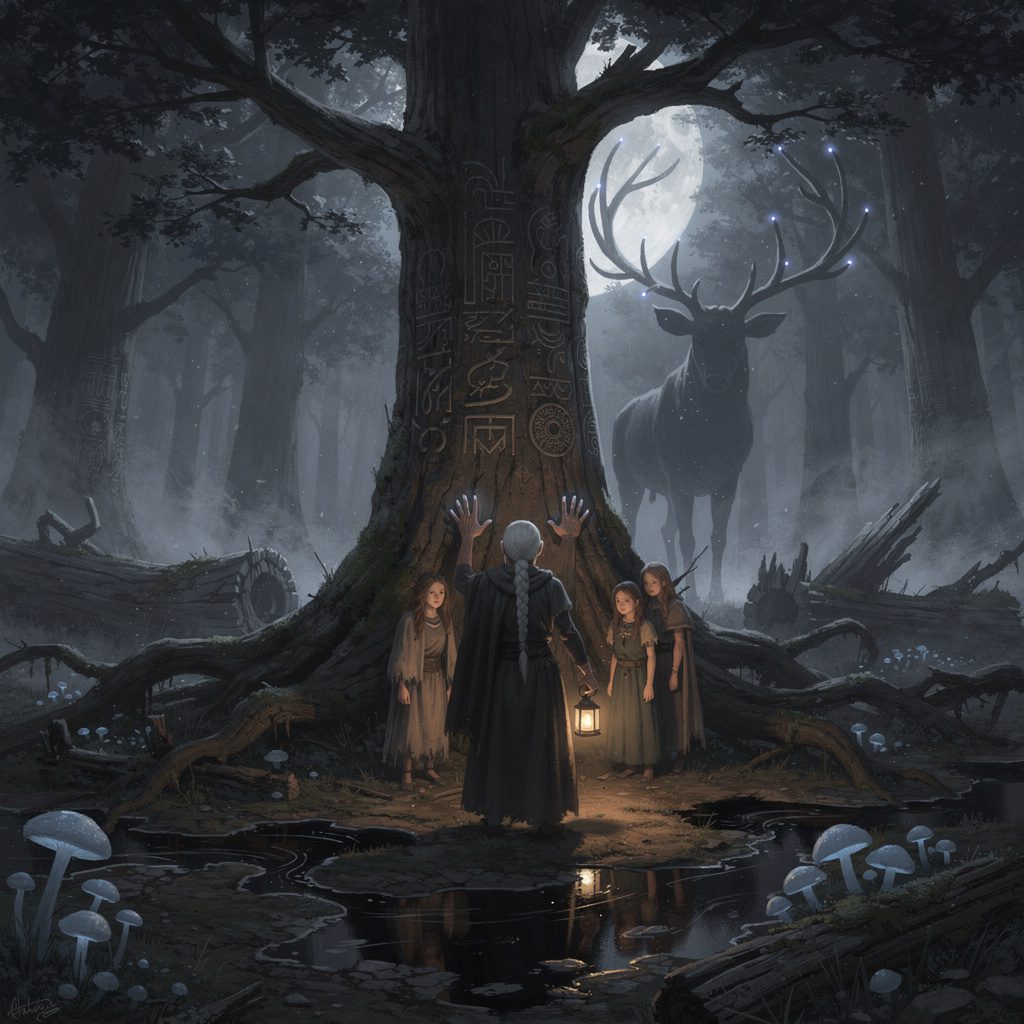
The creature that lived at the heart of the Greywood was not invisible. It had never been invisible. It had simply been contained, and containment had given it the quality of something dreamed rather than real — present in the mind, absent in the body. But as they neared the Accord Oak, they began to see its edges. It existed in the spaces between the trees, which is to say it was large enough that the trees were not obstacles to it but furniture. It was shaped loosely like a stag, but the resemblance was the way a shadow resembles the thing that casts it — suggestive, imprecise, carrying the essential shape but none of the substance. Its body was made of something that was not quite shadow and not quite smoke, a dark, slow-moving mass that had weight — they felt that weight as pressure against their ears, against their chests, the way deep water presses. Its antlers, if they could be called that, were branching structures of condensed darkness that rose from its skull and spread outward and upward in perfect symmetry, each tine ending in a point of cold light, blue-white, the same color as the fungi on the fallen trunks. Where its eyes should have been were two hollows that were somehow darker than the rest of it, darker than the space behind them, a darkness that pulled at the gaze rather than simply occupying it. It made no sound. That was the worst of it. Something that size, moving through a forest, should have made sound. Instead, it moved in a silence so complete that the absence of sound felt like a sound itself.
“We’re here,” Bo Lu said, and her voice was very small.
The Accord Oak stood at the center of a clearing that had no business existing this deep in the forest, wide and level, the grass short and dark. The tree itself was vast — its trunk wider than the workroom they had left that morning, its bark the color of charcoal, carved all over with marks that were not quite letters and not quite pictures but carried the quality of both. Its roots spread across the entire clearing, rising and falling, and in the hollows between them the dark liquid from the village fountain pooled and gleamed.
Priya Chauhan walked to the base of the tree and placed both palms against its bark.
She had known the name for forty years. Her mother had told her, and her mother’s mother had told her, passed down in a whisper in a locked room, never written, never spoken aloud. A name that old had texture to it, weight, the way a stone picked up from a riverbed is heavier than it looks because it carries the river’s memory in its density.
She spoke it.
It was not a long name. It was three syllables, and it sounded like water moving over stone and like the sustained note the wind made in the outer trees and like something else that had no comparison. The moment the third syllable left her mouth, the clearing went absolutely still — the creature, the trees, the dark liquid in the root-hollows, all of it — and then the creature stepped forward, and forward, and through. Not through the tree. Through the space between the tree and everything else, a space that opened for a moment like a door in a wall no one had known was there, and then closed.
The light returned to normal.
Priya Chauhan’s hands slid from the bark and she sat down among the roots, slowly, with the careful deliberateness of someone who has decided to sit rather than fall.
She was alive. She was unhurt. But the name was gone from her. Not forgotten — gone, the way a word is gone when you give it away, the container empty now. And with the name went something else, something she had not anticipated losing: the particular quality of knowing that she had been the keeper of the thing that mattered most. For forty years, that knowing had been the axis of her life. Now the axis was simply absent, and she was ninety-one years old, sitting in a clearing in a dark forest, feeling the specific lightness of a person who has completed the thing they were made for.
The others gathered around her without a word. Bo Lu sat beside her. Ximena closed the folio. Swati held the lantern lower so its warmth reached further.
They stayed until she was ready to stand, and then they walked back together through a forest that was, for the first time in three hundred years, simply a forest.
Ashveil was quiet when they returned. The shadows in the workroom corners were only shadows. The fountain in the square was dry at last — completely, finally dry, its basin pale and empty in the afternoon light.
No one celebrated. That was not the kind of thing this was.
Priya Chauhan made tea, because that was something she still knew how to do, and they sat together in the workroom as the light changed, and they did not speak of what had been given, or what had been kept, or the precise weight of the difference between the two.

 WhatsApp
 Telegram
 Email







Leave a Reply