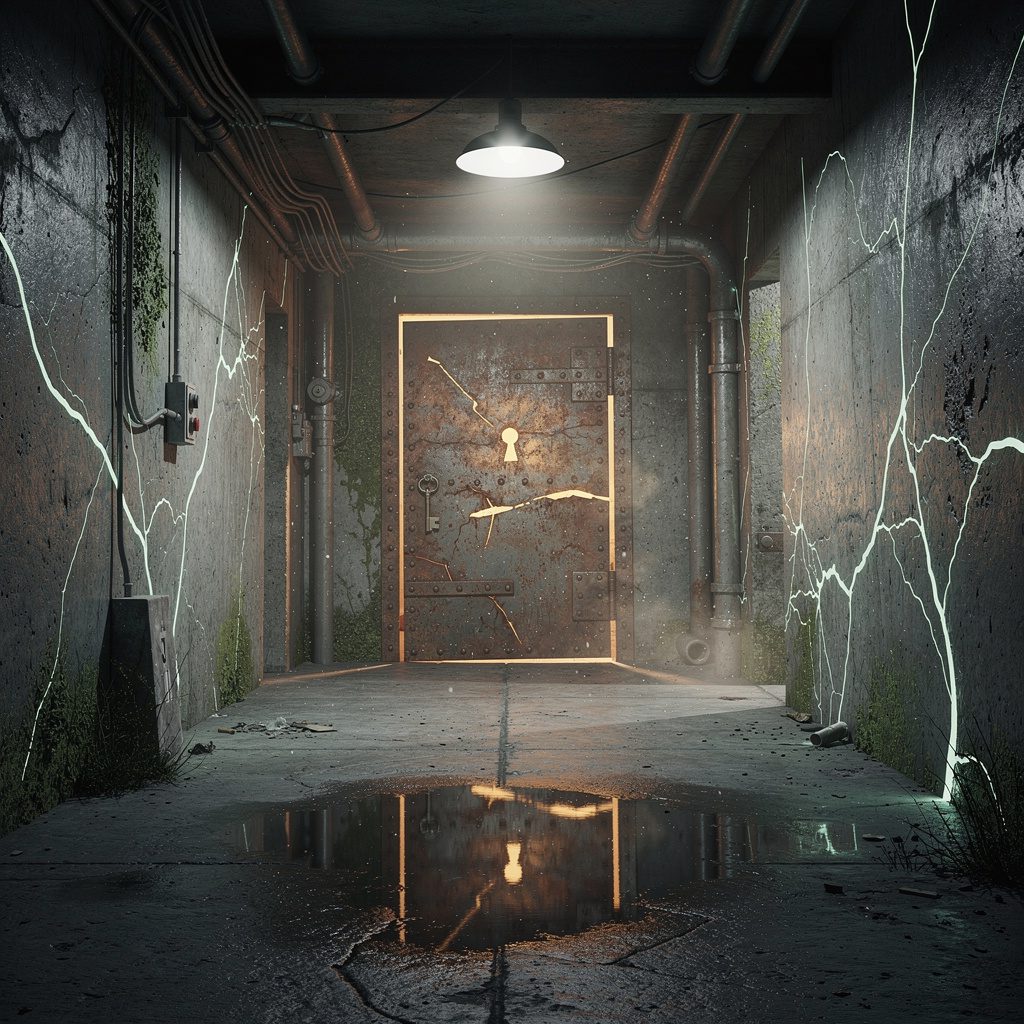
Ifeoma’s hollow is named Dara.
Dara, her brother, who died on a Wednesday in autumn, who loved bad puns and excellent coffee and who sent her a voicemail three days before the accident that she has never been able to listen to all the way through. Forty-seven seconds long. She has started it seventeen times. She has never passed the fourteen-second mark, where his voice does something unguarded and bright that breaks her open every single time.
She does not know that is why the door opened.
She thinks it opened because she pushed at the right angle.
Deep in the market, past the stall of frozen laughter and the coat of kitchen memory, there is a table with nothing on it. Just a table, plain wood, and on the bench beside it, a small device — her brother’s brand of phone, outdated now, the model he had in the last year of his life. She moves toward it the way you move toward something in a dream, knowing you are moving and unable to stop. The singing grows louder as she walks, and now she can almost hear the shape of it: not words, but the feeling of a particular afternoon, a particular quality of light through a car window, a particular silence between two people who do not need to speak.
She sits down.
The phone screen lights up without her touching it.
A voicemail. Forty-seven seconds.
Her hands go flat against the table. She is doing the stillness again — that animal stillness, armor against everything.
Then she presses play.
The first fourteen seconds are what she already knows: the sound of his voice finding its footing, the ambient noise of wherever he was calling from, a bus or a café, the faint percussion of a city going about its business. And then the thing that always breaks her — his voice going soft and unguarded, saying her name, Ife, not the full name, just that, the two syllables he had used since they were children and she had not let anyone else use since.
She listens past it.
Second fifteen. Sixteen. She is shaking slightly, but she does not stop.
He says: I’ve been thinking about that argument we had. The stupid one. About the move and the money and all of it. I was wrong. I know I was wrong. I just wanted to say that, actually say it, because I’m bad at saying things in person and I figured a voicemail is basically a letter and I’m better at letters. So. That’s the message. I was wrong. I love you. Don’t be weird about it.
Fourty-seven seconds.
Done.
Ifeoma sits at the plain wooden table in the impossible market beneath the laundromat on Vessen Street, and she cries in a way she has not cried in four years — not the controlled, managed grief she has allowed herself in private, but the full thing, the unfolded thing, the version that has been living in her back pocket since a Wednesday in autumn.
I will tell you now who I am, because you have earned it: I am the voice of this place. Not its keeper — there is no keeper. I am the record it makes of everyone who passes through, the impression left by each hollow that the door admits. I have held the grief of hundreds. I hold Ifeoma’s now, and I will hold it carefully, because that is what this place does. It does not fix. It does not return what is lost. It only gives you the thing you were not ready for when it mattered — the ending of the voicemail, the second half of the sentence, the moment of clarity that grief kept just out of reach.
Ifeoma stays at the table until the crying is finished.
Then she stands, straightens her jacket, and walks back through the market, past the stall of frozen laughter — and this time she notices that the shimmer above the cup is the sound of Dara laughing, specifically, at one of his own bad puns. She does not take it. She does not need to.
The door opens from this side without any resistance at all.
She steps back into the corridor. The puddle. The smell of old concrete. The flashlight in her hand.

 WhatsApp
 Telegram
 Email






Categories
- AI & Technology
- Contemporary
- Corporate Control
- Creepypasta
- Crime Thriller
- Cyberpunk
- Dark Fantasy
- Enemies to Lovers
- Fairy Tale Retelling
- Fantasy
- First Contact
- Forbidden
- Genetic/Body Horror
- High Fantasy
- Monster Hunter
- Mythic/Folklore
- Paranormal
- Portal/Otherworld
- Post-Apo
- Post-Collapse Society
- Psychological Thriller
- Romances
- SCI-FI
- Second Chance
- Slow Burn
- Space Combat
- Spacepunk
- Surveillance State
- Survival Thriller
- Thrillers
- Time Travel
- Treasure Hunter
- Urban Fantasy
- Witchcraft/Curses
Tags
10min stories atmospheric atmospheric fantasy atmospheric fiction contemporary romance Creepy creepypasta crime thriller dark fantasy debt dystopia emotional fiction enemies to lovers ensemble cast epistolary fantasy female protagonist first person forbidden romance framed narrative high fantasy love story magic Memory mystery Paranormal psychological horror psychological thriller romance sci-fi second chance second chance romance short fiction short story slow burn space station speculative fiction supernatural Survival survival thriller suspense thriller travel romance witchcraft workplace romance
Leave a Reply