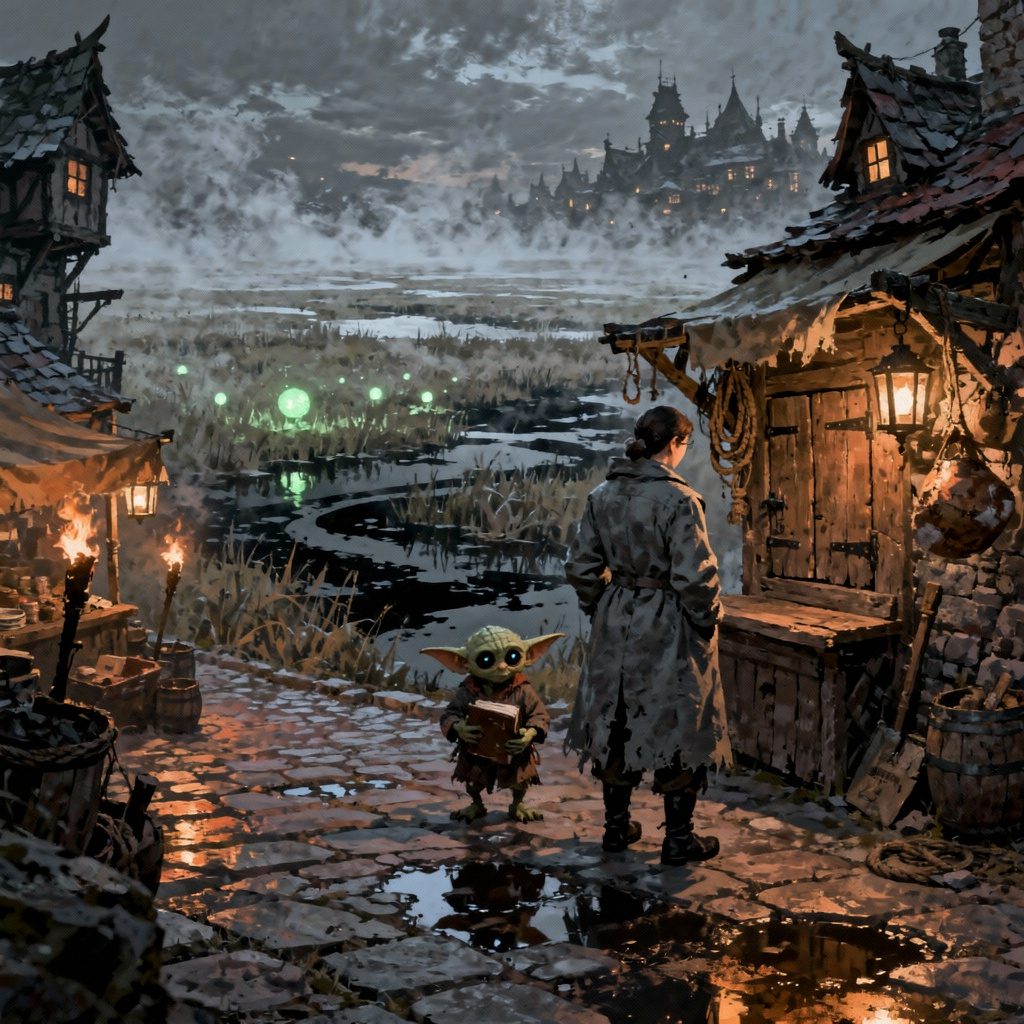
The cellar was cold. Not the ordinary cold of underground stone, but the particular cold that has weight to it, that presses against the back of your neck like a held breath.
She found the creature in the corner behind the salt barrels.
It is difficult to describe something that does not want to be seen clearly. This one was perhaps the size of a large dog, but it did not move like a dog and it did not hold its shape the way solid things do. It was predominantly the color of the cellar walls — grey-brown stone — but its edges blurred and shifted, as though the darkness around it was part of its body rather than merely its surroundings. Where its head should have been, there was instead a cluster of pale filaments, fine as hair, each one ending in a tiny point of faint green light. These filaments moved continuously, not with any wind, but with a slow, deliberate rotation, like the spokes of a wheel turning in a dream. The jaw she had examined at the market was clearly its jaw, though the creature’s mouth was currently sealed, a thin line of darker shadow across the lower part of its blurred form. It was old. She could tell by the way the cold organized itself around it — not radiating outward from the creature, but flowing toward it, as though it consumed cold the way other things consumed warmth.
She had seen three of this kind before. The fae called them Listeners. The name was not metaphorical.
She set her trap — iron dust laid in a ring, a small glass vial of rendered mistletoe oil, a length of copper wire wound in a specific pattern she had learned from a book she had paid too much for and never regretted. She worked quickly. The Listener’s filaments tracked her movements with unsettling precision.
Then the trap failed.
Not because she’d made an error. Because something intervened.
The cold shifted. The filaments froze. And in the corner of the cellar, where no door existed, a figure stepped through the stone wall as though the stone were merely a suggestion.
I will be honest: this is the part I had been dreading.
The fae was called Tindrel, and Tindrel looked, at first glance, like a very composed young person in a pale coat. The second glance corrected this impression substantially. Tindrel stood perhaps five feet tall, with limbs that were slightly too long for the torso, fingers that had one joint too many, and a face that was beautiful in the precise way that certain mathematical patterns are beautiful — correct, symmetrical, and deeply uncomfortable to look at directly. The skin was the silver-white of birch bark, faintly luminescent in the cellar dark. The eyes had no visible iris, only a deep, still amber that seemed to absorb light rather than reflect it. Tindrel’s hair moved without wind, a slow drift of silver-black that suggested the creature existed in a slightly different gravitational field than everything else in the room. The coat was not quite any color. It changed as Tindrel moved — pearl, then grey, then the exact shade of the sky before a storm decides what it wants to be.
“Evan Gilmartin,” Tindrel said. The voice was pleasant and absolutely without warmth. “Seven years.”
Evan did not step back. “I know.”
“The debt was a life. You borrowed a life. You have not repaid it.”
“I know what the debt was.”
“The Listener is mine,” Tindrel said, almost gently. “I placed it here. It collects what I am owed. The child’s sleep. The family’s quiet. These are interest, Evan. The debt itself remains.”
The Listener’s filaments had resumed their slow rotation. Toward Tindrel now. Deferential.
Evan’s jaw tightened. “The child is six.”
“Interest is interest.”
There was a silence in the cellar that had texture to it.
Here is what I know, because I was outside the cellar door by then, pressed against it with my ear against the wood like the professional I am: Evan Gilmartin had borrowed a life seven years ago. Not a metaphor. A literal life — her own, which had been ending, which Tindrel had extended in exchange for a future payment of equivalent value. One life, to be named later. That is the worst kind of fae contract. The open-ended kind. The kind where they get to define the terms when they’re ready to collect.
Tindrel was ready.

 WhatsApp
 Telegram
 Email






Categories
- AI & Technology
- Contemporary
- Corporate Control
- Creepypasta
- Crime Thriller
- Cyberpunk
- Dark Fantasy
- Enemies to Lovers
- Fairy Tale Retelling
- Fantasy
- First Contact
- Forbidden
- Genetic/Body Horror
- High Fantasy
- Monster Hunter
- Mythic/Folklore
- Paranormal
- Portal/Otherworld
- Post-Apo
- Post-Collapse Society
- Psychological Thriller
- Romances
- SCI-FI
- Second Chance
- Slow Burn
- Space Combat
- Spacepunk
- Surveillance State
- Survival Thriller
- Thrillers
- Time Travel
- Treasure Hunter
- Urban Fantasy
- Witchcraft/Curses
Tags
10min stories atmospheric atmospheric fantasy atmospheric fiction contemporary romance Creepy creepypasta crime thriller dark fantasy debt dystopia emotional fiction enemies to lovers ensemble cast epistolary fantasy first person folklore forbidden romance framed narrative high fantasy love story magic Memory mystery Paranormal psychological horror psychological thriller romance sci-fi second chance second chance romance short fiction short story slow burn space station speculative fiction supernatural Survival survival thriller suspense thriller travel romance witchcraft workplace romance
Leave a Reply