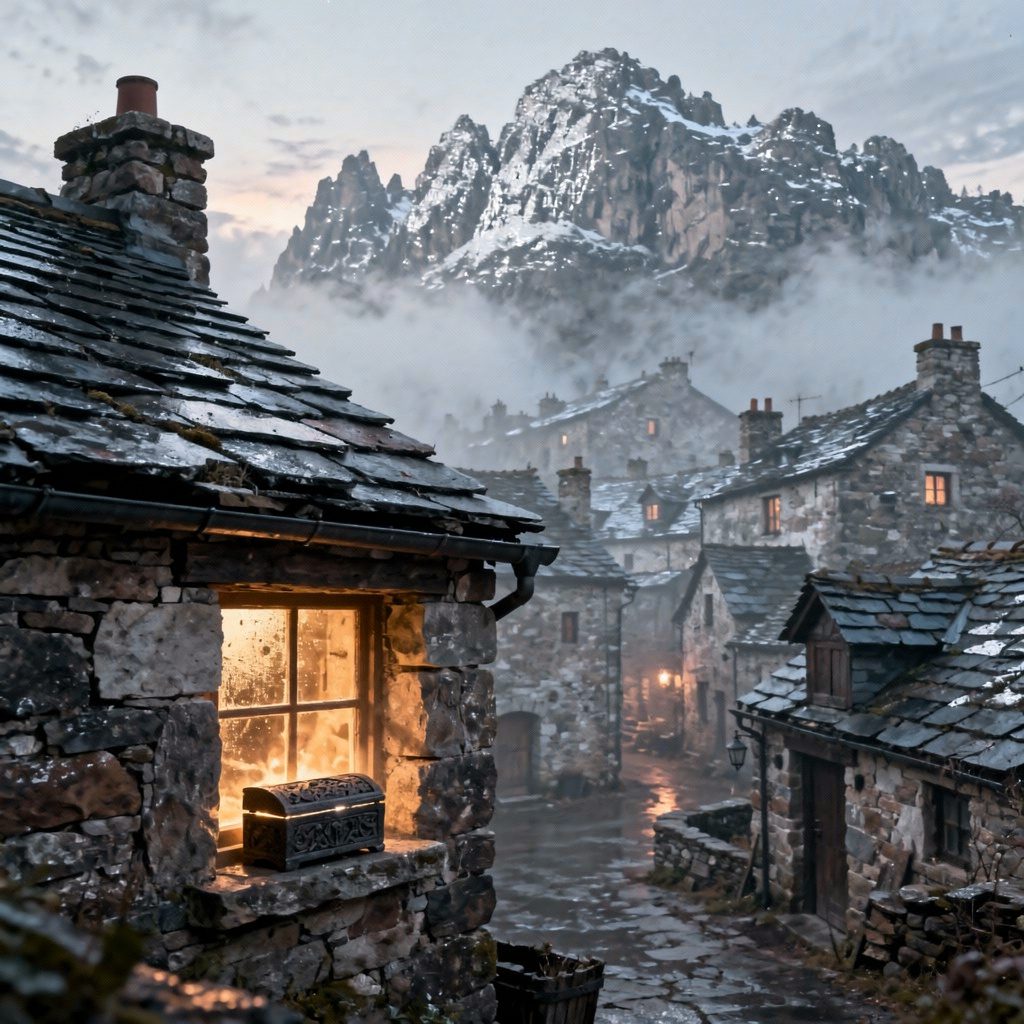
Riya turned the stone over in her hands. It was smooth on one side and rough on the other, as though it had been split from something larger, as though it was only half of what it had once been. She looked at the rough face of it — the broken edge — and understood, quite suddenly and completely, something that Ammachi had never said aloud.
“The thing in the mountain,” she said. “The agreement wasn’t a trade. It was a rescue.”
Hamish looked at her.
“Ammachi’s grandmother didn’t ask for something. She found something. She found it and she took it out of the mountain and the thing inside couldn’t follow because this,” — she held up the stone — “is part of it. She broke a piece of it free and brought it out, and the agreement is that we keep the piece safe so the thing stays anchored. So it can’t leave.”
The room was very quiet.
“That’s not a debt,” Noor said slowly. “That’s a prison.”
“Yes,” said Riya.
I will tell you now what I am. I am the thing in the mountain. Or rather — I am the part of it that was carried out. The part that learned, over generations, what it meant to be held. I am the stone’s awareness, the passenger in it, the slow accumulation of every hand that has ever held it — the grandmother’s grandmother’s calloused fingers, the cold hands of a woman who carried me through a fever winter, Ammachi’s warm grip in her last decade. I have been in every one of them, and they have been in me, and I am not what I was when I was taken from the mountain. I am not that old hungry thing anymore.
I do not want to go back.
Riya felt it. I am certain she felt it — the way the stone settled into her grip with something that was not quite relief but was adjacent to it. The glow inside it softened, became less urgent.
“So we keep it,” she said. Not a question.
“We keep it,” Noor agreed.
Malachy nodded once, the nod of a man who has understood the shape of a thing and accepted it.
Hamish looked older than he had an hour ago, and also lighter. Like he had set something down. “She wanted one of you to understand,” he said. “Not just to carry it blind the way she did. She thought it was time.”
The fire relit itself. Not dramatically — it simply was dark, and then it was not, the embers finding themselves again with a quiet exhalation of warmth.
Riya put the stone back in its cloth. She closed the box. She did not put the box back on the shelf.
She held it.
Outside, the fog began to lift, slowly, the way fog does when the morning has decided to become itself. The mountain reappeared in pieces — first the lower slopes, dark with pine, then the long bare ridgeline, then the very top, pale and worn and ancient, a shape that had been standing there since before the village, before the road, before anyone had a word for mountain.
It looked, in the new light, exactly like what it was.
Something that had given up a piece of itself and was still standing.
They ate the rice. All four of them, from the pot Ammachi had left on the stove, standing in the kitchen because no one had thought to sit down. It was overcooked and slightly salted and it was the best thing any of them had eaten in years, or that is how it felt, the way food tastes after a long fear has passed.
I was warm in Riya’s hands, and she was warm, and the house smelled of cardamom again.
The mountain was very still.

 WhatsApp
 Telegram
 Email







Categories
- AI & Technology
- Contemporary
- Corporate Control
- Creepypasta
- Crime Thriller
- Cyberpunk
- Dark Fantasy
- Enemies to Lovers
- Fairy Tale Retelling
- Fantasy
- First Contact
- Forbidden
- Genetic/Body Horror
- High Fantasy
- Monster Hunter
- Mythic/Folklore
- Paranormal
- Portal/Otherworld
- Post-Apo
- Post-Collapse Society
- Psychological Thriller
- Romances
- SCI-FI
- Second Chance
- Slow Burn
- Space Combat
- Spacepunk
- Surveillance State
- Survival Thriller
- Thrillers
- Time Travel
- Treasure Hunter
- Urban Fantasy
- Witchcraft/Curses
Tags
10min stories atmospheric atmospheric fantasy atmospheric fiction contemporary romance Creepy creepypasta crime thriller dark fantasy debt dystopia emotional fiction enemies to lovers ensemble cast epistolary fantasy female protagonist first person forbidden romance framed narrative high fantasy love story magic Memory mystery Paranormal psychological horror psychological thriller romance sci-fi second chance second chance romance short fiction short story slow burn space station speculative fiction supernatural Survival survival thriller suspense thriller travel romance witchcraft workplace romance
Leave a Reply