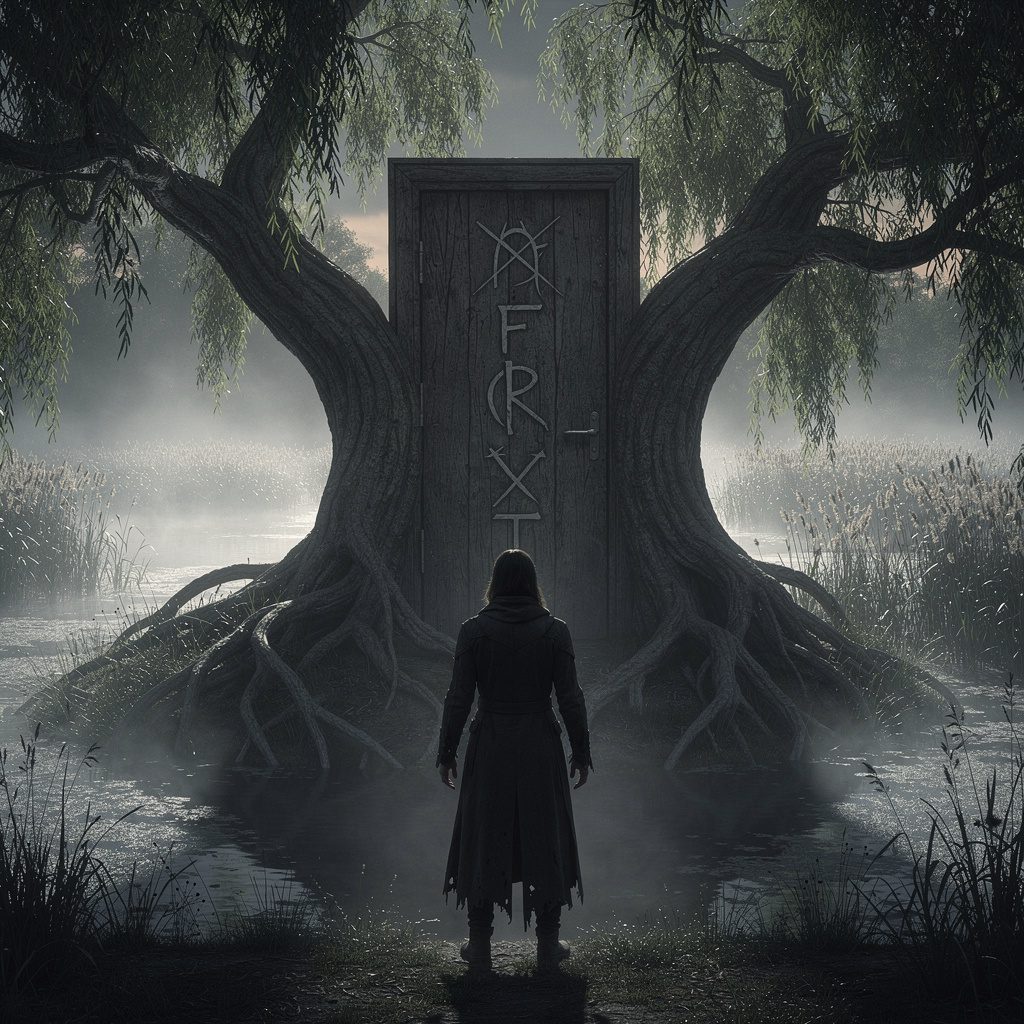
The Hollow Keeper had been waiting since her great-great-great-grandmother pressed her thumb to a reed-parchment contract and said: we accept. It had watched each payment arrive. It had watched Marit born, and named, and grown. It had known, always, that the seventh debt would be a conversation, and it had been curious — genuinely, deeply curious, in the way only very old things that have seen many outcomes can still manage to be — about what she would say.
She opened the door.
Beyond it was not another place. It was a space — a room with no walls she could locate, filled with the same fog as the marsh but warmer, and lit by no source she could name. In the center of that space stood the Hollow Keeper.
It was tall, and it was old, and it was made of the same materials as the marsh — reed and water and patience and fog. Its face was a smooth pale oval, featureless except for two long, vertical marks where eyes would have been on a human face, dark as still water. Its fingers were too long and ended in points like the tips of reeds. It wore something that might have been a coat or might have been a collection of shadows that had agreed to hold a shape. When it moved, it did not make sound. When it was still, the air around it felt like the moment before a question is asked.
“You are the seventh,” it said. Its voice was the sound of water moving under ice.
“I know,” Marit said.
“The seventh debt is a conversation. Your ancestor agreed that the seventh of her line would answer one question honestly. One question. Nothing more.”
Marit had expected a demand. She had expected to be asked to give something up — a memory, a year of her life, a name. She had braced herself for loss.
“Ask it,” she said.
The Hollow Keeper was quiet for a long moment. The fog shifted.
“Do you believe the pact was worth it?”
The question landed in her chest like a stone into still water, and the ripples moved outward through everything she had ever known about Valderskot. The healthy births. The never-dry well. The names erased, the children given over, the sealed wells and the quiet sacrifices she had grown up beside without ever looking at directly. She thought about her grandmother, who had paid the fourth debt and never spoken of it. She thought about the village in winter, warm and fed while the settlements on either side of the fen starved. She thought about her own life, given freely to her, unasked for, built on a foundation she had not laid.
She answered honestly.
“I don’t know,” she said. “I think it kept people alive who would have died. I think it cost people things they shouldn’t have had to pay. I think both of those things are true at the same time, and I don’t think I get to decide which one matters more.”
The Hollow Keeper looked at her for a long moment with its dark, still eyes.
“That is an honest answer,” it said.
Then it reached out one long-fingered hand and drew a line through the seventh mark on the door.
The debt was finished.
Marit walked back through the marsh as the fog began, slowly, to thin. The reeds were still. The water held the last light of the sky in long, flat reflections. She felt no different than she had that morning, and also entirely different, in the way a person feels after they have said something true that they have been turning over in silence for a long time.
She had gone in expecting to lose something.
What she had lost, she realized, was the belief that the pact was either purely good or purely terrible — a clean story she could carry without looking at it too hard. What she had found instead was the full weight of it: the lives saved and the lives changed and the cost that ran through all of them like a seam of dark stone through pale rock. It was heavier than the clean story. It was also, somehow, easier to carry.
The village gate was lit when she came back through it. Someone had left a lantern burning on the post.
She went inside and sat by the cold hearth and held a cup of tea that went cold without her drinking it, and she said nothing to anyone that night.
The Hollow Keeper, for its part, returned to the deep fen. It had asked its question across six generations of waiting, and it had received the only answer worth receiving — not certainty, but honesty. It settled into the fog and the reeds and the slow, patient dark, and it did not watch Valderskot anymore.
The village’s good fortune did not end. But it became, from that point forward, entirely its own.

 WhatsApp
 Telegram
 Email






Categories
- AI & Technology
- Contemporary
- Corporate Control
- Creepypasta
- Crime Thriller
- Cyberpunk
- Dark Fantasy
- Enemies to Lovers
- Fairy Tale Retelling
- Fantasy
- First Contact
- Forbidden
- Genetic/Body Horror
- High Fantasy
- Monster Hunter
- Mythic/Folklore
- Paranormal
- Portal/Otherworld
- Post-Apo
- Post-Collapse Society
- Psychological Thriller
- Romances
- SCI-FI
- Second Chance
- Slow Burn
- Space Combat
- Spacepunk
- Surveillance State
- Survival Thriller
- Thrillers
- Time Travel
- Treasure Hunter
- Urban Fantasy
- Witchcraft/Curses
Tags
10min stories atmospheric atmospheric fantasy atmospheric fiction contemporary romance Creepy creepypasta crime thriller dark fantasy debt dystopia emotional fiction enemies to lovers ensemble cast epistolary fantasy first contact first person forbidden romance framed narrative high fantasy love story magic Memory mystery Paranormal psychological horror psychological thriller romance sci-fi second chance second chance romance short fiction short story slow burn space station speculative fiction supernatural Survival survival thriller suspense thriller travel romance witchcraft workplace romance
Leave a Reply