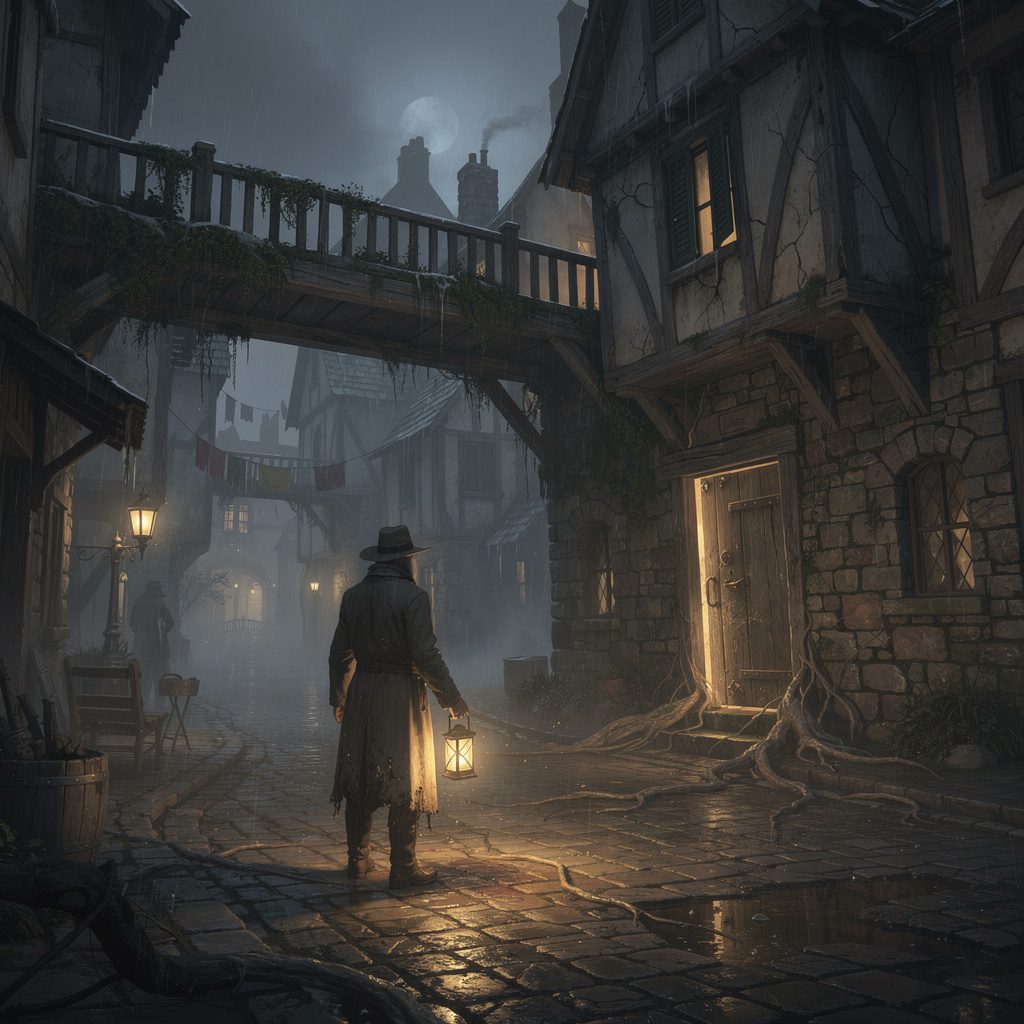
Zhi Nakamura arrived in Vethmarr on the morning of the same day Adaeze found the door. He was a botanical archivist from the eastern city of Drenmark, traveling with a satchel of pressed specimens and a letter of introduction to a herbalist on Canal Row who had reportedly catalogued every root and spore growing in the Hollow Ward’s cracked streets. Zhi was meticulous and unhurried in the way that scholars are — not from caution but from the habit of attention. He was slight in frame, with close-cropped hair and ink-stained fingers and a tendency to crouch near the base of walls to examine the growth there, which meant he spent much of his first hour in Vethmarr crouching. He had noticed the pale root-threads in the cobblestones almost immediately. He had crouched and pressed a fingertip to one and found it warm. He had written this down in a small notebook with a soft cover.
He did not find the herbalist’s address on Canal Row.
He found, instead, a lane called Tether Lane. And at the end of it, a millhouse. And in the east wall of the millhouse, a door.
He was reaching for it when Adaeze’s hand closed around his wrist.
“Don’t.”
He turned. She was already pulling him backward, not roughly, but with the kind of certainty that does not leave room for argument.
“That door,” he said.
“I know.”
“It wasn’t—”
“I know what it wasn’t. Step back.”
He stepped back. He was not a foolish man. The smell reached him then — that low, wet, organic wrongness — and his body understood it before his mind caught up.
Adaeze was already moving. From one of her coat’s inner pockets she drew the copper wire threaded with heather, and from another the ghost-nettle oil, and she worked quickly now, with the focused efficiency of someone who has rehearsed this in the dark many times. She pressed the wire against the doorframe at three points — low, mid, high — and touched a drop of oil to each contact point. The heather, she told him later, was for anchoring. The oil was for opening channels in the boundary between the Vestment’s borrowed body and the material of the wall it had settled into. The copper carried the intention.
I remember the smell of the oil more than anything else. Bright and sharp, like something green being torn open.
“Cover your ears,” she said.
He did.
She spoke the word on the bark slip. Not loudly. A word does not need to be loud to be absolute.
The door shuddered. The wood darkened further, as though something behind it was pressing outward — not in panic, but in the slow, vast, indifferent way that a tide presses against a seawall. The pale root-threads in the cobblestones around them went rigid and white, and then they went dark. The smell intensified for three full seconds and then vanished entirely, like a candle snuffed between two fingers.
The door was still there. But it was just a door now. Old wood. No warmth. No smell. No wrongness in the grain of it.
Adaeze let out a slow breath.
“What was it?” Zhi asked.
She told him the word for it. He wrote it in his notebook, which she found, later, to be the most characteristic response she had ever witnessed from someone who had just survived an encounter with something that ate people through borrowed architecture.
“And the roots,” he said, looking at the cobblestones. “They were warm when I arrived. They’re cold now.”
“They were feeding it.” She crouched beside him and looked at the pale threads. “Or it was feeding them. I’ve never been certain which direction that runs.”
He looked at her. “Do you want to know?”
She considered this for a long moment. In eleven years of hunting in Vethmarr, no one had ever asked her that particular question.
“Yes,” she said. “I think I do.”
I am writing this from a room that smells of dried fennel and copper, with a window that faces a courtyard I cannot leave — not because I am imprisoned, but because the courtyard is where we work. The bench outside is covered in specimens: pressed roots, vials of extracted oil, coils of copper wire, and a growing catalogue of the things that live beneath the stones of the Hollow Ward. The herbalist on Canal Row turned out to be a useful contact after all. The city still leans and whispers. The canal still holds its bruised lamplight. But the doors that should not be there — we find them now before they find anyone else, and I am no longer writing alone.

 WhatsApp
 Telegram
 Email







Categories
- AI & Technology
- Contemporary
- Corporate Control
- Creepypasta
- Crime Thriller
- Cyberpunk
- Dark Fantasy
- Enemies to Lovers
- Fairy Tale Retelling
- Fantasy
- First Contact
- Forbidden
- Genetic/Body Horror
- High Fantasy
- Monster Hunter
- Mythic/Folklore
- Paranormal
- Portal/Otherworld
- Post-Apo
- Post-Collapse Society
- Psychological Thriller
- Romances
- SCI-FI
- Second Chance
- Slow Burn
- Space Combat
- Spacepunk
- Surveillance State
- Survival Thriller
- Thrillers
- Time Travel
- Treasure Hunter
- Urban Fantasy
- Witchcraft/Curses
Tags
10min stories atmospheric atmospheric fantasy atmospheric fiction contemporary romance Creepy creepypasta crime thriller dark fantasy debt dystopia emotional fiction enemies to lovers ensemble cast epistolary fantasy female protagonist first person forbidden romance framed narrative high fantasy love story magic Memory mystery Paranormal psychological horror psychological thriller romance sci-fi second chance second chance romance short fiction short story slow burn space station speculative fiction supernatural Survival survival thriller suspense thriller travel romance witchcraft workplace romance
Leave a Reply