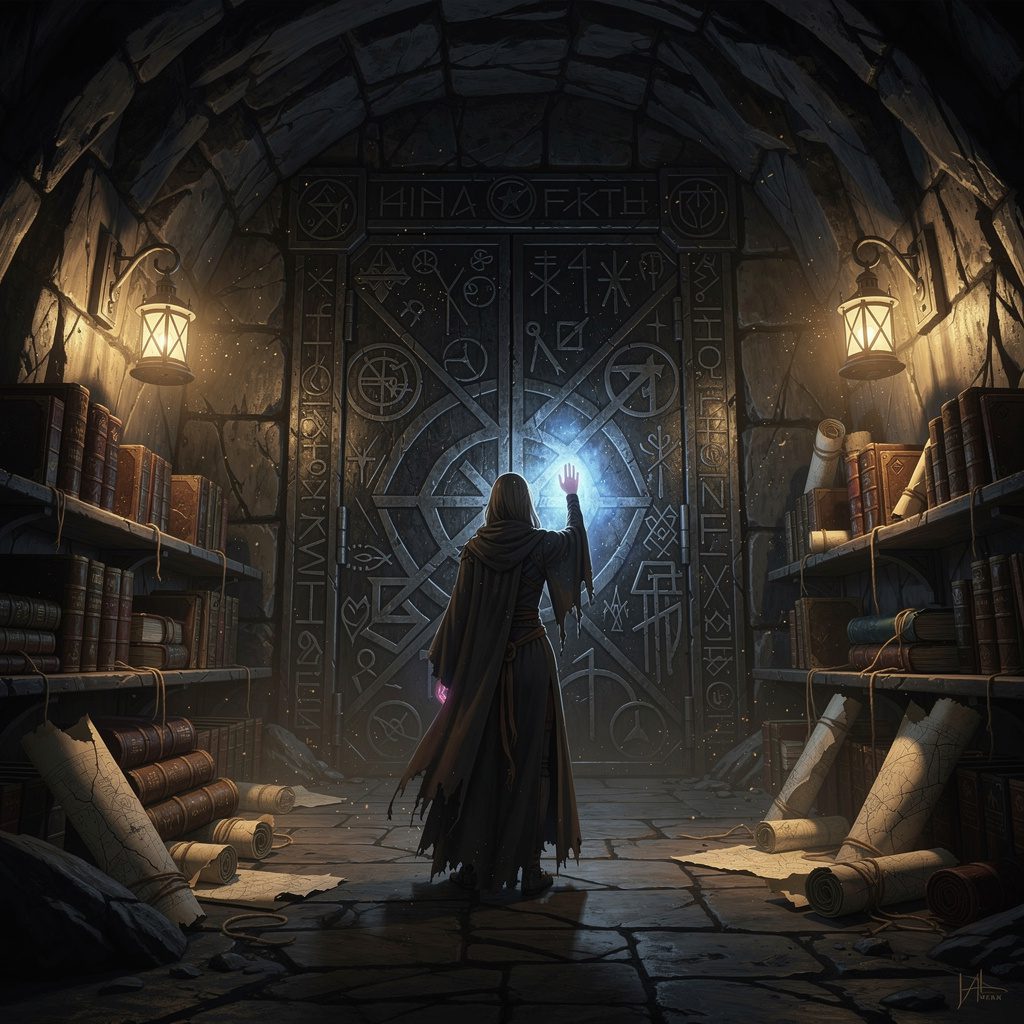
The door was open when I came back. That was the first wrong thing. I had left it sealed, left it humming with whatever old grief the stone remembered, and now it stood wide, breathing cold air into the corridor like a mouth that had finally said what it meant to say. Sorwen was gone. The lantern she had carried lay on its side, still lit, its flame burning flat and steady in the stillness. I knelt beside it and pressed two fingers to the floor, and the stone was warm where she had stood, warmer than it should have been, warmer than stone has any right to be. That was how I knew she had gone through willingly. Sorwen Duskwhisper, who had survived the collapse of the Greyveil Bridge and the winter siege of Ashmark, had walked through a door that I had specifically, clearly, and loudly told her not to touch. I stayed kneeling for a long moment. Then I picked up her lantern, and I went in after her.
I should tell you how we got there.
The fortress of Khaldun-Serrat had been dead for two hundred years when the cartographer’s guild first marked it on their revised maps, and dead for another forty by the time Sorwen and I accepted the commission to find what was left of its archive. The guild wanted records — old territorial agreements, boundary-marks, names of passes that had been forgotten when the fortress fell. Dry work, they said. Safe work. The kind of commission you take when you are tired and your bones ache and you want three weeks of quiet corridors instead of another contract that ends with someone bleeding on a hillside. We rode north from the city of Verath Dun through farmland that slowly became scrubland, and scrubland that slowly became the kind of grey, windswept emptiness that makes you feel like the land itself has given up. Sorwen spent most of the ride reading. She was tall for a half-Vael, with the long, slightly luminous fingers her mother’s bloodline gave her and the dark, deeply set eyes of her father’s people, and she had a habit of reading on horseback that I had long since stopped finding remarkable. I rode and watched the horizon. I had commanded enough campaigns to know that horizons lie, that the thing that will kill you never announces itself from a distance. But nothing came. The land stayed empty. And on the fourth morning, Khaldun-Serrat appeared on a ridge above us like a broken tooth against the white sky.
The fortress was vast and it was cold and it smelled of old iron and standing water. We entered through the collapsed eastern gate, picking our way over rubble that had long since been colonized by pale, tenacious moss, and we found the main hall in reasonable condition — the roof intact, the great hearthstone cracked but present, the walls still holding their carved friezes of mounted soldiers and river-maps and the looping script of the old Khalduni administrative language that Sorwen could read and I could not. She moved through it with her notebook open, copying inscriptions, pausing to trace a carved border with her fingertip and murmur something to herself. I walked the perimeter. Old habit. You walk the perimeter of every space you enter, even dead ones, because dead spaces have a way of becoming suddenly less dead. The hall was clear. The two side chambers were clear. The stairwell leading down to what had once been the records vault was clear, if you did not count the smell, which was not rot exactly but was something adjacent to it — the smell of a space that had been sealed and then unsealed and then sealed again, repeatedly, over a very long time.

 WhatsApp
 Telegram
 Email






Categories
- AI & Technology
- Contemporary
- Corporate Control
- Creepypasta
- Crime Thriller
- Cyberpunk
- Dark Fantasy
- Enemies to Lovers
- Fairy Tale Retelling
- Fantasy
- First Contact
- Forbidden
- Genetic/Body Horror
- High Fantasy
- Monster Hunter
- Mythic/Folklore
- Paranormal
- Portal/Otherworld
- Post-Apo
- Post-Collapse Society
- Psychological Thriller
- Romances
- SCI-FI
- Second Chance
- Slow Burn
- Space Combat
- Spacepunk
- Surveillance State
- Survival Thriller
- Thrillers
- Time Travel
- Treasure Hunter
- Urban Fantasy
- Witchcraft/Curses
Tags
10min stories atmospheric atmospheric fantasy atmospheric fiction contemporary romance Creepy creepypasta crime thriller dark fantasy debt dystopia emotional fiction enemies to lovers ensemble cast epistolary fantasy female protagonist first person forbidden romance framed narrative high fantasy love story magic Memory mystery Paranormal psychological horror psychological thriller romance sci-fi second chance second chance romance short fiction short story slow burn space station speculative fiction supernatural Survival survival thriller suspense thriller travel romance witchcraft workplace romance
Leave a Reply