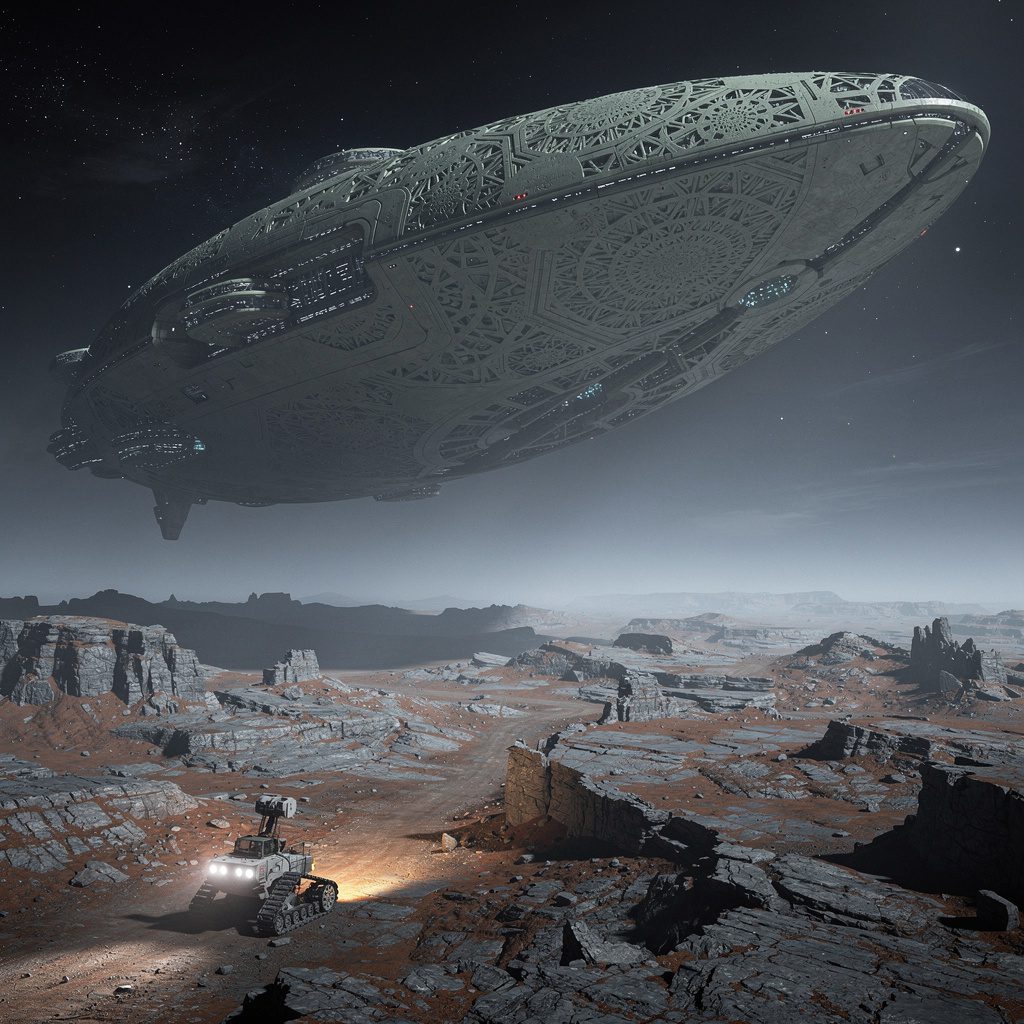
Four minutes and eleven seconds remained on the contact window when Deirdre Callahan pressed her palm flat against the hull and said, “It’s showing me the chamber again.”
No one argued. No one had the time.
The vessel—if vessel was even the right word for a structure that seemed to grow rather than be built—had been drifting in a decaying orbit above Ceth IV for nineteen days. Its surface was a matte grey-green, the color of lichen on old stone, covered in what the survey team had initially catalogued as corrosion. Closer inspection revealed something else entirely: texture. Deliberate, recursive, fractal texture, as though every square centimeter of the hull had been carved with the same patient obsession. Not decoration. Language, possibly. Or memory. The structure was roughly four kilometers along its longest axis, tapered at both ends like a seed pod that had never needed to open, its midsection swollen with a vast interior space that their ground-penetrating scans could not fully resolve. It absorbed most frequencies. It reflected light in a way that made it look wet even in vacuum.
They had eleven minutes of viable signal each orbital pass. The orbit was degrading. In four minutes and eleven seconds, the window would close, and the vessel would swing behind Ceth IV’s terminator line into seventeen hours of silence.
Deirdre had the implant. The others did not.
The Forerunner Predictive Interface—FPI-7, in the documentation no one read anymore—had been installed at the base of her skull fourteen months ago as part of a xenolinguistics research program that assumed first contact, if it ever came, would require faster cognitive processing than unaugmented human biology could manage. The implant was a bridge, theoretically. It sampled incoming data streams—electromagnetic, acoustic, structured light, anything the sensors fed it—and extrapolated forward, presenting the most probable next-state as a brief, vivid hallucination layered over her normal vision. Not the future, the documentation insisted. A prediction. A best guess, rendered in full sensory detail.
For fourteen months it had shown her nothing unusual. Conversations before they happened. A corridor junction before she turned the corner. Ravi’s coffee mug reaching the table before it landed.
Then the vessel arrived, and the implant began showing her things it had no business predicting.
Ravi Menon saw her hand trembling against the hull. He crossed the crawler’s narrow operations deck in three steps. “Same image?”
“Same chamber. Different angle.” She blinked hard, and the overlay faded. “It’s like the implant is receiving. Not predicting. Receiving.”
Henrik Moen looked up from the signal console. He was a tall man, economical with words, the kind of engineer who communicated primarily through the quality of his silences. This silence said: that is not how the implant works.
“I know,” Deirdre said, answering the silence. “But the imagery is too specific. The chamber has a floor pattern—concentric rings, alternating matte and reflective. There’s a structure at the center. Cylindrical, about two meters tall. And every time I see it, the cylinder is open.”
“Open how?” Ravi asked.
“Like it’s waiting.”
Three minutes, forty seconds.
Nikhil Iyer had not moved from the secondary display. He was the mission’s contact theorist, and he had spent nineteen days arguing that the vessel was not responding to any of their signals because the vessel was not yet ready to respond. He believed, with the particular patience of someone who had staked a career on a single idea, that contact was not an event but a process, and that the process had its own tempo that human urgency could not accelerate.
He was reconsidering that now.
“If the implant is receiving,” he said carefully, “then something inside that vessel is transmitting. Specifically to the FPI hardware. Which means it knows the FPI hardware exists.” He paused. “Which means it has been studying us for longer than we’ve been studying it.”
The crawler went quiet except for the soft percussion of environmental systems.
“The imagery,” Deirdre said. “I think it’s an invitation.”
“Or a lure,” Henrik said, not looking up.
“Or a lure,” she agreed. “But we have three and a half minutes left in this window, and we’ve had nineteen days of nothing. If we don’t attempt a response now—”
“What kind of response?” Ravi asked.

 WhatsApp
 Telegram
 Email







Categories
- AI & Technology
- Contemporary
- Corporate Control
- Creepypasta
- Crime Thriller
- Cyberpunk
- Dark Fantasy
- Enemies to Lovers
- Fairy Tale Retelling
- Fantasy
- First Contact
- Forbidden
- Genetic/Body Horror
- High Fantasy
- Monster Hunter
- Mythic/Folklore
- Paranormal
- Portal/Otherworld
- Post-Apo
- Post-Collapse Society
- Psychological Thriller
- Romances
- SCI-FI
- Second Chance
- Slow Burn
- Space Combat
- Spacepunk
- Surveillance State
- Survival Thriller
- Thrillers
- Time Travel
- Treasure Hunter
- Urban Fantasy
- Witchcraft/Curses
Tags
10min stories atmospheric atmospheric fantasy atmospheric fiction contemporary romance Creepy creepypasta crime thriller dark fantasy debt dystopia emotional fiction enemies to lovers ensemble cast epistolary fantasy female protagonist first person forbidden romance framed narrative high fantasy love story magic Memory mystery Paranormal psychological horror psychological thriller romance sci-fi second chance second chance romance short fiction short story slow burn space station speculative fiction supernatural Survival survival thriller suspense thriller travel romance witchcraft workplace romance
Leave a Reply