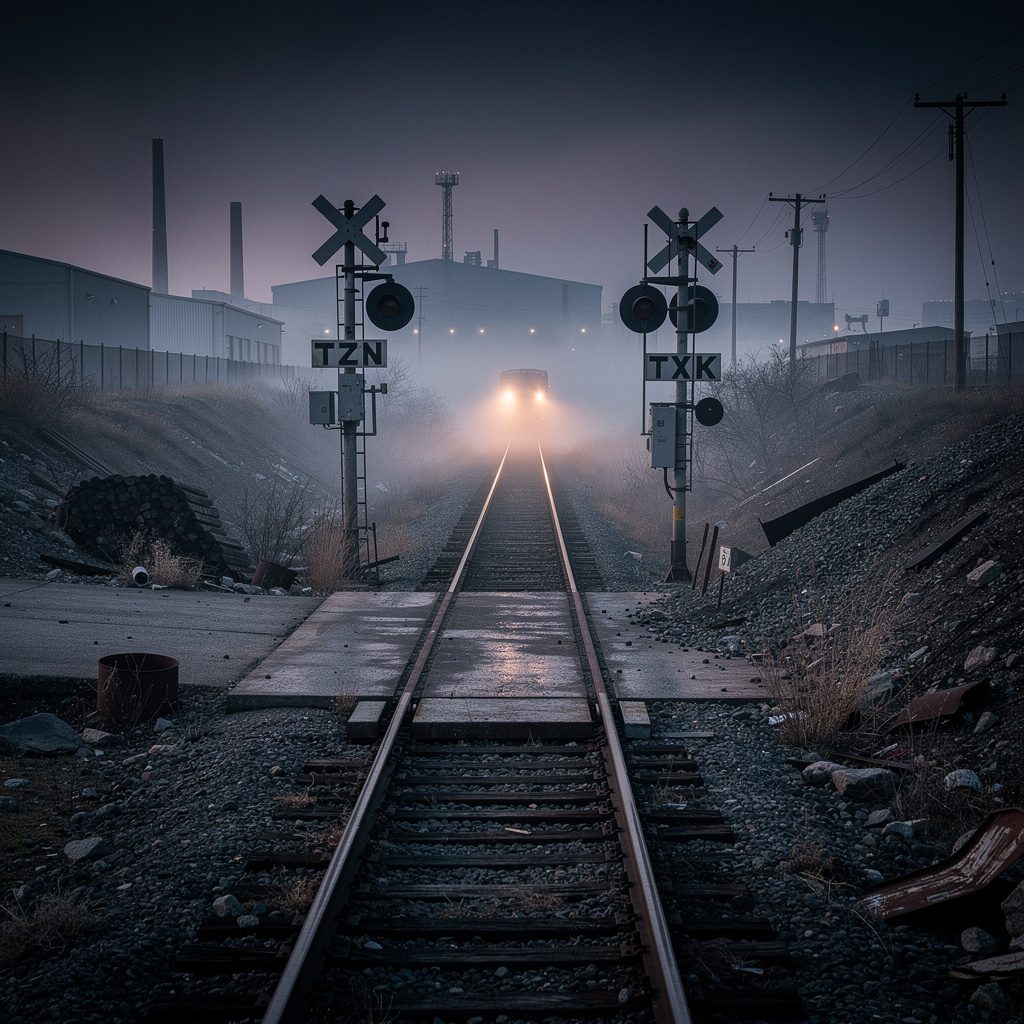
Eleven minutes.
That was how long remained before the 6:47 freight train out of Pittsburgh would roll through the Millbrook crossing at the edge of town — the same crossing where, according to the voice on Verity Ashworth’s car radio, a man named Fernando Cordoba was sitting in a stolen Dodge, engine dead, doors jammed, unable to move.
Verity didn’t know Fernando Cordoba. She didn’t know if the voice was real. She didn’t know, yet, why she was the only one who could hear it.
But she was already driving.
—
It had started forty minutes earlier, on the highway shoulder outside Millbrook, Pennsylvania — a grey industrial town draped along the Monongahela River like a coat someone dropped and never picked up. Verity was a field investigator for the state insurance fraud division, mid-forties, precise, cautious to the point of being called cold by people who didn’t understand the difference between cold and careful. She had pulled over to check a route on her phone when the radio — tuned to a country station she’d barely registered — went quiet.
Not static. Quiet. The kind of quiet that has weight.
Then the voice.
Male, unhurried, almost conversational. “Millbrook freight crossing. A man is in the car. He can’t get out. The 6:47 will not stop.”
Verity had looked at the radio. She had looked at the highway around her — a semi rolling past, a pickup behind it, nobody stopping, nobody reacting. She had turned the volume knob down to zero.
The voice continued at exactly the same level.
“You have time. He doesn’t.”
She had sat very still for a moment. Then she had pulled back onto the highway.
—
Fernando Cordoba, thirty-one years old, had been in the Dodge for just over twenty minutes by the time Verity was turning off Route 40 toward the crossing road. He was not, technically, a victim. He had taken the car — borrowed was the word he used inside his own head, though he knew that wasn’t honest — from the lot behind Delvecchio Brothers Auto, where he worked the night shift and where, three weeks ago, he had found something in the service records that he was not supposed to find.
He had told one person. That had been the mistake.
The Dodge had stalled on the crossing tracks at 6:31 and would not restart. The doors opened normally — he had tested that, twice — but something had happened between the first time he tested them and the second. Both front doors now resisted with a pressure that felt mechanical, engineered, not like a malfunction. The rear doors were the same. He had tried the windows. The electric motor gave a small, defeated sound and stopped.
Fernando was not the kind of man who panicked easily. He had grown up in Allentown in a house where staying calm was a survival skill, not a personality trait. But the tracks were humming now. He could feel it in his seat, a low, rhythmic vibration that the body understands before the mind processes it. He had tried his phone. No signal. The crossing was in a shallow cut between two embankments, and whatever cell coverage existed up on the road did not reach down here.
He looked at the crossing signal. Dark. The mechanism was dead too.
He thought about the name he had given Verity Ashworth six days ago.
—
Verity had met Fernando exactly once, in a coffee shop on Decker Street, at his request. He had called the fraud division’s tip line and she had been assigned the follow-up. He was nervous in the way that people are when they’re doing something right for the first time and aren’t sure it will be received that way — eyes moving, voice low, hands wrapped around a cup he never drank from. He told her that Delvecchio Brothers had been cycling stolen vehicles through their lot, laundering them through fraudulent insurance write-offs, and that the operation ran deeper than the two brothers whose name was on the sign.
He gave her a name. A secondary name. Someone inside the fraud division itself.
Verity had written it down, thanked him, and driven back to the regional office in Pittsburgh with a careful, neutral expression and a feeling in her chest that she recognized and distrusted in equal measure: the feeling of something being true.

 WhatsApp
 Telegram
 Email






Categories
- AI & Technology
- Contemporary
- Corporate Control
- Creepypasta
- Crime Thriller
- Cyberpunk
- Dark Fantasy
- Enemies to Lovers
- Fairy Tale Retelling
- Fantasy
- First Contact
- Forbidden
- Genetic/Body Horror
- High Fantasy
- Monster Hunter
- Mythic/Folklore
- Paranormal
- Portal/Otherworld
- Post-Apo
- Post-Collapse Society
- Psychological Thriller
- Romances
- SCI-FI
- Second Chance
- Slow Burn
- Space Combat
- Spacepunk
- Surveillance State
- Survival Thriller
- Thrillers
- Time Travel
- Treasure Hunter
- Urban Fantasy
- Witchcraft/Curses
Tags
10min stories atmospheric atmospheric fantasy atmospheric fiction contemporary romance Creepy creepypasta crime thriller dark fantasy debt dystopia emotional fiction enemies to lovers ensemble cast epistolary fantasy female protagonist first person forbidden romance framed narrative high fantasy love story magic Memory mystery Paranormal psychological horror psychological thriller romance sci-fi second chance second chance romance short fiction short story slow burn space station speculative fiction supernatural Survival survival thriller suspense thriller travel romance witchcraft workplace romance
Leave a Reply