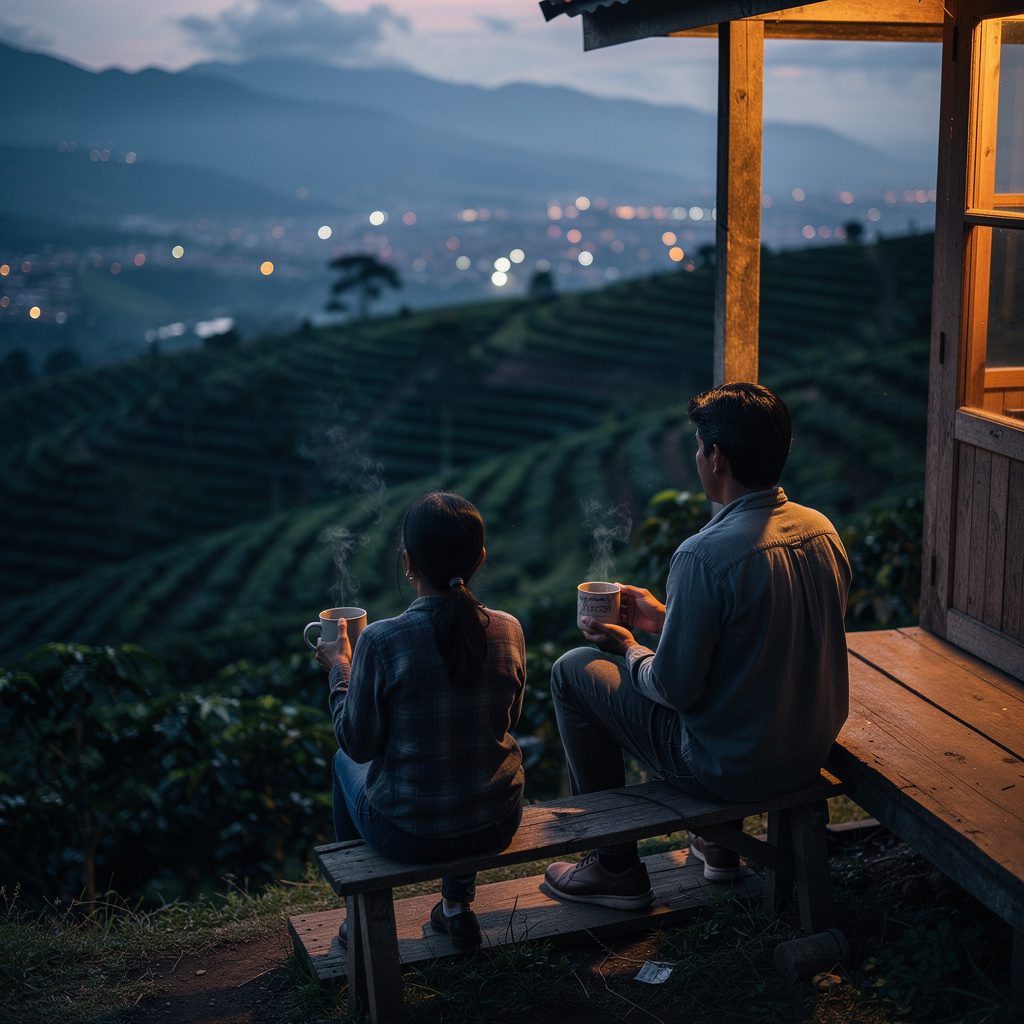
I smell him before I see him.
That sounds absurd, I know. But the plantation has a way of carrying things — pollen, woodsmoke, the green-sweet breath of coffee cherries just before harvest. And underneath all of it, this morning, something that stops me mid-row.
Cedar. Rain-damp wool. A particular kind of stillness.
I press my fingers against the nearest branch and keep walking.
—
His name is Jin Morita, and I haven’t seen him in ten years.
I am Carmela Rincon, and I run this plantation now. My grandmother left it to me three years ago, along with forty acres of arabica, a crumbling farmhouse with a view that makes visitors cry, and a book of handwritten harvest notes going back to 1962. I know every row. Every slope. Every place where the morning fog settles longest and makes the cherries slow and sweet.
I know this land better than I know most people.
What I don’t know — what I never quite figured out — is what to do with the fact that Jin Morita left ten years ago and I told him to go.
—
*Jin, now:*
Dolores Herrera meets me at the road.
She is Carmela’s oldest friend, and she is already grinning in that way she has — like she’s holding a lit match and waiting to see what catches fire.
“She doesn’t know you’re coming,” Dolores says.
“You told me she invited me.”
“I told her the harvest collective needed an agronomist consultant. I told you she specifically requested you.” She shrugs, entirely unrepentant. “Both things are partially true.”
I stare at her.
“The collective really does need a consultant,” she adds helpfully. “And she really does need to see you. She just doesn’t know that second part yet.”
I should leave. I should get back in the rented car and drive down the hill and fly back to Osaka and forget that Dolores sent me a message six weeks ago that said only: *She still has your jacket. Come back.*
I don’t leave.
I follow Dolores up the dirt path toward the farmhouse, and the fog is still thick in the lower rows, and somewhere above us, through the trees, I can hear someone moving.
—
*Carmela, now:*
I hear the voices before I see them.
Dolores. And a man. My chest does something complicated before my brain catches up.
I step out of the row and there he is.
Ten years does things to a person. Jin is leaner, quieter in the way he holds himself — less like someone bracing for something and more like someone who has learned to wait. His hair is shorter. There’s a scar above his left eyebrow I don’t recognize.
He looks at me the way he always did. Like I’m a problem he finds genuinely interesting.
“Carmela.”
Just my name. That’s all.
I look at Dolores. Dolores looks at the sky.
“I’ll go check the drying beds,” she says, already walking away, and I could absolutely kill her.
—
We stand in the row for a moment that has no comfortable edges.
The arabica plants reach our shoulders here. The light is still soft — early morning, the sun just clearing the eastern ridge — and the cherries are small and green and weeks from ripe.
“Dolores told me you needed a consultant,” Jin says.
“Dolores told me the collective was sending someone.” I cross my arms. “She didn’t mention who.”
“Ah.”
“Ah,” I agree.
A beat. A bird calls from somewhere in the shade trees above us — a long, descending note.
“Do you actually need a consultant?” he asks.
“The collective does. There’s a rust problem in the lower sector. I’ve been managing it, but a second opinion would be useful.”
“Then I’ll look at it.”
“You don’t have to.”
“I know.” He looks at me steadily. “I want to.”
I don’t know what to do with that. I turn and walk back into the row, and after a moment, I hear his footsteps behind me.
—
*Jin, ten years ago:*
I need to go back, just for a moment.
I was twenty-four. I had a research fellowship in Osaka — soil science, agronomy, the thing I’d spent four years working toward. Carmela was twenty-three and had just learned her grandmother was ill and would need her here, on this plantation, indefinitely.
We stood in this same row — I’m almost certain it was this row — and she said: “You should go.”
Not: *I want you to go.* Not: *I don’t want to do this long-distance.* Just: *You should go.*
And I was twenty-four and terrified and I went.
I have spent ten years being very competent and moderately successful and quietly, persistently sorry about that.

 WhatsApp
 Telegram
 Email







Categories
- AI & Technology
- Contemporary
- Corporate Control
- Creepypasta
- Crime Thriller
- Cyberpunk
- Dark Fantasy
- Enemies to Lovers
- Fairy Tale Retelling
- Fantasy
- First Contact
- Forbidden
- Genetic/Body Horror
- High Fantasy
- Monster Hunter
- Mythic/Folklore
- Paranormal
- Portal/Otherworld
- Post-Apo
- Post-Collapse Society
- Psychological Thriller
- Romances
- SCI-FI
- Second Chance
- Slow Burn
- Space Combat
- Spacepunk
- Surveillance State
- Survival Thriller
- Thrillers
- Time Travel
- Treasure Hunter
- Urban Fantasy
- Witchcraft/Curses
Tags
10min stories atmospheric atmospheric fantasy atmospheric fiction contemporary romance Creepy creepypasta crime thriller dark fantasy debt dystopia emotional fiction enemies to lovers ensemble cast epistolary fantasy female protagonist first person forbidden romance framed narrative high fantasy love story magic Memory mystery Paranormal psychological horror psychological thriller romance sci-fi second chance second chance romance short fiction short story slow burn space station speculative fiction supernatural Survival survival thriller suspense thriller travel romance witchcraft workplace romance
Leave a Reply