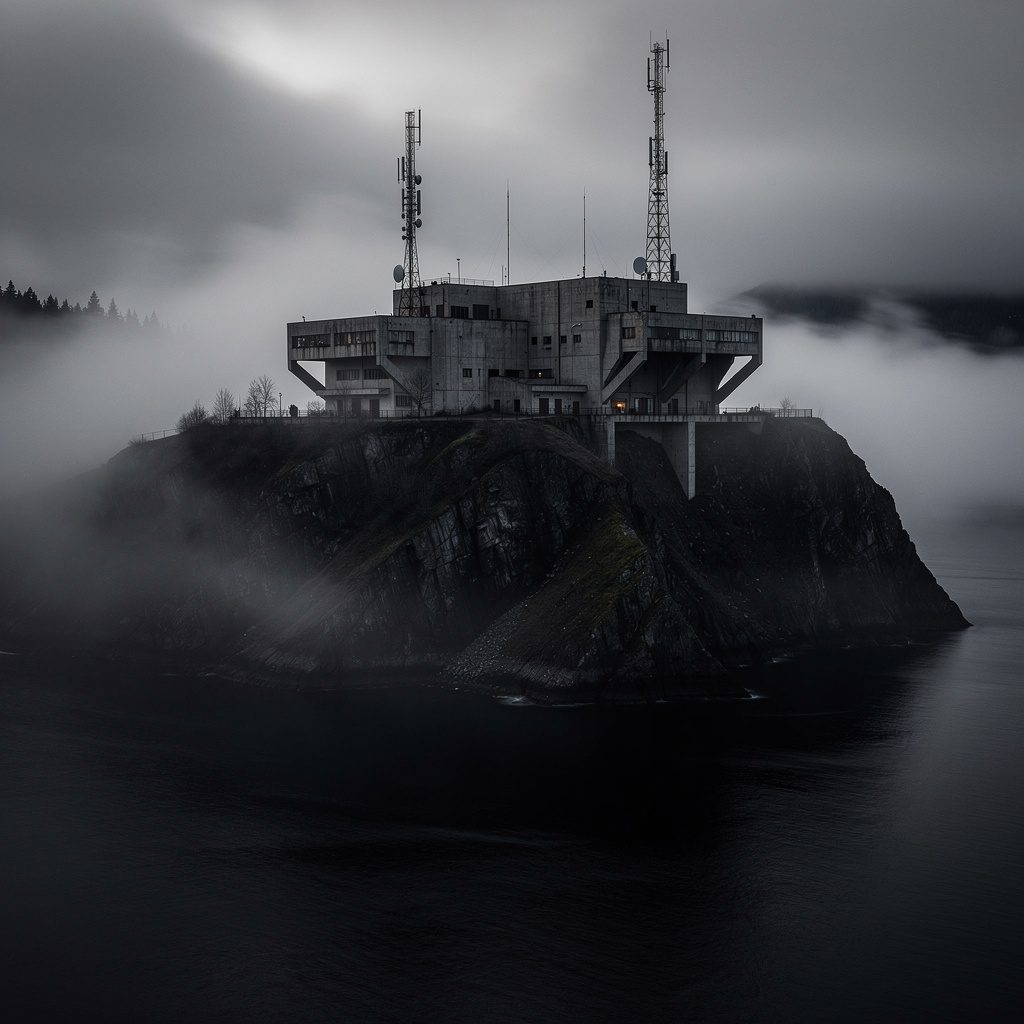
The antenna array had been dark for eleven years before it started transmitting again.
That was the fact none of them could get past, the one that kept surfacing in the silences between their voices as they moved through the relay station’s main corridor, flashlights cutting pale arcs through the dark. Josette had her recorder running. Barrington had his signal analyzer clutched in both hands, its small green screen pulsing like a heartbeat. Oskar walked behind them both, not because he was afraid exactly, but because he understood more than the others did what a decommissioned antenna array was and what it was not capable of doing on its own, and that understanding had weight.
The station sat on a low ridge above the Puget Sound, outside of Bremerton, Washington, a squat brutalist structure that the Navy had quietly decommissioned in 2013 and then more quietly forgotten. The ridge got fog in from the water most evenings, and tonight the fog was dense enough that the lights of the ferry crossing far below were just rumors, soft smears of gold that appeared and vanished. They had driven up a service road so overgrown the brambles scraped both sides of Barrington’s truck the whole way, and when they stepped out the air tasted of brine and rust and something else, something organic and faintly sweet that none of them mentioned.
Josette had received the recording four days ago. That was how it had started — not with a plan, not with a theory, but with a file attached to an email from an address she did not recognize, a string of letters and numbers that resolved to nothing when she tried to trace it. The file was forty-seven seconds of audio. She had played it three times alone in her apartment in Seattle before she called Barrington, and twice more with him sitting across her kitchen table, both of them leaning toward her laptop like people leaning toward a fire. The sound was structured — not random static, not wind noise, not the artifact of corrupted data. It had rhythm and interval. It had what sounded, terrifyingly, like intent. Barrington had run it through his software and found that the signal’s origin point, triangulated from the metadata embedded in the file, corresponded to the coordinates of the Bremerton relay station. A station with no power. A station with no staff. A station that had not, according to every public record they could find, transmitted anything since its decommission.
Oskar had joined because he was the one who knew what the station had actually been used for. He had worked naval communications for six years before his discharge, and when Barrington showed him the triangulation data, something in his expression had closed like a door. He had agreed to come without explaining why, and they had not pressed him, because the way he agreed — quietly, immediately, without the excitement Josette felt or the nervous energy Barrington wore like a coat — suggested that his reason was not curiosity.
The main corridor smelled of mildew and old metal. Some of the ceiling panels had come down, and the insulation beneath them hung in soft gray tongues. Their flashlights found equipment consoles along the walls, dials and toggles and reel-to-reel housings all filmed with dust, all obviously inert. Josette kept her recorder pointed outward like an offering. Barrington’s signal analyzer beeped once, softly, and he stopped walking.
“There.”
The screen showed a waveform. It was not strong — just a thin oscillation across the baseline, the kind of reading that could be interference, could be the equipment’s own internal noise. But the shape of it was familiar. Josette recognized it before she consciously understood why, and then she did understand: it matched the audio file. The same interval. The same rhythm. Whatever had produced the recording was producing it still, here, now, in this building with no power.

 WhatsApp
 Telegram
 Email







Categories
- AI & Technology
- Contemporary
- Corporate Control
- Creepypasta
- Crime Thriller
- Cyberpunk
- Dark Fantasy
- Enemies to Lovers
- Fairy Tale Retelling
- Fantasy
- First Contact
- Forbidden
- Genetic/Body Horror
- High Fantasy
- Monster Hunter
- Mythic/Folklore
- Paranormal
- Portal/Otherworld
- Post-Apo
- Post-Collapse Society
- Psychological Thriller
- Romances
- SCI-FI
- Second Chance
- Slow Burn
- Space Combat
- Spacepunk
- Surveillance State
- Survival Thriller
- Thrillers
- Time Travel
- Treasure Hunter
- Urban Fantasy
- Witchcraft/Curses
Tags
10min stories atmospheric atmospheric fantasy atmospheric fiction contemporary romance Creepy creepypasta crime thriller dark fantasy debt dystopia emotional fiction enemies to lovers ensemble cast epistolary fantasy female protagonist first person forbidden romance framed narrative high fantasy love story magic Memory mystery Paranormal psychological horror psychological thriller romance sci-fi second chance second chance romance short fiction short story slow burn space station speculative fiction supernatural Survival survival thriller suspense thriller travel romance witchcraft workplace romance
Leave a Reply