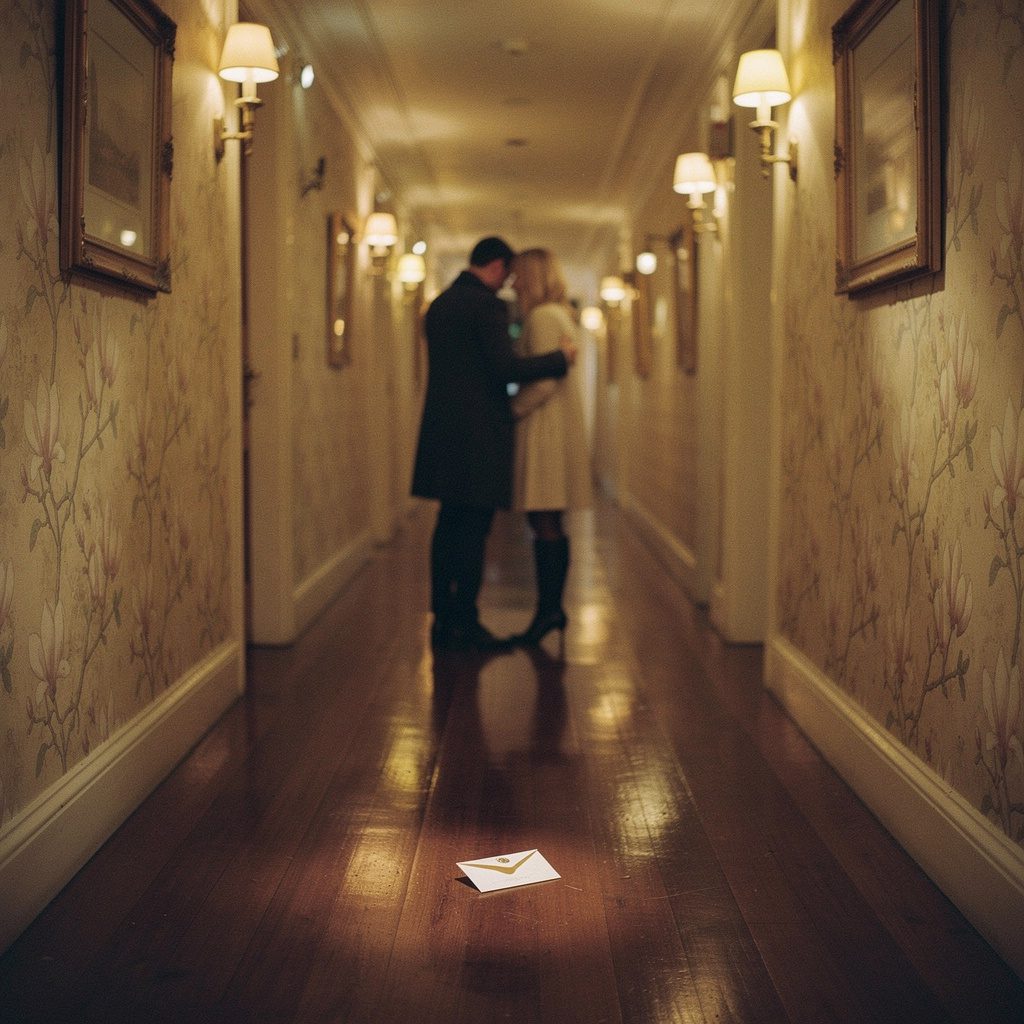
The envelope was still in her hand when Viktor found her.
She was standing in the corridor outside room 14, back against the wallpaper — cream with faded magnolias — and her eyes were the particular kind of dry that comes after crying has finished but the reason hasn’t.
He didn’t say anything. Neither did she.
That was how it ended. Or rather, how it began again.
—
Three days earlier, Nadia Melnyk had arrived at the Hargrove House hotel with a single rolling suitcase, a work lanyard she hadn’t taken off since the airport, and the specific exhaustion of someone who has been professional for too long without a break.
She was there for a conference. Boutique hospitality trends, three days, continental breakfast included. Her firm had sent her because she was good at this — at absorbing information, at networking with a smile that looked real even when it cost something.
She checked in, took her key, and didn’t notice the name on the conference roster until she was already in the elevator.
Viktor Rudenko. Keynote speaker. Day Two.
She read it twice.
The elevator doors opened on the third floor and she stood there until they closed again.
—
Viktor had not planned for this either. That felt important to him, in the way that small exonerations feel important when you’ve been carrying guilt for years.
He’d taken the keynote because the topic was genuinely his — sustainable design in heritage spaces, the ethics of renovation — and because Charleston in October was the kind of thing you said yes to without thinking. The light here had a quality he couldn’t describe in English. He’d tried once, in Ukrainian, and it still hadn’t been right.
He arrived Tuesday evening, later than planned, and ate dinner at the small bar off the hotel lobby because he was too tired to go out.
He was reading the menu when someone sat down two stools away and ordered sparkling water with a lime wedge in a voice he recognized before he looked up.
He looked up.
Nadia.
She was already looking at him. Her expression said: I know. I know and I haven’t decided yet what to do about it.
He said, “Nadia.”
She said, “You look exactly the same.”
It wasn’t a compliment. It wasn’t an insult. It was just a fact she seemed to be working through.
“You don’t,” he said. “You look better.”
She picked up her lime wedge and squeezed it slowly into her glass. “Don’t do that.”
“I meant it.”
“I know you did. That’s why I said don’t.”
She took her water and moved to a table by the window. He didn’t follow. He sat with his menu and the knowledge that she was twelve feet behind him and that the city outside was doing that thing with the light again, all amber and impossible.
—
Nadia had told herself, years ago, that she was over it.
Not over him, exactly — she’d been honest enough with herself to know that was too clean a word for what they’d had. But over the wanting. Over the particular ache of a thing that was never allowed to be what it was.
They’d met at a firm in Kyiv, seven years back. He was a senior architect. She was consulting on a hospitality project. The rules were unspoken but clear: the firm’s culture was old-fashioned, hierarchical, and Dmytro — Viktor’s then-partner, colleague, oldest friend — had made it quietly obvious that he considered Nadia his, in that particular way men sometimes decide things without asking.
Dmytro hadn’t been cruel. That was the complicated part. He’d just been certain. And his certainty had taken up all the air in every room.
Viktor and Nadia had spent six months working on the same project, talking every day, and neither of them had said the obvious thing because the obvious thing had nowhere to go.
On her last day, he’d walked her to the building entrance. The city had smelled like rain and diesel and the river.
He’d said: “If things were different.”
She’d said: “They’re not.”
He’d said: “I know. But if they were — I’d find you. Wherever you ended up. I’d find you and I’d say the thing I’m not saying now.”
She’d laughed, just a little, because it was either that or something worse. “That’s a very romantic promise for a man who isn’t making any promises.”
“I’m making this one.”
She’d believed him. That was what she’d spent seven years trying to undo.

 WhatsApp
 Telegram
 Email







Categories
- AI & Technology
- Contemporary
- Corporate Control
- Creepypasta
- Crime Thriller
- Cyberpunk
- Dark Fantasy
- Enemies to Lovers
- Fairy Tale Retelling
- Fantasy
- First Contact
- Forbidden
- Genetic/Body Horror
- High Fantasy
- Monster Hunter
- Mythic/Folklore
- Paranormal
- Portal/Otherworld
- Post-Apo
- Post-Collapse Society
- Psychological Thriller
- Romances
- SCI-FI
- Second Chance
- Slow Burn
- Space Combat
- Spacepunk
- Surveillance State
- Survival Thriller
- Thrillers
- Time Travel
- Treasure Hunter
- Urban Fantasy
- Witchcraft/Curses
Tags
10min stories atmospheric atmospheric fantasy atmospheric fiction contemporary romance Creepy creepypasta crime thriller dark fantasy debt dystopia emotional fiction enemies to lovers ensemble cast epistolary fantasy female protagonist first person forbidden romance framed narrative high fantasy love story magic Memory mystery Paranormal psychological horror psychological thriller romance sci-fi second chance second chance romance short fiction short story slow burn space station speculative fiction supernatural Survival survival thriller suspense thriller travel romance witchcraft workplace romance
Leave a Reply