The calibration needle on Renata’s temporal anchor read 0.003 seconds fast.
She noticed it the way you notice a crack in a wall you pass every morning — not with alarm, just a quiet registration that something had shifted. She tapped the casing with her thumbnail, the way her trainer had taught her at Vantara Corp’s orientation six years ago, and the needle settled back to zero. She thought nothing more of it.
She should have.
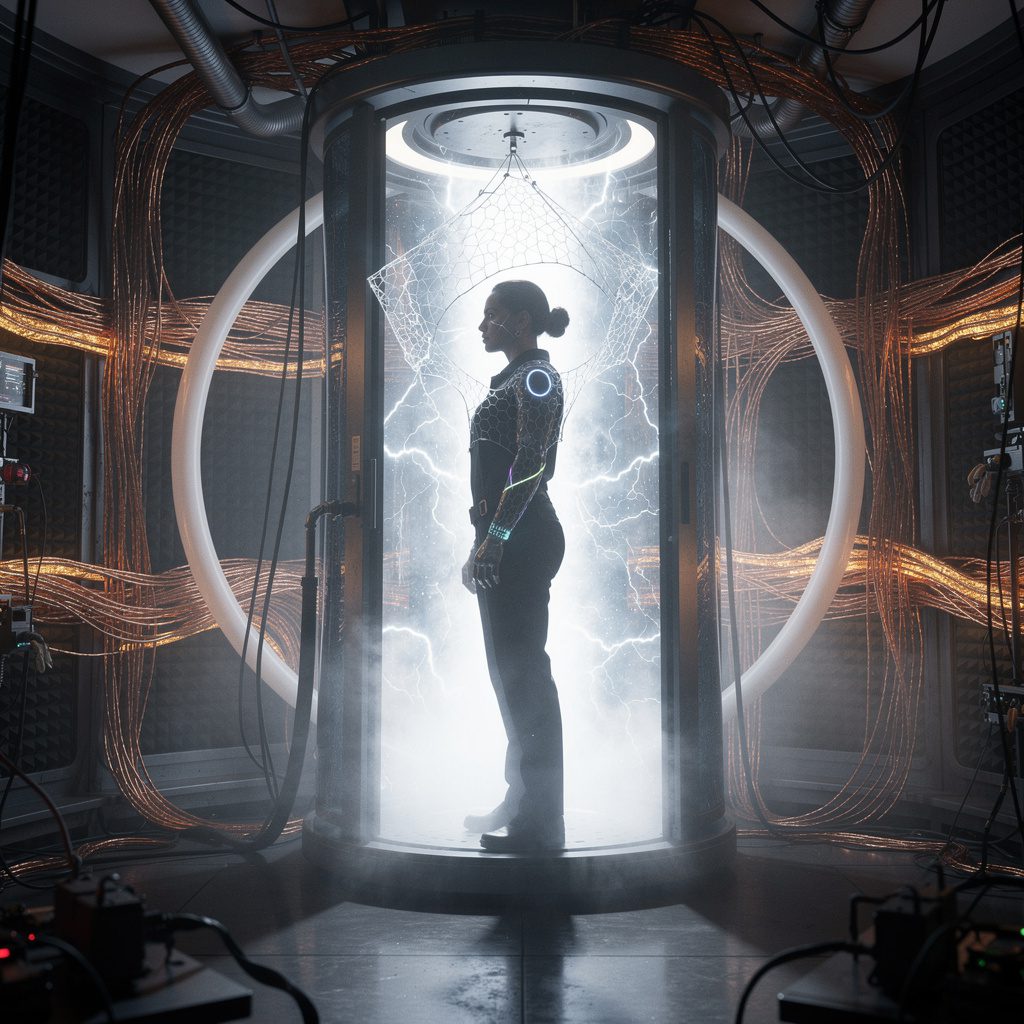
The Vantara insertion pod smelled like ozone and recycled coolant, a smell Renata had come to associate with the particular anxiety of a job about to begin. The pod was roughly the size of a freight elevator, its walls lined with matte-black dampening foam and copper-threaded wiring that pulsed faintly with a light the color of old amber. At the center, her anchor harness hung from a ceiling mount — a web of graphene straps, resonance coils, and a biometric cradle that fit her spine exactly, because Vantara had mapped her spine. They had mapped everything.
That was the thing about working for a temporal logistics company. The contract was generous. The pay was exceptional. And the cost was something you didn’t fully understand until you were already several years in.
Renata Trujillo was thirty-one years old in linear time. In deployed time — the actual hours she had lived, counting every insertion — she was closer to forty-four. Vantara owned the difference. That was the clause. Clause 7, subsection C, buried in page forty-nine of the employment agreement she had signed at twenty-five, bright-eyed and in debt from her physics degree. “All temporal displacement hours accrued during active employment shall be considered company time and shall be logged against the employee’s personal chronological debt ledger.”
She hadn’t understood what that meant then. She understood it perfectly now.
“You look tense.”
Jun Cui leaned against the pod’s far wall, arms crossed, watching her with the mild, unreadable expression he always wore. He was her insertion handler — the person who monitored her anchor signal from the base end while she was deployed, the person who pulled her back if something went wrong. He was also, she had begun to suspect in the last three weeks, the person who had been feeding her file to Vantara’s compliance division.
Jun was compact and precise in everything he did, from the way he folded his jacket to the way he phrased his questions. His eyes were dark and calm, and they gave away nothing. He had been her handler for two years. She had trusted him for most of that.
“I’m always tense before an insertion,” she said.
“This one is routine. A document retrieval. Seventeen minutes in 2031, low-interference zone.” He checked his tablet. “You’ll be back before the coolant finishes cycling.”
She nodded. She stepped into the harness. The biometric cradle closed around her spine with a sound like a sigh.
But here was what Jun didn’t know, because she hadn’t told him, because she had been careful: this insertion wasn’t for Vantara.
For the past four months, Renata had been quietly, methodically preparing a single unauthorized deployment. Not to retrieve a document. Not to verify a transaction or audit a historical record for some corporate client. She was going back to 2027 — to the week before she had signed her contract — to leave herself a message.
Not to stop herself from signing. That would collapse the timeline in ways she didn’t want to think about. Just a message. A precise, careful warning about Clause 7, subsection C, and what it actually meant in practice: that Vantara didn’t just employ temporal couriers. They harvested their time. Every insertion aged the courier in real biological terms while the company clocked those hours as debt, meaning the longer you worked, the more years you owed them, and the more years you owed them, the longer you had to keep working. It was a loop. An elegant, contractual, perfectly legal loop.
The only exit was a full chronological audit — a legal process so expensive and technically complex that no courier had ever successfully completed one. Until Renata had found, buried in a 2019 regulatory archive, a loophole. A self-notification clause, meant to protect couriers from insertion errors, that technically permitted a deployment to one’s own personal timeline if the purpose was “correction of material informational deficit.”
A warning about a contract clause she hadn’t understood was, she was fairly certain, a material informational deficit.

 WhatsApp
 Telegram
 Email







Categories
- AI & Technology
- Contemporary
- Corporate Control
- Creepypasta
- Crime Thriller
- Cyberpunk
- Dark Fantasy
- Enemies to Lovers
- Fairy Tale Retelling
- Fantasy
- First Contact
- Forbidden
- Genetic/Body Horror
- High Fantasy
- Monster Hunter
- Mythic/Folklore
- Paranormal
- Portal/Otherworld
- Post-Apo
- Post-Collapse Society
- Psychological Thriller
- Romances
- SCI-FI
- Second Chance
- Slow Burn
- Space Combat
- Spacepunk
- Surveillance State
- Survival Thriller
- Thrillers
- Time Travel
- Treasure Hunter
- Urban Fantasy
- Witchcraft/Curses
Tags
10min stories atmospheric atmospheric fantasy atmospheric fiction contemporary romance Creepy creepypasta crime thriller dark fantasy debt dystopia emotional fiction enemies to lovers ensemble cast epistolary fantasy female protagonist first person forbidden romance framed narrative high fantasy love story magic Memory mystery Paranormal psychological horror psychological thriller romance sci-fi second chance second chance romance short fiction short story slow burn space station speculative fiction supernatural Survival survival thriller suspense thriller travel romance witchcraft workplace romance
Leave a Reply