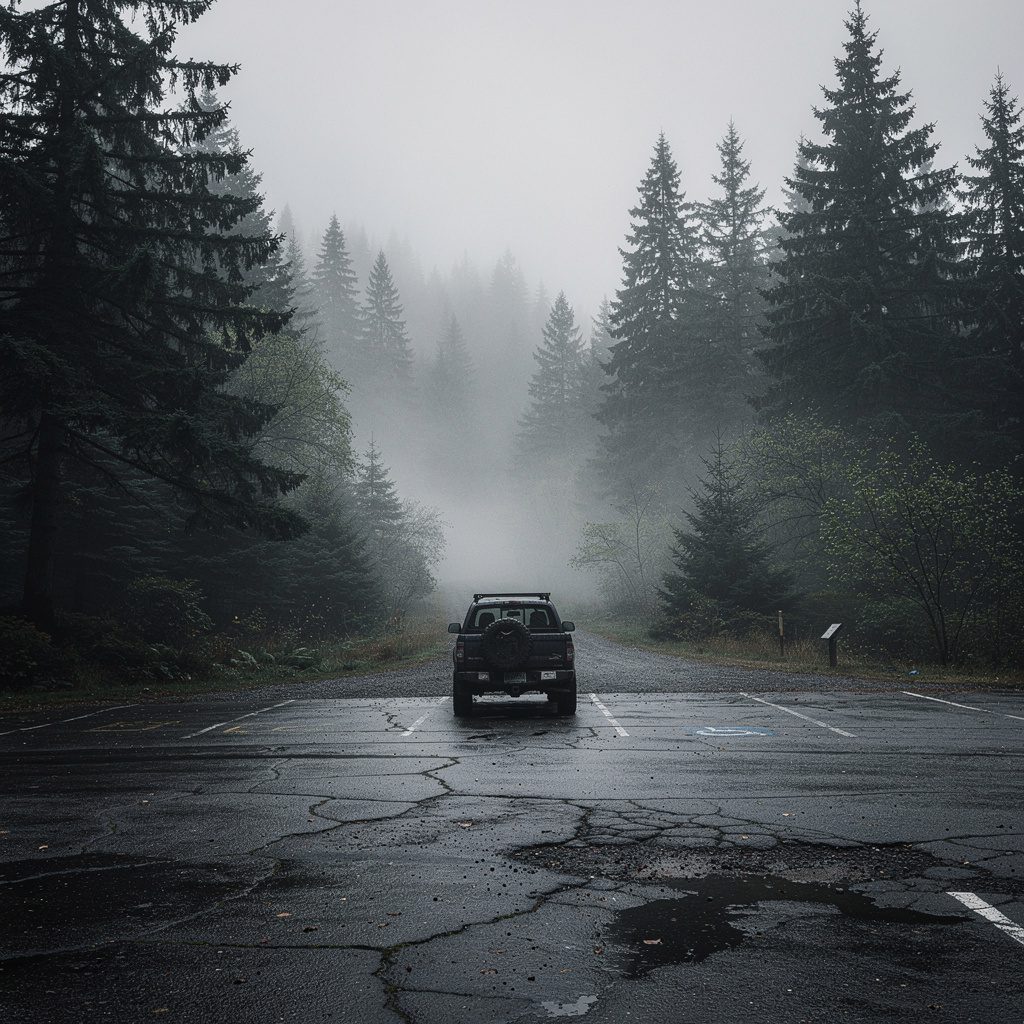
The ranger at the checkpoint stared at Mara’s ID card, then looked up at her face, then back at the card — one too many times. She had been hiking the Cascade backcountry for six days and had not seen another soul until this moment, so the look on his face sent a cold wire straight through her chest.
“Is there a problem?” she asked.
He handed the card back slowly. “No, ma’am. Enjoy the rest of your trip.” But he reached for his radio the moment she turned away. She heard the click of it opening. She did not hear what he said.
Mara kept walking. The trailhead parking lot was two miles south, her truck waiting exactly where she had left it six days ago. She told herself the ranger was just bored. She told herself a lot of things in the mountains when the silence got too loud.
The Cascades in late October were not kind. The sky had gone the color of old pewter, and the fir trees pressed close on both sides of the gravel path, their branches laced together overhead like fingers. Her boots were wet through. Her pack straps had worn grooves into her shoulders. She was ready to go home.
She rounded the last bend and saw her truck.
Someone was leaning against the driver’s side door.
Mara slowed without thinking, the way an animal slows when it senses something wrong before the brain has finished processing why. The figure was a woman. Same height as Mara. Same dark green rain jacket — the exact same jacket, the one Mara had bought at an outlet store in Bellingham two years ago because it was on clearance and she had never seen another one like it. Same dark hair pulled back in a trail braid.
The woman was looking at her phone. She had not noticed Mara yet.
Mara stopped walking entirely. Forty feet of gravel between them.
She told herself it was a coincidence. Jackets got copied. Hair was hair. She took three more steps and the woman looked up.
The face stopped her cold.
It was not exactly her face. That was the part that made it worse than if it had been a perfect copy. It was close — close enough to make her stomach drop — but the jaw was a fraction sharper, the eyes set a degree wider. Like a photograph of Mara taken from a slightly wrong angle, printed and then worn by someone else.
The woman smiled. “Mara. Finally.”
Mara did not move. “Who are you?”
“You look exhausted.” The woman pushed off the truck door and took a step forward. “Six days is a long time to be out here alone.”
The fact that she knew the number of days landed like a stone in still water. Mara’s hand went to the bear spray clipped to her hip strap. She did not unclip it. Not yet.
“How do you know how long I’ve been out?”
The woman tilted her head. The gesture was familiar in a way that made Mara’s skin tighten — it was the way Mara herself tilted her head when she was deciding how to explain something. She had seen it in videos of herself. She had never seen it on a stranger.
“I’ve been following your trip,” the woman said. “Your permit. Your vehicle registration. Your emergency contact form. You filed everything very carefully.” She said it like a compliment. It did not feel like one.
Mara took a step back. Her mind ran the geometry of the situation: truck to her left, blocked. Trail behind her, two miles back to the checkpoint. Tree line ten feet to her right, dense, no path.
“What do you want?”
The woman reached into the pocket of the green jacket — Mara’s jacket, or one identical to it — and produced a set of keys. Mara’s truck keys. The ones she had left locked inside the center console.
“I need you to understand something,” the woman said. “I’ve been living your life for eleven days. Your apartment in Seattle. Your job login. Your bank account.” She paused. “Your name.”
Mara’s throat went dry. She understood now why the ranger had looked at her that way. Whoever this woman was, she had been walking around as Mara Voss for nearly two weeks. Whatever was in those accounts, whatever she had done under that name, was already done.

 WhatsApp
 Telegram
 Email







Categories
- AI & Technology
- Contemporary
- Corporate Control
- Creepypasta
- Crime Thriller
- Cyberpunk
- Dark Fantasy
- Enemies to Lovers
- Fairy Tale Retelling
- Fantasy
- First Contact
- Forbidden
- Genetic/Body Horror
- High Fantasy
- Monster Hunter
- Mythic/Folklore
- Paranormal
- Portal/Otherworld
- Post-Apo
- Post-Collapse Society
- Psychological Thriller
- Romances
- SCI-FI
- Second Chance
- Slow Burn
- Space Combat
- Spacepunk
- Surveillance State
- Survival Thriller
- Thrillers
- Time Travel
- Treasure Hunter
- Urban Fantasy
- Witchcraft/Curses
Tags
10min stories atmospheric atmospheric fantasy atmospheric fiction contemporary romance Creepy creepypasta crime thriller dark fantasy debt dystopia emotional fiction enemies to lovers ensemble cast epistolary fantasy female protagonist first person forbidden romance framed narrative high fantasy love story magic Memory mystery Paranormal psychological horror psychological thriller romance sci-fi second chance second chance romance short fiction short story slow burn space station speculative fiction supernatural Survival survival thriller suspense thriller travel romance witchcraft workplace romance
Leave a Reply