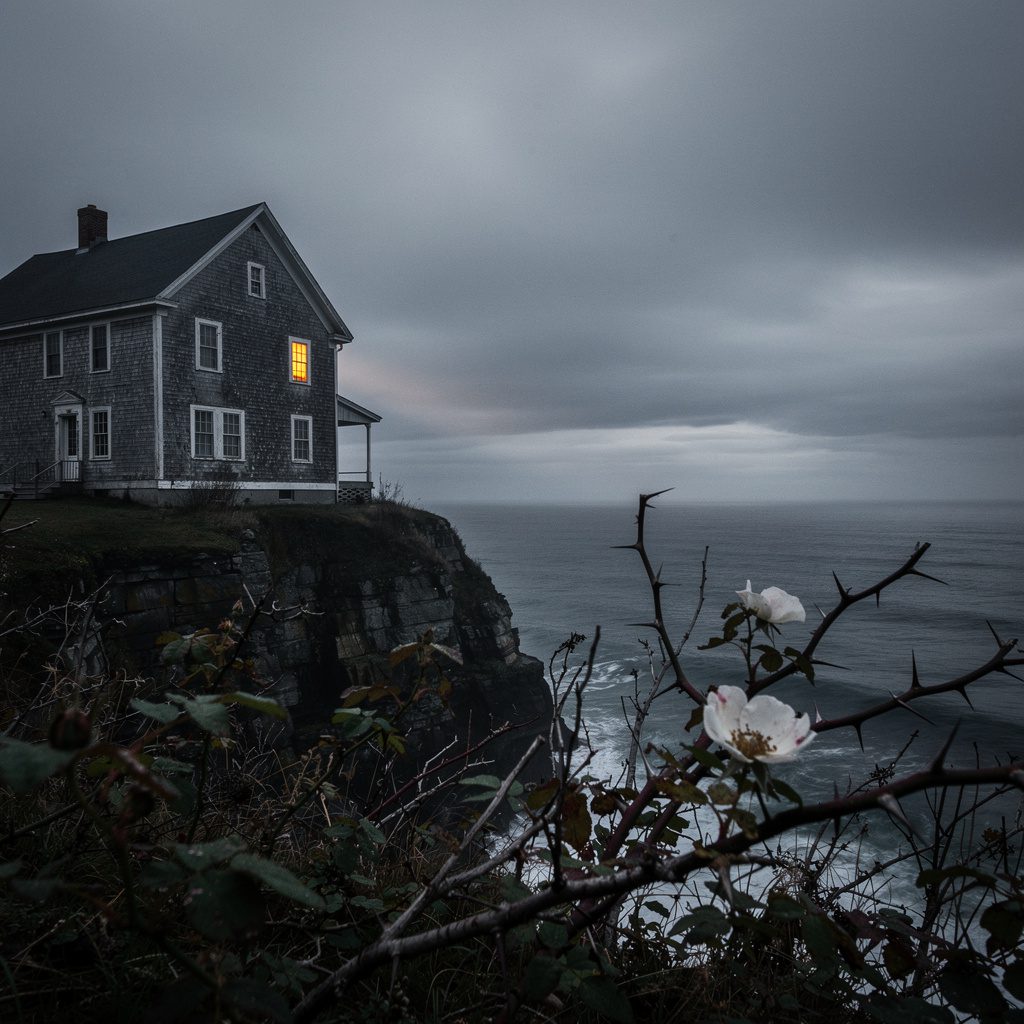
The moment Cara stepped through the front door, she heard a child laugh. There was no child in the house — there hadn’t been for thirty years.
She told herself it was the wind. Old houses in coastal Maine did that, she knew. They groaned and whistled and played tricks on newcomers. The realtor had warned her the place had “character.” Cara had smiled at that. She was a forensic archivist. She dealt in facts, documents, cold evidence. Character didn’t scare her.
The house was a two-story colonial on a bluff above Penobscot Bay, gray-shingled, salt-weathered, surrounded by wild rose bushes that had long since gone to thorn. She’d bought it sight-unseen after inheriting it from a great-aunt she’d never met. A woman named Edith, who had lived alone here for decades and left no explanation — only the deed, a key, and a single handwritten note that said: “Don’t ask the house questions you aren’t ready to answer.”
Cara had laughed at that too. She wasn’t laughing now.
The laugh came again — high and bright, a little girl’s laugh — from somewhere above her. She stood at the base of the staircase, gripping the newel post, listening. Silence. Then the creak of a floorboard directly overhead, slow and deliberate, like a footstep.
She climbed the stairs.
The upper hallway was narrow and smelled of cedar and something older, something she couldn’t name. Four doors, all closed. She opened the first — a bathroom, claw-foot tub, nothing unusual. The second — a linen closet, shelves of folded yellowed sheets. The third — a small bedroom, empty except for a child’s wooden rocking chair positioned in the center of the floor, facing the window.
The chair was moving. Slowly. Back and forth.
No draft. No open window. Just the chair, rocking.
Cara stood in the doorway for a long moment. Then she did what she always did when something unsettled her: she pulled out her notebook and wrote it down. Time, observation, detail. Facts. She was good at facts.
She told herself there was a rational explanation. Warped floorboards. Residual motion. She even pressed her hand against the seat of the chair to stop it. It stopped. She exhaled.
Then, under her palm, she felt a faint warmth — as if someone had been sitting there moments before.
She pulled her hand back.
That night she set up in the kitchen, the most ordinary room in the house. Bare bulb overhead, old pine table, a woodstove she managed to coax to life. She spread out what she’d found in the attic: boxes of Edith’s papers, photographs, letters. She was an archivist. This was what she did. She would understand this house the same way she understood everything — through its records.
The photographs stopped her cold.
They were arranged chronologically, she realized, though no one had labeled them. The house appeared in every single one. Always in the background, always the same — but the people in front of it changed. Decades of families. A couple in the 1940s. A man alone in the 1960s. A young woman with a little girl in the 1970s. And in each photo, without exception, the same upstairs window was lit — the room with the rocking chair — even in photos taken in the middle of the day when no lamp should have been burning.
Cara turned the last photograph over. On the back, in Edith’s handwriting: “It shows you what it wants you to see. Be careful what you look for.”
The woodstove popped. Cara flinched.
She went back to the papers. Letters, mostly. But near the bottom of the third box she found something different — a journal, leather-bound, the pages brittle. Not Edith’s handwriting. Older. She opened it carefully.
The first entry was dated 1923. A woman named Margaret had lived here then. She wrote about the house with a reverence that slowly, over the pages, curdled into dread. Margaret described hearing conversations in empty rooms. Smelling meals cooking when the kitchen was cold. Seeing, on the walls, the faint outlines of furniture that was no longer there — ghost-shapes of chairs and tables, pressed into the plaster like memories the house refused to release.

 WhatsApp
 Telegram
 Email







Categories
- AI & Technology
- Contemporary
- Corporate Control
- Creepypasta
- Crime Thriller
- Cyberpunk
- Dark Fantasy
- Enemies to Lovers
- Fairy Tale Retelling
- Fantasy
- First Contact
- Forbidden
- Genetic/Body Horror
- High Fantasy
- Monster Hunter
- Mythic/Folklore
- Paranormal
- Portal/Otherworld
- Post-Apo
- Post-Collapse Society
- Psychological Thriller
- Romances
- SCI-FI
- Second Chance
- Slow Burn
- Space Combat
- Spacepunk
- Surveillance State
- Survival Thriller
- Thrillers
- Time Travel
- Treasure Hunter
- Urban Fantasy
- Witchcraft/Curses
Tags
10min stories atmospheric atmospheric fantasy atmospheric fiction contemporary romance Creepy creepypasta crime thriller dark fantasy debt dystopia emotional fiction enemies to lovers ensemble cast epistolary fantasy female protagonist first person forbidden romance framed narrative high fantasy love story magic Memory mystery Paranormal psychological horror psychological thriller romance sci-fi second chance second chance romance short fiction short story slow burn space station speculative fiction supernatural Survival survival thriller suspense thriller travel romance witchcraft workplace romance
Leave a Reply