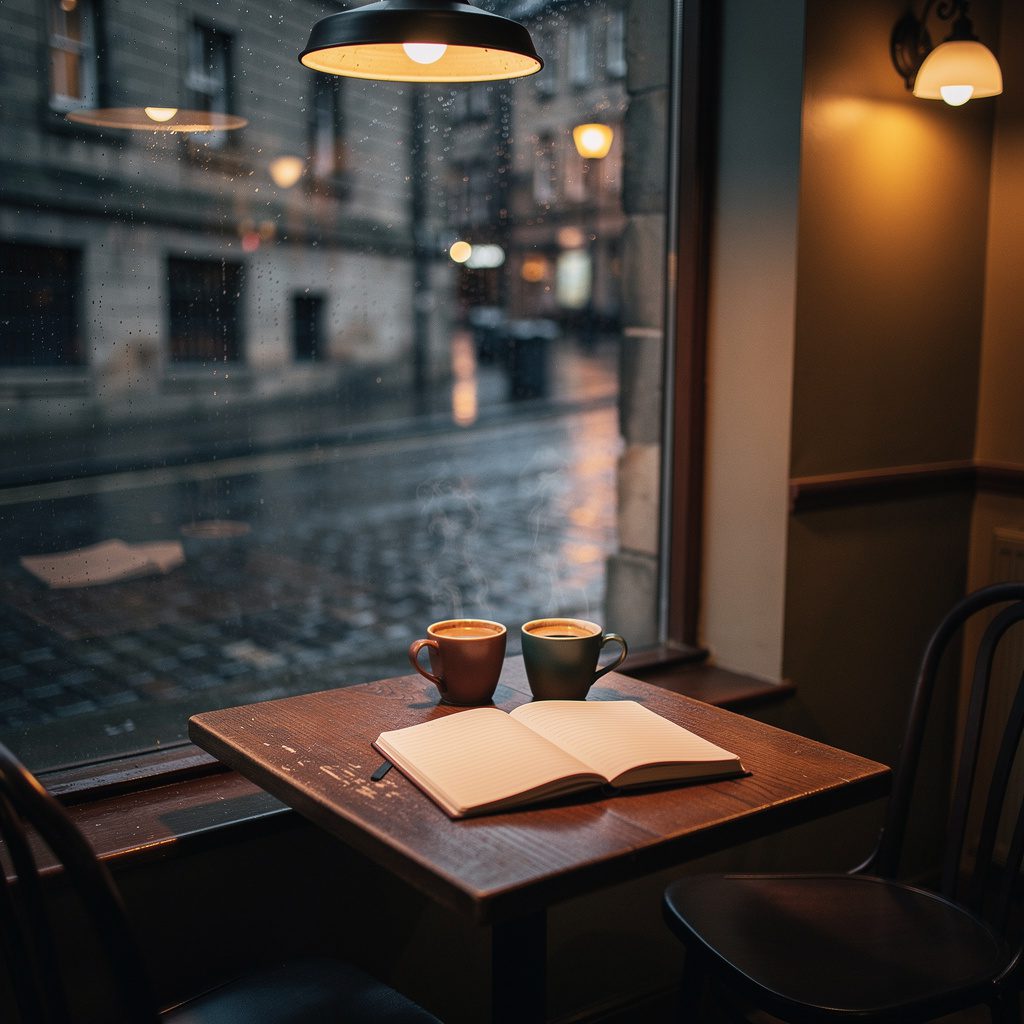
She had been coming to the same café in Edinburgh’s Grassmarket for two years, and she had never once let anyone sit at her table. Then one rainy Tuesday in October, she noticed him — and everything quietly shifted.
Nora had a system. She arrived at Brew & Stone every morning at eight fifteen, ordered a flat white with one sugar, and claimed the corner table by the rain-streaked window before anyone else could. She spread her notebooks across the surface like a small fortress. She was a freelance illustrator, and the café was her office, her sanctuary, and — if she was honest — her only real reason to leave her flat most days.
She had been going through a long, grey season of the heart. A breakup eighteen months ago had left her cautious in ways she hadn’t fully admitted to herself. She wasn’t sad exactly. She was just… still. Like a lake after a stone has been thrown in and the ripples have finally settled.
She noticed him the first time on a Wednesday.
He sat two tables away, near the bookshelf that held mismatched paperbacks and a ceramic owl. He had dark hair that curled slightly at the collar, a worn leather jacket, and a notebook of his own — a thick one, spiral-bound, filled with what looked like architectural sketches. He ordered black coffee. He stayed for exactly ninety minutes. He left without looking up.
Nora told herself she hadn’t been watching.
But she had.
He came back Thursday. Then Friday. Then the following Monday. Always the same order. Always the same table. Always the notebook. He had a way of frowning at his own work that she found oddly endearing — a small crease between his brows, a tilt of the head, as if the page had said something mildly offensive.
By the second week, Nora had given him a name in her mind: the Architect. It was safer that way. Names you invented kept people at a comfortable distance.
The problem was, she had also started drawing him.
Not deliberately. It happened the way things sometimes do — her hand moving while her attention drifted, and then she’d look down and there he was, rendered in soft pencil lines on the edge of her sketchbook. The curve of his jaw. The way he held his pen. The small, private smile that crossed his face when he found something in his work that pleased him.
She felt embarrassed by this in a way she couldn’t quite name.
On a Thursday morning in November, the café was fuller than usual. A tour group had wandered in out of the cold, filling every table with damp coats and loud conversation. Nora arrived to find her corner table occupied by a family of four. She stood in the doorway, wet umbrella dripping, feeling a disproportionate sense of loss.
“You can share mine, if you like.”
She turned. The Architect was standing beside the bookshelf, holding two coffees, nodding toward his table. He said it simply, without performance, as if it were the most natural thing in the world.
Nora’s first instinct was to decline. She had a whole speech ready — she worked better alone, she needed space, she was expecting a call. But the rain was loud against the windows, and his expression was open and unhurried, and she was so tired of her own careful distances.
“Thank you,” she said instead.
His name was Daniel. He was an architect — she felt a small, ridiculous thrill at being right — working on a restoration project for a Georgian townhouse in the New Town. He’d been coming to Brew & Stone because his office was too loud and his flat was too quiet, and he’d found the café’s particular hum of background noise helpful for thinking.
“I’ve seen you here before,” he said, wrapping both hands around his cup. “You always have about seven notebooks open at once.”
“Five,” she corrected. “Seven is excessive.”
He smiled. It was the same smile she’d drawn on the edge of her sketchbook — small, genuine, slightly lopsided on the left side. She felt something move in her chest, quiet and warm, like a lamp being switched on in a room that had been dark for a while.

 WhatsApp
 Telegram
 Email







Categories
- AI & Technology
- Contemporary
- Corporate Control
- Creepypasta
- Crime Thriller
- Cyberpunk
- Dark Fantasy
- Enemies to Lovers
- Fairy Tale Retelling
- Fantasy
- First Contact
- Forbidden
- Genetic/Body Horror
- High Fantasy
- Monster Hunter
- Mythic/Folklore
- Paranormal
- Portal/Otherworld
- Post-Apo
- Post-Collapse Society
- Psychological Thriller
- Romances
- SCI-FI
- Second Chance
- Slow Burn
- Space Combat
- Spacepunk
- Surveillance State
- Survival Thriller
- Thrillers
- Time Travel
- Treasure Hunter
- Urban Fantasy
- Witchcraft/Curses
Tags
10min stories atmospheric atmospheric fantasy atmospheric fiction contemporary romance Creepy creepypasta crime thriller dark fantasy debt dystopia emotional fiction enemies to lovers ensemble cast epistolary fantasy female protagonist first person forbidden romance framed narrative high fantasy love story magic Memory mystery Paranormal psychological horror psychological thriller romance sci-fi second chance second chance romance short fiction short story slow burn space station speculative fiction supernatural Survival survival thriller suspense thriller travel romance witchcraft workplace romance
Leave a Reply